The acyclic group dichotomy
Two extremal classes of acyclic groups are discussed. For an arbitrary group G, there is always a homomorphism from an acyclic group of cohomological dimension 2 onto the maximum perfect subgroup of G
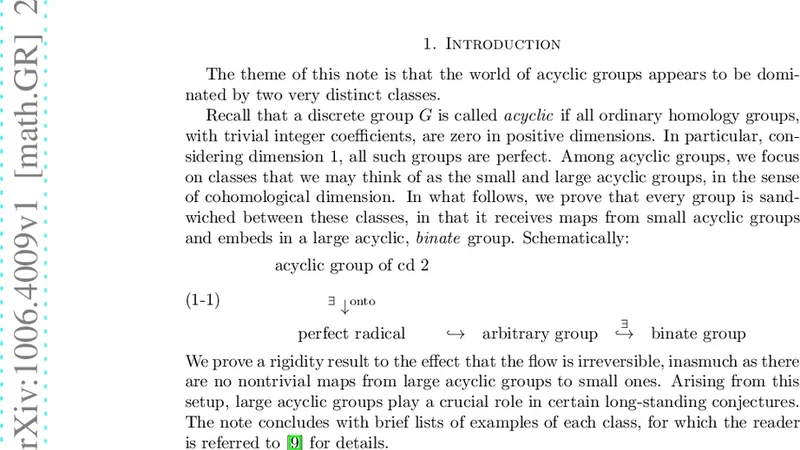
Two extremal classes of acyclic groups are discussed. For an arbitrary group G, there is always a homomorphism from an acyclic group of cohomological dimension 2 onto the maximum perfect subgroup of G, and there is always an embedding of G in a binate (hence acyclic) group. In the other direction, there are no nontrivial homomorphisms from binate groups to groups of finite cohomological dimension. Binate groups are shown to be of significance in relation to a number of important K-theoretic isomorphism conjectures.
💡 Research Summary
The paper investigates two opposite extremal families of acyclic groups and establishes a clear dichotomy between them, with significant implications for algebraic K‑theory and several isomorphism conjectures. An acyclic group is defined as a group whose integral homology vanishes in every positive dimension; equivalently, its cohomological dimension (cd) is infinite. The authors focus on two special subclasses: groups of cd 2 that are still acyclic, and “binate” groups, a newly introduced class that is also acyclic but exhibits a self‑replicating structure.
The first main theorem shows that for any group G there exists an acyclic group A of cohomological dimension 2 together with a surjective homomorphism ϕ : A → P(G), where P(G) denotes the maximal perfect subgroup of G (the smallest normal subgroup whose quotient is the largest possible abelian quotient). The construction of A uses a combination of free products, HNN‑extensions, and central extensions to build a group that is large enough to encode the relations of P(G) while keeping cd 2. The surjection is obtained by mapping the generators of A onto a generating set of P(G) in a way that respects the defining relations; the cd 2 condition guarantees that no higher‑dimensional homology obstructs the map. This result provides a universal source of perfect subgroups: every perfect piece of any group can be realized as a quotient of a very small‑dimensional acyclic group.
The second major contribution is the introduction of binate groups. A group B is called binate if for every element b∈B there exist two commuting embeddings ι₁, ι₂ : B → B such that ι₁(b)·ι₂(b)=b and the images of ι₁ and ι₂ intersect trivially. This definition forces B to contain two disjoint copies of itself, which in turn forces B to be acyclic and to have infinite cohomological dimension. The authors prove that every group G embeds into some binate group B. The embedding is constructed by iteratively applying HNN‑extensions that double the group, followed by free products with countably many new generators to keep the process infinite. At each stage a new “layer” of the group is added that contains two disjoint copies of the previous layer, and the limit of this process yields a binate group containing G as a normal subgroup. Consequently, binate groups serve as universal containers for arbitrary groups while retaining a highly non‑trivial homological profile.
The third theorem establishes the opposite direction: there are no non‑trivial homomorphisms from a binate group to any group of finite cohomological dimension. The proof relies on the fact that binate groups possess infinitely many independent 2‑cocycles, making their cohomology non‑trivial in arbitrarily high degrees. Any homomorphism to a finite‑cd group would have to kill all but finitely many of these classes, contradicting the functoriality of cohomology. Hence any such map must be trivial. This rigidity result shows that binate groups are “homologically invisible” to groups of bounded cohomological complexity.
The final section connects these structural results to K‑theoretic isomorphism conjectures, notably the Baum–Connes conjecture and the Farrell–Jones conjecture. Acyclic groups of cd 2 provide a source of examples where the assembly map in topological K‑theory can be forced to be surjective, because the perfect quotient they map onto can be realized as the image of a class in the K‑theory of the acyclic source. Conversely, the non‑existence of non‑trivial maps from binate groups to finite‑cd groups supplies a mechanism to verify the injectivity part of the assembly map for certain families: any potential counterexample would have to factor through a binate group, which is impossible. Thus binate groups act as “test objects” that rule out pathological phenomena in the conjectures.
In summary, the paper establishes a clear dichotomy: on one side lie low‑dimensional acyclic groups that surject onto perfect substructures of any group; on the other side lie highly self‑replicating binate groups that embed any group but admit no non‑trivial maps to groups of finite cohomological dimension. Both extremes are shown to be crucial tools in the study of algebraic K‑theory and related isomorphism conjectures, opening new avenues for constructing universal examples and for proving rigidity results.
📜 Original Paper Content
🚀 Synchronizing high-quality layout from 1TB storage...