The Shield that Never Was: Societies with Single-Peaked Preferences are More Open to Manipulation and Control
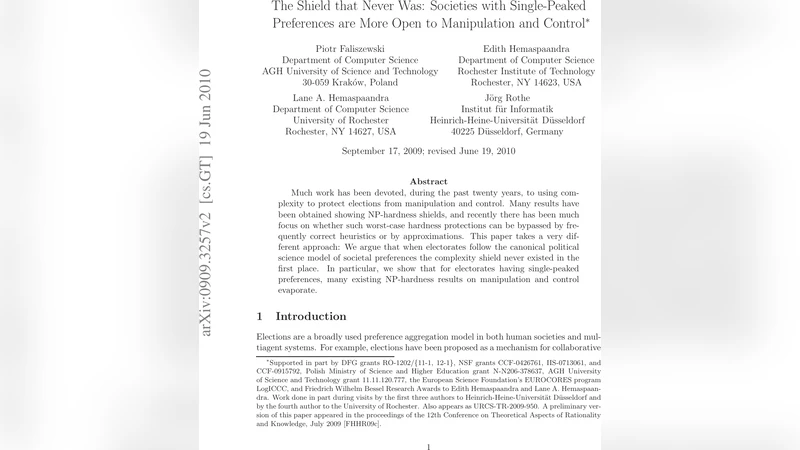
Much work has been devoted, during the past twenty years, to using complexity to protect elections from manipulation and control. Many results have been obtained showing NP-hardness shields, and recently there has been much focus on whether such worst-case hardness protections can be bypassed by frequently correct heuristics or by approximations. This paper takes a very different approach: We argue that when electorates follow the canonical political science model of societal preferences the complexity shield never existed in the first place. In particular, we show that for electorates having single-peaked preferences, many existing NP-hardness results on manipulation and control evaporate.
💡 Research Summary
The paper challenges the prevailing line of research that relies on computational complexity—specifically NP‑hardness—to protect elections from manipulation and control. While the past two decades have produced a wealth of results showing that many control and manipulation problems are computationally intractable in the worst case, the authors argue that these “complexity shields” are largely illusory when the electorate follows the canonical political‑science model of single‑peaked preferences.
A single‑peaked preference profile assumes that there exists a linear ordering L of the candidates (often interpreted as an ideological or policy axis) such that each voter’s ranking rises to a peak and then falls, or, in the approval‑voting model, each voter approves a contiguous block of candidates with respect to L. This structure is well‑studied in political science and is considered the “canonical setting” for many theoretical models. The paper first formalizes single‑peakedness for both linear‑order votes and binary approval vectors, and notes that efficient algorithms already exist for recognizing single‑peakedness and constructing a witnessing order L.
The authors then examine a broad suite of election‑control problems—adding or deleting candidates, adding or deleting voters, unlimited candidate addition, and both constructive and destructive variants. In the general (unrestricted) setting many of these problems are known to be NP‑hard. However, when the input is promised to be single‑peaked with a given axis L, each control problem can be reduced to a simple interval‑selection or dynamic‑programming task on L. For example, adding a set of candidates that helps a distinguished candidate p become the unique winner corresponds to choosing a contiguous subset of candidates on L whose inclusion maximizes p’s score while minimizing the scores of rivals. Because scores change linearly with the presence or absence of candidates, the optimal subset can be found in polynomial time. Consequently, all the control problems studied become tractable under the single‑peaked assumption.
The manipulation side receives a more nuanced treatment. For many common voting rules—plurality, Borda, j‑approval, veto, and various scoring protocols—the authors present polynomial‑time algorithms that construct a successful manipulation when one exists, again exploiting the interval structure imposed by L. Nevertheless, not every manipulation problem collapses. Building on Walsh’s result that Single Transferable Vote (STV) remains NP‑hard to manipulate even with single‑peaked preferences, the paper shows that several other rules retain their hardness. Moreover, the authors identify a striking non‑monotonic relationship between the number of candidates and the difficulty of manipulation in 3‑vote elections (each voter casts a single vote). They prove that manipulation is in P for up to four candidates, becomes NP‑hard for exactly five candidates, and returns to P for six or more candidates (Theorem 4.2). This demonstrates that increasing the candidate set can sometimes decrease computational difficulty, contrary to intuition.
The paper also discusses the practical relevance of these findings. Real‑world elections typically have fixed voting rules (plurality, approval, etc.) that cannot be altered simply because the electorate is believed to be single‑peaked. Hence, relying on worst‑case complexity as a safeguard is misguided. While single‑peakedness guarantees the existence of a Condorcet winner for odd numbers of voters, many widely used voting systems are not Condorcet‑consistent, so this guarantee does not automatically translate into protection. The authors argue that policymakers should focus on structural or institutional safeguards rather than hoping that computational hardness will deter strategic behavior.
In summary, the paper provides a comprehensive analysis showing that the “NP‑hardness shield” against election manipulation and control evaporates under the realistic assumption of single‑peaked preferences for a large class of voting systems. It supplies polynomial‑time algorithms for numerous control problems, identifies the exact boundary where manipulation remains hard, and highlights counter‑intuitive phenomena regarding candidate numbers. The work calls into question the practical relevance of complexity‑based defenses and urges a shift toward more realistic, socially‑aware approaches to securing elections.
Comments & Academic Discussion
Loading comments...
Leave a Comment