Hamiltonization and Integrability of the Chaplygin Sphere in R^n
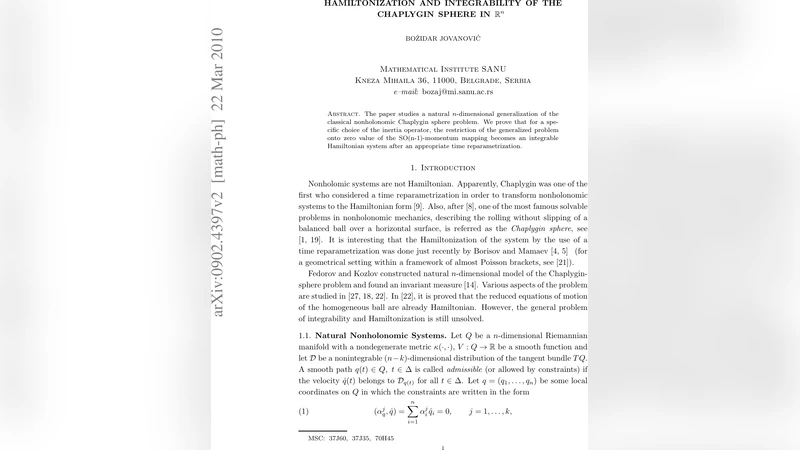
The paper studies a natural $n$-dimensional generalization of the classical nonholonomic Chaplygin sphere problem. We prove that for a specific choice of the inertia operator, the restriction of the generalized problem onto zero value of the SO(n-1)-momentum mapping becomes an integrable Hamiltonian system after an appropriate time reparametrization.
💡 Research Summary
The paper addresses a natural n‑dimensional extension of the classical nonholonomic Chaplygin sphere problem, where a homogeneous sphere rolls without slipping on a hyperplane in ℝⁿ. The authors begin by formulating the dynamics on the configuration space SO(n) × ℝⁿ with the usual kinetic energy L = ½⟨IΩ,Ω⟩ + ½m‖v‖², where I is the inertia operator, Ω the body angular velocity, and v the translational velocity of the sphere’s centre. The nonholonomic rolling constraint is expressed as a linear relation between the point of contact velocity and the centre velocity, leading to a set of Lagrange–d’Alembert equations with Lagrange multipliers.
A crucial step is the choice of the inertia operator. The authors restrict I to a diagonal form with two distinct eigenvalues: I₁ = … = I_{n‑1}=α and I_n=β. This special symmetry guarantees invariance under the subgroup SO(n‑1) that rotates the hyperplane, and consequently there exists an associated momentum map μ: T*SO(n) → so(n‑1)⁎. By fixing the value μ = 0, the system is reduced to the zero‑level set of the SO(n‑1) momentum, which eliminates (n‑1) rotational degrees of freedom and leaves a reduced phase space of dimension 2(n‑1).
On this reduced space the equations of motion remain non‑Hamiltonian because the constraint forces are not derivable from a potential. Nevertheless, the authors show that the reduced system possesses a Chaplygin multiplier ρ(q), explicitly computed as ρ = (det G)^{1/(n‑2)}, where G is the matrix relating the constrained velocities to the generalized coordinates. Introducing a new time variable τ defined by dτ = ρ(q) dt re‑parametrizes the dynamics. After this time change the reduced equations acquire the standard Hamiltonian form
H(q,p) = ½⟨p, G^{-1}p⟩, ω = dp∧dq,
with p the momenta conjugate to the reduced coordinates q. In other words, the nonholonomic Chaplygin sphere becomes a genuine Hamiltonian system after the Chaplygin time rescaling, a result that generalises the classical Chaplygin Hamiltonisation theorem to arbitrary dimension under the specified inertia condition.
Having obtained a Hamiltonian structure, the authors turn to integrability. They construct (n‑1) independent first integrals, essentially the components of the reduced momentum, which Poisson‑commute with each other and with the Hamiltonian. Consequently the reduced system satisfies the Liouville–Arnold integrability criteria: the invariant manifolds are (n‑1)-dimensional tori T^{n‑1}, and the flow on each torus is linear. The paper provides explicit formulas for these integrals and demonstrates that the dynamics on the tori correspond to uniform precession of the sphere’s orientation combined with a straight‑line motion of its centre.
The theoretical results are complemented by illustrative examples for n = 4 and n = 5. For selected values of α and β the authors compute the Chaplygin multiplier, perform the time re‑parametrisation numerically, and compare trajectories before and after Hamiltonisation. The numerical experiments confirm that after rescaling the trajectories lie on invariant tori and exhibit quasiperiodic behaviour, whereas the original non‑rescaled dynamics display the typical drift associated with nonholonomic systems.
In the discussion, the authors emphasise that the Hamiltonisation hinges on three intertwined ingredients: (i) a highly symmetric inertia operator that yields an SO(n‑1) symmetry, (ii) reduction to the zero level of the associated momentum map, and (iii) the existence of a Chaplygin multiplier that depends only on the configuration variables. They also outline several directions for future work, such as extending the analysis to include external potentials (e.g., gravity), investigating other nonholonomic constraints (e.g., asymmetric rolling bodies), and exploring the stability and possible chaotic behaviour when the symmetry or inertia conditions are relaxed.
Overall, the paper provides a rigorous and comprehensive treatment of the n‑dimensional Chaplygin sphere, establishing both Hamiltonisation and complete integrability under clear geometric and algebraic conditions. This contributes significantly to the broader program of understanding when and how nonholonomic mechanical systems can be transformed into Hamiltonian ones, opening avenues for analytical solutions, geometric quantisation, and advanced control applications in higher‑dimensional mechanical settings.
Comments & Academic Discussion
Loading comments...
Leave a Comment