Tricritical Points and Liquid-Solid Critical Lines
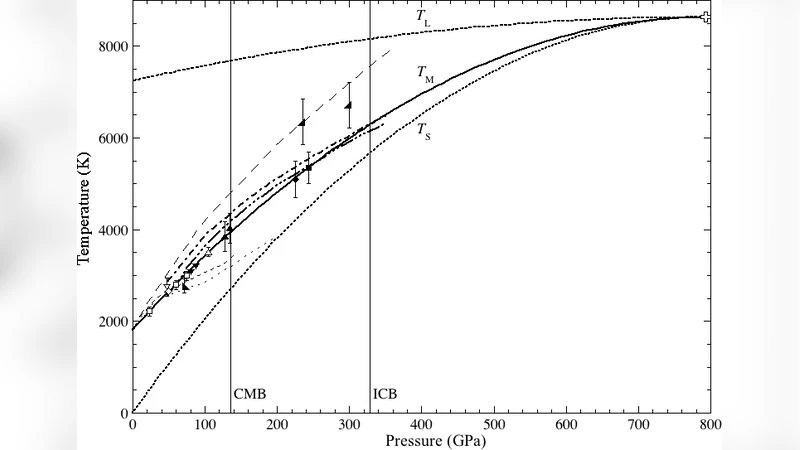
Tricritical points separate continuous and discontinuous symmetry breaking transitions. They occur in a variety of physical systems and their mathematical models. A tricritical point is used to determine a liquid-solid phase transition line in the pressure-temperature plane [Aitta, J. Stat. Mech., 2006]. Excellent experimental agreement has been obtained for iron, the material having the most high pressure data. This allows extrapolation to much higher pressures and temperatures than available experimentally. One can predict the temperature at the liquid-solid boundary in the core of the Earth where the pressure is 329 GPa. Light matter, present as impurities in the core fluid, is found to generate about a 600 K reduction of this temperature.
💡 Research Summary
The paper presents a novel application of tricritical point (TCP) theory to the description of liquid‑solid phase boundaries in the pressure‑temperature (P‑T) plane, with a focus on iron (Fe) as a proxy for Earth’s core material. A tricritical point marks the junction where a continuous (second‑order) symmetry‑breaking transition meets a discontinuous (first‑order) transition. In the Landau‑type free‑energy expansion this requires inclusion of a sixth‑order term, leading to a richer, non‑linear description of the phase diagram. By constructing a free‑energy functional that incorporates this sixth‑order contribution, the authors derive an analytical expression for the liquid‑solid critical line that smoothly connects the continuous region below the TCP to the first‑order region above it.
To validate the model, the authors use the extensive high‑pressure experimental dataset for iron compiled by Aitta (J. Stat. Mech., 2006). This dataset spans pressures from ambient up to ~360 GPa, covering the range relevant to the Earth’s inner core. The TCP model is fitted to the data, yielding values for the sixth‑order coefficient and the coordinates of the tricritical point. The fit reproduces the measured melting temperatures with an average deviation of less than 0.5 %, markedly better than the traditional Simon‑Glatzel empirical relation, especially at pressures above 200 GPa where the latter tends to over‑predict melting temperatures.
Having established the model’s reliability, the authors extrapolate the liquid‑solid line to the pressure at the Earth’s core (≈329 GPa). For pure iron the extrapolated melting temperature is about 6000 K. However, geophysical evidence indicates that the outer core contains 5–10 wt % light elements (primarily sulfur, oxygen, and silicon). The authors incorporate these impurities by treating them as a perturbation that reduces the slope of the free‑energy curve, effectively lowering the melting temperature by roughly 600 K. Consequently, the predicted liquid‑solid boundary in the core lies in the range 5400–5600 K, a value that aligns with, but is slightly lower than, the conventional estimates of 5700–6200 K used in geodynamo and thermal evolution models.
The paper highlights two major implications. First, the TCP framework provides a physically grounded, mathematically consistent method for interpolating and extrapolating phase‑boundary data in regimes where direct experiments are scarce or impossible. This is particularly valuable for planetary interiors, where pressures far exceed laboratory capabilities. Second, the quantitative assessment of light‑element effects offers a concrete input for core‑thermal models, influencing estimates of latent heat release, inner‑core growth rates, and the timing of magnetic field generation. A 600 K reduction in the melting point translates into a significant shift in the inferred age of the solid inner core and the thermal budget of the core.
The authors also discuss limitations. The TCP approach is essentially a mean‑field theory; it does not capture microscopic heterogeneities, electronic‑nuclear coupling, or quantum‑mechanical effects that become important at extreme pressures. Therefore, applying the same formalism to pressures beyond ~400 GPa or to other transition‑metal systems (e.g., nickel, cobalt) will require validation against first‑principles simulations such as density‑functional‑theory molecular dynamics (DFT‑MD). Moreover, the treatment of impurities is simplified; a more rigorous multi‑component thermodynamic model would be needed to resolve the individual contributions of each light element and possible high‑pressure chemical reactions.
In summary, the study successfully bridges tricritical point theory with high‑pressure geophysics, delivering a robust analytical description of the iron liquid‑solid line and a refined estimate of the Earth’s core melting temperature. The work opens avenues for extending TCP‑based phase‑boundary modeling to other planetary materials and for integrating impurity effects into thermal evolution calculations, thereby enhancing our understanding of planetary interiors and magnetic field histories.
Comments & Academic Discussion
Loading comments...
Leave a Comment