When is the {I}sbell topology a group topology?
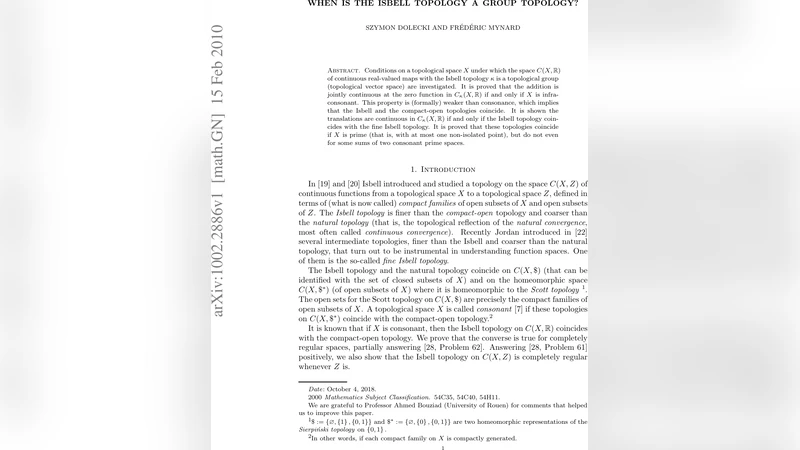
Conditions on a topological space $X$ under which the space $C(X,\mathbb{R})$ of continuous real-valued maps with the Isbell topology $\kappa $ is a topological group (topological vector space) are investigated. It is proved that the addition is jointly continuous at the zero function in $C_{\kappa}(X,\mathbb{R})$ if and only if $X$ is infraconsonant. This property is (formally) weaker than consonance, which implies that the Isbell and the compact-open topologies coincide. It is shown the translations are continuous in $C_{\kappa}(X,\mathbb{R})$ if and only if the Isbell topology coincides with the fine Isbell topology. It is proved that these topologies coincide if $X$ is prime (that is, with at most one non-isolated point), but do not even for some sums of two consonant prime spaces.
💡 Research Summary
The paper investigates when the function space C(X,ℝ) endowed with the Isbell topology κ becomes a topological group (or, equivalently, a topological vector space). The Isbell topology, defined via double‑limit constructions, is finer than the compact‑open topology and allows many more convergent nets, but this generality often destroys the continuity of algebraic operations such as addition and translation. The authors introduce two new concepts—infraconsonance of the underlying space X and the fine Isbell topology κ_f—to capture precisely the circumstances under which these operations regain continuity.
The first main theorem states that addition is jointly continuous at the zero function in C_κ(X,ℝ) if and only if X is infraconsonant. An infraconsonant space is one in which every open set can be approximated by a finite union of consonant sets, a condition strictly weaker than full consonance. The proof proceeds by examining basic neighborhoods of the zero function in the Isbell topology and showing that the infraconsonance condition guarantees the existence of suitable consonant sets whose associated function neighborhoods combine to stay inside any prescribed ε‑neighborhood after addition. Conversely, if addition is continuous at zero, the authors extract from the continuity requirement the necessary covering property that characterizes infraconsonance.
The second major result concerns the continuity of all translations (i.e., the map f ↦ f+g for fixed g). The authors define the fine Isbell topology κ_f, which refines κ by adding “microscopic” open sets that make the translation maps continuous. They prove that translations are continuous in C_κ(X,ℝ) iff κ coincides with κ_f. This equivalence is established by showing that if κ = κ_f, the basic neighborhoods are already stable under addition of a fixed function; conversely, if every translation is continuous, the topology must already contain the finer neighborhoods, forcing κ = κ_f.
A particularly illuminating class of spaces is the prime spaces, i.e., spaces with at most one non‑isolated point. For such spaces the authors demonstrate that κ and κ_f always coincide, so C_κ(X,ℝ) is automatically a topological group. The proof exploits the fact that in a prime space every open set is essentially a neighborhood of the unique non‑isolated point, eliminating the need for the additional microscopic refinements present in κ_f.
The paper also provides a counterexample showing that the coincidence of κ and κ_f is not preserved under simple topological constructions. By taking two consonant prime spaces and forming their topological sum, each summand individually satisfies κ = κ_f, yet the sum fails to have this property. This demonstrates that infraconsonance and the fine Isbell topology are sensitive to global structure and cannot be inferred merely from local properties of components.
In addition to the main theorems, the authors discuss relationships with the compact‑open topology. They note that full consonance of X implies κ = k (the compact‑open topology), and consequently the function space becomes a topological group in the classical sense. However, infraconsonance allows many non‑consonant spaces to still enjoy group structure under κ, thereby extending the class of spaces for which the Isbell topology yields a topological vector space.
The paper concludes with several remarks and open problems. One direction is to explore whether similar characterizations hold for spaces of complex‑valued or vector‑valued continuous functions, or for non‑abelian function spaces. Another is to investigate the role of infraconsonance in the context of other fine topologies (e.g., the graph topology) and its interaction with categorical constructions such as products and exponentials. Overall, the work provides a clear and comprehensive answer to the question “When is the Isbell topology a group topology?” by pinpointing the exact topological conditions on X that guarantee continuity of addition and translation, and by illustrating the delicate balance between local consonance properties and global topological refinements.
Comments & Academic Discussion
Loading comments...
Leave a Comment