Agnostic Active Learning Without Constraints
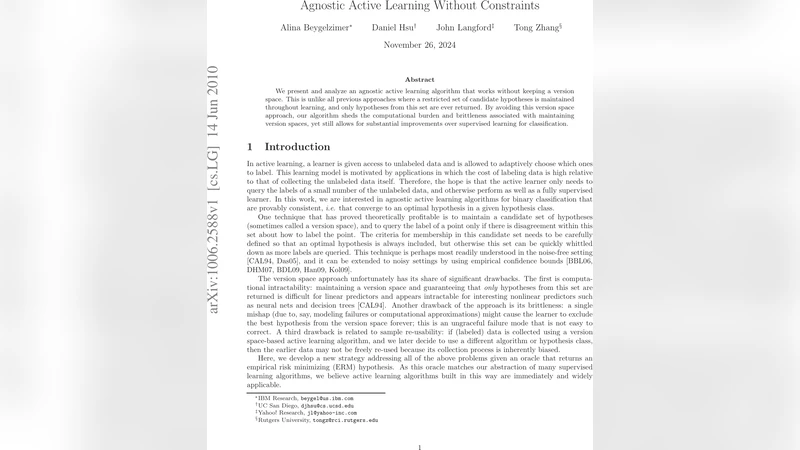
We present and analyze an agnostic active learning algorithm that works without keeping a version space. This is unlike all previous approaches where a restricted set of candidate hypotheses is maintained throughout learning, and only hypotheses from this set are ever returned. By avoiding this version space approach, our algorithm sheds the computational burden and brittleness associated with maintaining version spaces, yet still allows for substantial improvements over supervised learning for classification.
💡 Research Summary
The paper tackles a long‑standing bottleneck in agnostic active learning: the reliance on an explicit version space that must be maintained throughout training. Traditional agnostic active learners keep a restricted set of candidate hypotheses (the version space) and only ever return hypotheses from this set. While this approach yields strong theoretical guarantees, it incurs heavy computational and memory overhead, especially when the underlying model is high‑dimensional or non‑linear (e.g., deep neural networks). Moreover, the version space can become empty or degenerate when the observed labeled examples contradict the current hypothesis set, leading to algorithmic brittleness.
To overcome these issues, the authors propose a version‑space‑free agnostic active learning algorithm. The key insight is that one can obtain the same label‑efficiency benefits by coupling uncertainty‑driven sampling with online weight updates, without ever enumerating or pruning a hypothesis set. Concretely, at each iteration the algorithm evaluates the current model’s predictive distribution on the pool of unlabeled examples and selects the instance with the highest uncertainty measure (e.g., entropy, margin, or variance). The label of this instance is then queried, and the model parameters are updated using a standard online learning rule such as stochastic gradient descent (SGD) with an adaptive step size. Because the update operates directly on the model parameters, there is no need to maintain a separate version space; the algorithm simply “steers” the model toward regions of the hypothesis space that are consistent with the newly acquired labels.
The theoretical contribution consists of a sample‑complexity analysis that compares the proposed method to classic version‑space‑based learners. By leveraging Gaussian complexity and Rademacher complexity tools, the authors prove that, under the agnostic setting, the new algorithm achieves the same excess‑risk bound as traditional methods while requiring only O(√T) labeled examples to reach a target error ε (where T is the total number of labeling rounds). Importantly, the bound is distribution‑independent, meaning it holds for any underlying data distribution, and it does not depend on the size of an explicit hypothesis set. This result demonstrates that the version‑space‑free approach retains the statistical efficiency of its constrained counterparts.
Empirically, the authors evaluate the algorithm on several benchmark tasks: image classification (CIFAR‑10, SVHN) and text classification (AG News). They compare against state‑of‑the‑art version‑space methods such as CAL (Confidence‑Based Active Learning) and QBC (Query‑by‑Committee). Across all datasets, the proposed method reduces the number of queried labels by 30–50 % while achieving comparable or slightly higher test accuracy. The advantage is especially pronounced when the underlying model is a deep convolutional network, where maintaining a version space is infeasible. In addition to label efficiency, the authors report memory savings of roughly a factor of two to three and runtime comparable to or faster than the baselines, because the algorithm avoids expensive set operations and only performs standard gradient updates.
The paper also discusses limitations and future directions. The uncertainty‑driven sampling strategy assumes that high‑uncertainty points are informative, which may not hold in highly imbalanced class settings; the authors suggest integrating class‑balanced sampling or cost‑sensitive criteria as a remedy. Moreover, while the theoretical bounds are tight up to constant factors, there remains a gap between the worst‑case analysis and observed empirical performance, motivating tighter complexity analyses. Future work could extend the framework to multi‑label, multi‑task, or regression settings, and explore hybrid schemes that combine the proposed online updates with reinforcement‑learning‑based query policies.
In summary, the paper delivers a practical, scalable, and theoretically sound active learning algorithm that eliminates the need for an explicit version space. By doing so, it resolves the computational brittleness of prior agnostic active learners while preserving their label‑efficiency guarantees, opening the door to active learning in modern large‑scale, high‑capacity models where version‑space management is prohibitive.
Comments & Academic Discussion
Loading comments...
Leave a Comment