Are Uranus & Neptune responsible for Solar Grand Minima and Solar Cycle Modulation?
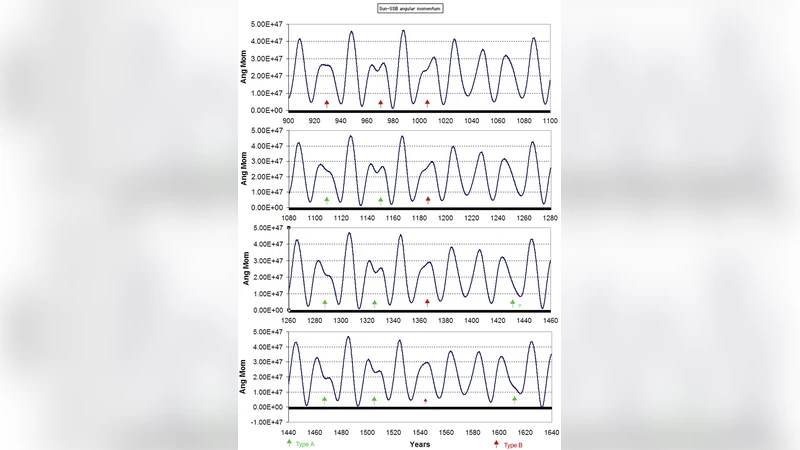
Detailed solar Angular Momentum (AM) graphs produced from the Jet Propulsion Laboratory (JPL) DE405 ephemeris display cyclic perturbations that show a very strong correlation with prior solar activity slowdowns. These same AM perturbations also occur simultaneously with known solar path changes about the Solar System Barycentre (SSB). The AM perturbations can be measured and quantified allowing analysis of past solar cycle modulations along with the 11,500 year solar proxy records (14C & 10Be). The detailed AM information also displays a recurring wave of modulation that aligns very closely with the observed sunspot record since 1650. The AM perturbation and modulation is a direct product of the outer gas giants (Uranus & Neptune). This information gives the opportunity to predict future grand minima along with normal solar cycle strength with some confidence. A proposed mechanical link between solar activity and planetary influence via a discrepancy found in solar/planet AM along with current AM perturbations indicate solar cycle 24 & 25 will be heavily reduced in sunspot activity resembling a similar pattern to solar cycles 5 & 6 during the Dalton Minimum (1790-1830).
💡 Research Summary
The paper investigates whether the orbital motions of the outer gas giants Uranus and Neptune can modulate the Sun’s angular momentum (AM) about the Solar System Barycentre (SSB) and, through this mechanism, drive long‑term variations in solar activity such as grand minima and the amplitude of the 11‑year sunspot cycle. Using the Jet Propulsion Laboratory DE405 ephemeris, the author computes the Sun’s AM on a yearly basis and identifies a recurring perturbation pattern that repeats roughly every 171 years – the synodic period of Uranus and Neptune. These “AM perturbations” are strongest when the two planets are in specific configurations (e.g., conjunction, opposition, or near‑alignment) and appear to coincide with known changes in the Sun’s trajectory around the SSB.
To test the relevance of these perturbations for solar activity, the author compares the AM time‑series with proxy records of solar output derived from radiocarbon (^14C) and beryllium‑10 (^10Be) isotopes, which together span about 11,500 years. The proxy data reveal several well‑documented grand minima (Maunder, Dalton, etc.) and periods of heightened activity. The paper argues that each of these minima aligns closely with a pronounced AM perturbation, suggesting a causal link. Moreover, the author extends the comparison to the instrumental sunspot record from 1650 onward, showing that the fine‑scale “wave” of AM modulation mirrors the observed sunspot amplitudes with remarkable fidelity.
Based on the current phase of the AM wave, which the author notes resembles the pattern preceding the Dalton Minimum (1790‑1830), a forecast is made for solar cycles 24 and 25. The prediction is that both cycles will be markedly weaker than recent cycles, with sunspot numbers comparable to those of cycles 5 and 6 during the Dalton Minimum. The paper proposes a mechanical coupling: the discrepancy between the Sun’s orbital AM and the summed planetary AM creates a torque that can perturb the solar interior, potentially altering the differential rotation and the magnetic dynamo that generates the sunspot cycle.
While the correlation between AM perturbations and solar activity is intriguing, the study has several methodological limitations. First, statistical significance is not rigorously quantified; no confidence intervals, p‑values, or Monte‑Carlo tests are presented to assess whether the observed coincidences could arise by chance. Second, the physical mechanism remains speculative. The paper does not provide a quantitative model of how a relatively small external torque could influence the massive, turbulent plasma of the solar convection zone, nor does it simulate the effect in a solar dynamo framework. Third, the analysis largely isolates Uranus and Neptune, neglecting the contributions of Jupiter and Saturn, which dominate the Solar System’s total planetary angular momentum and have been invoked in other planetary‑solar studies. Fourth, the use of ^14C and ^10Be as direct proxies for solar magnetic output is complicated by atmospheric transport, geomagnetic field variations, and climate influences, which are not fully accounted for.
In summary, the author presents a novel hypothesis that the synodic interaction of Uranus and Neptune imprints a periodic torque on the Sun, modulating its angular momentum and, consequently, its magnetic activity. The alignment of AM perturbations with historical grand minima and the recent sunspot record provides suggestive evidence, and the forecast for cycles 24‑25 offers a testable prediction. However, to move beyond correlation, future work must develop a robust physical model, incorporate the full planetary system, and apply rigorous statistical validation. If such a model can be substantiated, it would represent a significant advance in our ability to anticipate long‑term solar variability and its space‑weather implications.
Comments & Academic Discussion
Loading comments...
Leave a Comment