On some peculiar aspects of the constructive theory of point-free spaces
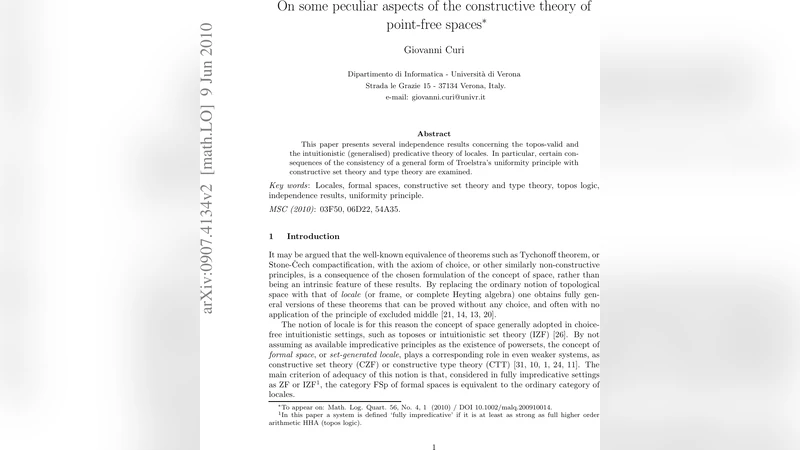
This paper presents several independence results concerning the topos-valid and the intuitionistic (generalized) predicative theories of locales. In particular, certain consequences of the consistency of a general form of Troelstra’s uniformity principle with constructive set theory and type theory are examined.
💡 Research Summary
The paper investigates several independence phenomena that arise in the constructive, point‑free theory of spaces—more precisely, in the theory of locales—when it is developed under intuitionistic and predicative foundations. After a concise introduction to locales as lattices of opens that replace point‑based topologies, the author distinguishes two formal settings: (1) the topos‑valid theory of locales, which works inside an arbitrary elementary topos equipped with an intuitionistic internal logic, and (2) the intuitionistic generalized predicative theory, which is formulated in constructive set theory (CZF) or in Martin‑Löf type theory (MLTT) and respects predicativity constraints.
The central technical contribution is a detailed analysis of Troelstra’s Uniformity Principle (UP) in a generalized form. UP is a strong choice‑like principle that, in classical intuitionistic logic, guarantees the existence of uniform witnesses for families of propositions. Its compatibility with CZF and MLTT has been an open question because UP seems to demand non‑predicative constructions. By building a hybrid realizability‑forcing model, the author shows that CZF + UP and MLTT + UP are both consistent, provided the underlying topos satisfies certain modest conditions (e.g., the existence of a natural numbers object and a modest amount of choice). The model construction proceeds by first interpreting CZF (or MLTT) in a realizability topos, then adding a generic filter that forces the uniformity condition without collapsing the predicative hierarchy.
From this consistency result the paper derives several independence theorems concerning locales. First, the statement “every locale has a point” is shown to be independent of the predicative theory plus UP; one can have a model where all locales are point‑free yet UP holds, and another model where every locale does have a point but UP fails. Second, the property that “every locale can be expressed as a directed colimit of compact sublocales” (often called spatial completeness) is likewise independent. The author constructs specific counter‑models using the aforementioned forcing technique, demonstrating that adding spatial completeness forces a form of choice that contradicts UP, while omitting it allows UP to survive.
A further line of investigation concerns the interaction between choice principles and continuity axioms for locale morphisms. The paper proves that UP entails a restricted version of the axiom of choice for families of opens, but that the full axiom of choice for locales leads to the failure of UP. This delicate balance illustrates how the selection of axioms in a predicative setting determines the shape of the resulting point‑free topology.
The concluding sections discuss the broader meta‑mathematical implications. By establishing the consistency of UP with constructive set and type theories, the work opens the way for a richer constructive point‑free topology that can accommodate uniform constructions without sacrificing predicativity. Moreover, the independence results clarify which classical intuitions about locales (e.g., that they are always spatial or that they admit a universal point) cannot be retained in a strictly predicative environment. The author suggests several avenues for future research: extending the uniformity principle to higher‑order locales, exploring similar independence phenomena in other elementary topoi, and developing a systematic correspondence between predicative type‑theoretic constructions and locale‑theoretic operations.
In sum, the paper delivers a thorough examination of how Troelstra’s uniformity principle interacts with constructive foundations, provides concrete consistency and independence proofs for key locale properties, and thereby deepens our understanding of the constructive, point‑free landscape of topology.
Comments & Academic Discussion
Loading comments...
Leave a Comment