On satellites in semi-abelian categories: Homology without projectives
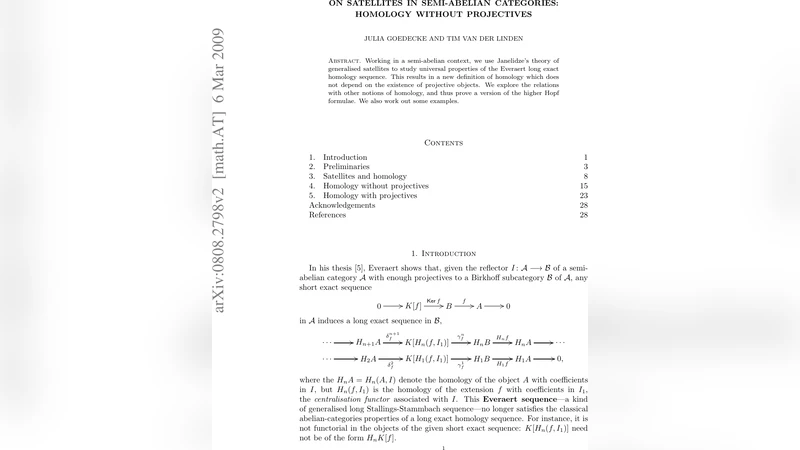
Working in a semi-abelian context, we use Janelidze’s theory of generalised satellites to study universal properties of the Everaert long exact homology sequence. This results in a new definition of homology which does not depend on the existence of projective objects. We explore the relations with other notions of homology, and thus prove a version of the higher Hopf formulae. We also work out some examples.
💡 Research Summary
The paper addresses a fundamental limitation in homology theory within semi‑abelian categories: the traditional reliance on the existence of enough projective objects. While classical homology for groups, Lie algebras, and other abelian‑like settings can be built using free or projective resolutions, many semi‑abelian contexts—such as modules over non‑commutative rings or certain chain‑complex categories—lack sufficient projectives, making standard constructions inapplicable. To overcome this obstacle, the authors import Janelidze’s theory of generalized satellites, a categorical framework that extracts universal properties of a pair of functors without invoking projective resolutions.
The core of the work re‑examines Everaert’s long exact homology sequence, which connects the homology of an object X, a normal subobject K, and the corresponding quotient. In the classical setting this sequence is derived by resolving X with a projective object and then applying the snake lemma. The authors replace the resolution step by constructing a satellite functor S associated with the regular epimorphism η:K→X and its cokernel. This satellite captures the “homological reflection” of X relative to K, and its left and right derived functors yield groups Hₙ(X) defined as πₙ(SX). Crucially, the definition makes sense even when no projective objects exist, because the satellite is built purely from universal properties of regular epimorphisms and kernels, which are always present in a semi‑abelian category.
The paper proves that the satellite‑based homology reproduces Everaert’s long exact sequence exactly. The authors verify the naturality of the connecting morphisms, the exactness at each term, and the compatibility with change‑of‑base functors. They also compare the new definition with several established notions: Barr‑Beck homology, Quillen’s higher homology via model categories, and Everaert’s original construction. In each case the satellite approach aligns with the existing theory when projectives are available, but it extends beyond, offering a uniform description that works in any semi‑abelian setting.
A significant contribution is the derivation of higher Hopf formulae without projectives. Classical Hopf formulae express H₂(G) in terms of a free presentation F→G and the intersection of the relation R with the commutator subgroup
Comments & Academic Discussion
Loading comments...
Leave a Comment