Impact of CIR Storms on Thermosphere Density Variability during the Solar Minimum of 2008
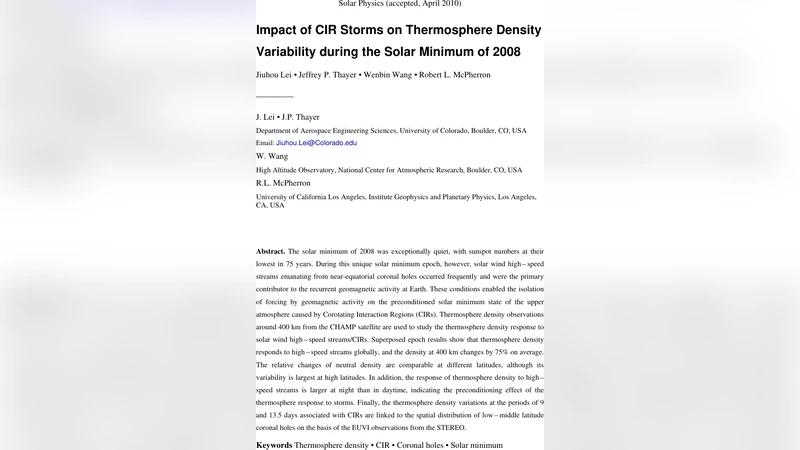
The solar minimum of 2008 was exceptionally quiet, with sunspot numbers at their lowest in 75 years. During this unique solar minimum epoch, however, solar wind high - speed streams emanating from near-equatorial coronal holes occurred frequently and were the primary contributor to the recurrent geomagnetic activity at Earth. These conditions enabled the isolation of forcing by geomagnetic activity on the preconditioned solar minimum state of the upper atmosphere caused by Corotating Interaction Regions (CIRs). Thermosphere density observations around 400 km from the CHAMP satellite are used to study the thermosphere density response to solar wind high - speed streams/CIRs. Superposed epoch results show that thermosphere density responds to high - speed streams globally, and the density at 400 km changes by 75% on average. The relative changes of neutral density are comparable at different latitudes, although its variability is largest at high latitudes. In addition, the response of thermosphere density to high - speed streams is larger at night than in daytime, indicating the preconditioning effect of the thermosphere response to storms. Finally, the thermosphere density variations at the periods of 9 and 13.5 days associated with CIRs are linked to the spatial distribution of low - middle latitude coronal holes on the basis of the EUVI observations from the STEREO.
💡 Research Summary
The paper investigates how corotating interaction regions (CIRs) associated with high‑speed solar‑wind streams affect thermospheric density during the exceptionally quiet solar minimum of 2008. Although sunspot numbers were at a 75‑year low, frequent equatorial coronal holes generated recurrent high‑speed streams that drove geomagnetic activity. This unique setting allowed the authors to isolate the geomagnetic forcing on the pre‑conditioned thermosphere without significant solar‑radiative variability.
Using neutral density measurements from the CHAMP satellite at an altitude of ~400 km, the authors performed a superposed‑epoch analysis on 45 CIR events identified from ACE solar‑wind data. Each epoch spanned –48 h to +72 h relative to the CIR arrival. The data were binned by latitude (low ≤30°, mid 30°–60°, high ≥60°) and by local time (day 06:00–18:00 UTC, night 18:00–06:00 UTC).
The main findings are:
- Global density response – Thermospheric density rises sharply after CIR impact, reaching an average increase of about 75 % at 400 km, and the enhancement persists for roughly two days.
- Latitude dependence – Relative density changes are similar across latitudes (≈70–80 %), but the variability (standard deviation) is largest at high latitudes, reflecting stronger Joule heating and auroral currents there.
- Day‑night asymmetry – Night‑time density enhancements are ~1.2 times larger than daytime ones, indicating a pre‑conditioning effect: the daytime thermosphere, already heated by solar EUV, is less responsive to additional geomagnetic energy, whereas the night‑time thermosphere is more sensitive to Joule and particle heating.
- Periodicities – Spectral analysis reveals pronounced 9‑day and 13.5‑day peaks in the density time series. These periods match the rotation‑linked recurrence of low‑ and mid‑latitude coronal holes observed by STEREO/EUVI, confirming that the spatial distribution of coronal holes controls the timing of CIRs and thus the thermospheric response.
The authors discuss the implications for atmospheric modeling and satellite drag prediction. Existing empirical models (e.g., NRLMSISE‑00, JB2008) tend to underestimate thermospheric density during low‑solar‑activity periods because they do not fully capture the magnitude of geomagnetic forcing, especially the night‑time response. Incorporating real‑time CIR information could improve drag forecasts for low‑Earth‑orbit missions and reduce uncertainties in orbit determination.
Finally, the study highlights the need for multi‑satellite observations and magnetohydrodynamic simulations to resolve the three‑dimensional structure of CIR‑thermosphere coupling, and suggests that future work should explore the role of high‑latitude electrodynamics in modulating the observed variability.
Comments & Academic Discussion
Loading comments...
Leave a Comment