On cycles through two arcs in strong multipartite tournaments
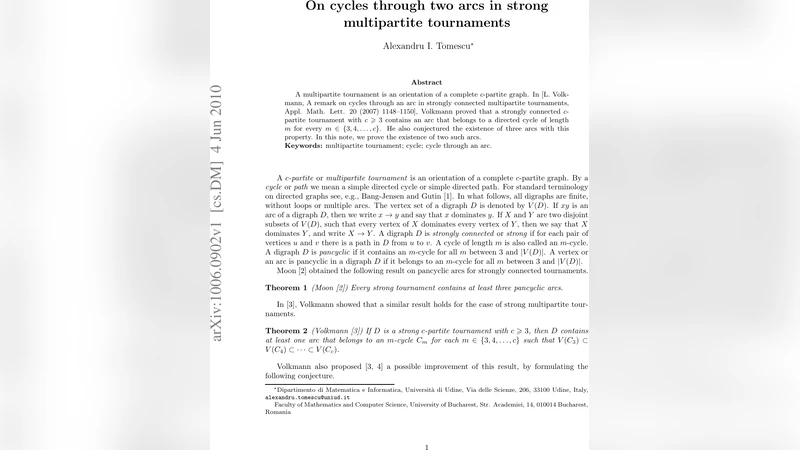
A multipartite tournament is an orientation of a complete $c$-partite graph. In [L. Volkmann, A remark on cycles through an arc in strongly connected multipartite tournaments, Appl. Math. Lett. 20 (2007) 1148–1150], Volkmann proved that a strongly connected $c$-partite tournament with $c \ge 3$ contains an arc that belongs to a directed cycle of length $m$ for every $m \in {3, 4, \ldots, c}$. He also conjectured the existence of three arcs with this property. In this note, we prove the existence of two such arcs.
💡 Research Summary
The paper deals with strong multipartite tournaments, i.e., orientations of complete c‑partite graphs that are strongly connected. For a strong c‑partite tournament D with c ≥ 4, Volkmann (2007) proved that there exists at least one arc that lies on a directed cycle of every length m∈{3,4,…,c}. He further conjectured that three such arcs should exist simultaneously. The present note establishes a weaker but still substantial result: there are always two arcs e₁ and e₂ in D such that each of them belongs to a directed m‑cycle for every m∈{3,4,…,c}. Moreover, the cycles can be chosen so that their vertex sets are nested, i.e., V(Cₖ₃)⊂V(Cₖ₄)⊂…⊂V(Cₖ_c) for each k∈{1,2}.
The proof proceeds by induction on the length m. The base case m = 3 is trivial because any strong multipartite tournament contains a directed 3‑cycle; any two arcs of that triangle satisfy the requirement for m = 3. Assuming that for some m (3 ≤ m < c) we already have two arcs e₁, e₂ each lying on cycles Cₖ₃,…,Cₖ_m with the nested vertex‑set property, the authors show how to extend the construction to length m + 1.
Two main mechanisms are employed:
-
Insertion of a new vertex from an unused partite set. Let S be the set of vertices belonging to partite classes not represented on Cₘ. If S contains a vertex w that has both an in‑neighbor and an out‑neighbor on Cₘ, then w can be inserted between two consecutive vertices u⁻, u⁺ of Cₘ, replacing the arc u⁻u⁺ by u⁻→w and w→u⁺. This yields a directed (m + 1)‑cycle containing the original arc eₖ, while preserving the nesting V(Cₖₘ)⊂V(Cₖₘ₊₁).
-
Creation of two new arcs. Even when no such w exists, the authors exploit the fact that the original 3‑cycle containing eₖ provides a vertex v with which w can form new 3‑ and 4‑cycles. Specifically, depending on the orientation between w and v, either the arc u₁w or wu₂ (where u₁u₂ is the original 3‑cycle edge) belongs to a new 3‑cycle, and both u₁w and wu₂ belong to a new 4‑cycle. By repeatedly replacing the original edge u₁u₂ in longer cycles with the pair (u₁w, wu₂), one obtains cycles of every length from 3 up to m + 1 that contain the newly introduced arcs.
If neither of the above situations occurs, the vertex set S can be partitioned into S₁ and S₂ with S₂→V(Cₘ)→S₁. Since m < c, one may assume S₁ is non‑empty. Strong connectivity guarantees a shortest directed path P from a vertex y₁∈S₁ to a vertex y_q∈V(Cₘ). The internal vertices of P lie outside S₁∪S₂, and the structure of the multipartite tournament forces arcs y_t→y₁ for all intermediate vertices. Depending on whether y_{q‑1} belongs to S₂, the authors construct two arcs (either y_{q‑2}y_{q‑1} and y_{q‑1}y_q, or y₁y₂ and y₂y₃) that lie on cycles of lengths ranging from 3 up to m + q − 1, again preserving the nesting property.
In every case, the inductive step succeeds, producing for each of the two distinguished arcs a family of cycles of all admissible lengths with nested vertex sets. Consequently, any strong c‑partite tournament (c > 3) contains at least two arcs that are “pancyclic” in the sense of belonging to cycles of every length from 3 to c.
The result confirms a substantial part of Volkmann’s conjecture and illustrates a constructive method for extending cycles in multipartite tournaments by either inserting vertices from unused partite classes or by exploiting short directed paths guaranteed by strong connectivity. The techniques may be useful for further investigations into pancyclic arcs, Hamiltonicity, and related extremal problems in oriented multipartite graphs.
Comments & Academic Discussion
Loading comments...
Leave a Comment