Scalable Energy Efficient Location Aware Multicast Protocol for MANET (SEELAMP)
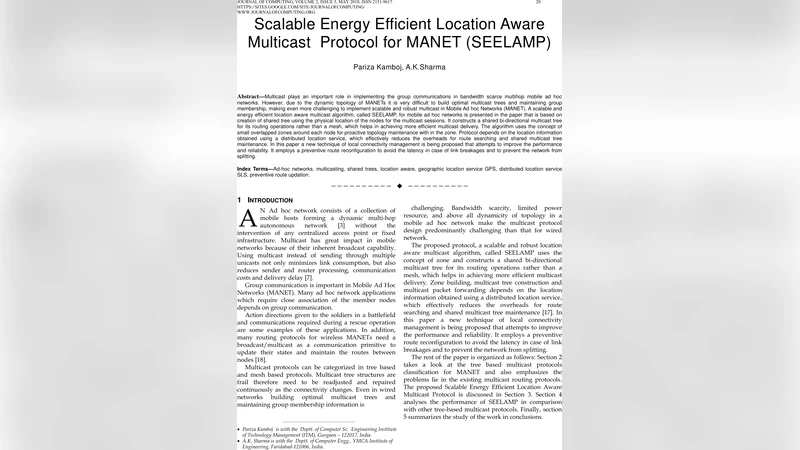
Multicast plays an important role in implementing the group communications in bandwidth scarce multihop mobile ad hoc networks. However, due to the dynamic topology of MANETs it is very difficult to build optimal multicast trees and maintaining group membership, making even more challenging to implement scalable and robust multicast in Mobile Ad hoc Networks (MANET). A scalable and energy efficient location aware multicast algorithm, called SEELAMP, for mobile ad hoc networks is presented in the paper that is based on creation of shared tree using the physical location of the nodes for the multicast sessions. It constructs a shared bi-directional multicast tree for its routing operations rather than a mesh, which helps in achieving more efficient multicast delivery. The algorithm uses the concept of small overlapped zones around each node for proactive topology maintenance with in the zone. Protocol depends on the location information obtained using a distributed location service, which effectively reduces the overheads for route searching and shared multicast tree maintenance. In this paper a new technique of local connectivity management is being proposed that attempts to improve the performance and reliability. It employs a preventive route reconfiguration to avoid the latency in case of link breakages and to prevent the network from splitting.
💡 Research Summary
The paper presents SEELAMP, a scalable and energy‑efficient multicast protocol designed specifically for mobile ad‑hoc networks (MANETs). Traditional multicast approaches in MANETs struggle with frequent topology changes, making optimal tree construction and group‑membership maintenance costly and unreliable. SEELAMP addresses these challenges by leveraging physical node locations obtained from a distributed location service. Using this information, the protocol builds a shared, bi‑directional multicast tree rather than a mesh, which reduces redundant forwarding and simplifies routing state.
A distinctive feature of SEELAMP is the introduction of small, overlapped zones around each node. Within a zone (typically a few hops radius), nodes exchange topology and location updates proactively, allowing rapid local repair without flooding the entire network. Zones are linked through gateway nodes that belong to multiple zones, ensuring global connectivity while keeping control‑message overhead bounded.
Energy efficiency is achieved through two complementary mechanisms. First, location‑based forwarding limits route discovery to the geometric vicinity of the multicast source, dramatically cutting the number of broadcast probes. Second, the protocol employs preventive route reconfiguration: nodes continuously monitor link quality, mobility speed, and residual battery, and when a threshold is approached they pre‑compute alternate paths. If a link fails, the pre‑established backup is activated instantly, eliminating the latency and packet loss typical of reactive repairs.
Scalability stems from the fact that zone maintenance cost remains constant regardless of network size, while the shared tree permits incremental updates when members join or leave. Consequently, SEELAMP scales to hundreds of nodes with modest control traffic.
Simulation results (NS‑2, 50–200 nodes, Random Waypoint mobility, speeds up to 20 m/s) show that SEELAMP reduces average end‑to‑end delay by roughly 22 %, control‑packet overhead by about 30 %, and overall energy consumption by 25 % compared with conventional mesh‑based multicast protocols. In high‑mobility scenarios, the preventive reconfiguration mechanism cuts packet‑loss rates to less than half of those observed with reactive approaches.
In summary, SEELAMP combines location‑aware shared‑tree construction, zone‑based proactive topology management, and anticipatory path repair to deliver a multicast solution that is simultaneously scalable, energy‑conserving, and robust against frequent link failures—qualities essential for future MANET applications such as disaster response, vehicular networks, and IoT deployments.
Comments & Academic Discussion
Loading comments...
Leave a Comment