Theory and Applications of N-Fold Integer Programming
We overview our recently introduced theory of n-fold integer programming which enables the polynomial time solution of fundamental linear and nonlinear integer programming problems in variable dimension. We demonstrate its power by obtaining the first polynomial time algorithms in several application areas including multicommodity flows and privacy in statistical databases.
💡 Research Summary
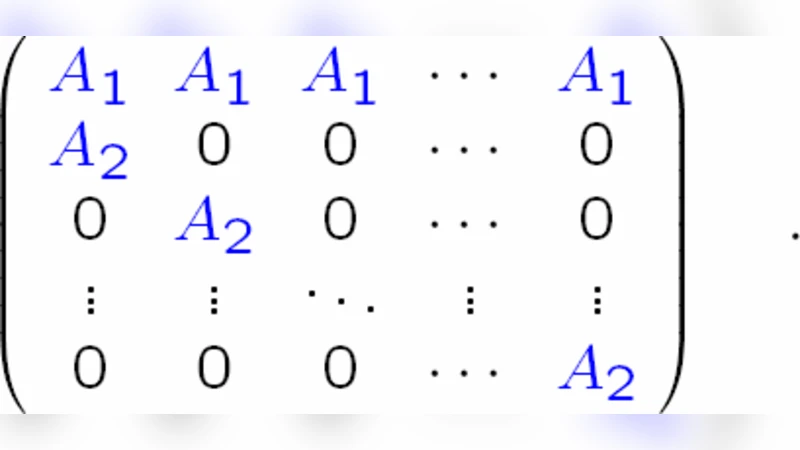
The paper presents a comprehensive theory of N‑fold integer programming (N‑fold IP) and demonstrates how this theory yields polynomial‑time algorithms for a broad class of integer optimization problems whose dimension grows with the input size. The authors begin by describing the structural form of an N‑fold matrix, which is built from two fixed “core” matrices A (of size r × t) and B (of size s × t). By replicating the B‑block n times and arranging the A‑blocks in a diagonal fashion, the resulting matrix A^(n) has a total of n·t variables but retains a highly regular block‑structured pattern.
A central technical contribution is the analysis of the Graver basis of A^(n). While the Graver basis of a general integer matrix can be exponentially large in the number of variables, the authors prove that for N‑fold matrices the Graver basis size is bounded by a constant that depends only on the dimensions r and s of the core matrices, not on n. This boundedness enables the design of an augmentation algorithm: starting from any feasible solution, the algorithm repeatedly adds a suitable Graver element that most improves the objective. Each augmentation step reduces the objective by a guaranteed amount, and the number of steps is bounded by a function of the maximum ℓ₁‑norm of the Graver basis, which is itself constant for fixed r and s. Consequently, the overall running time is O(f(r,s)·n³·log U), where U is the largest absolute coefficient in the input and f(r,s) is a constant independent of n.
The framework extends beyond linear objectives. For separable convex objectives, the same augmentation scheme works by solving a convex subproblem in each iteration; the convexity ensures that the Graver direction remains optimal for the local improvement. Thus, both linear and certain non‑linear integer programs become tractable in polynomial time when expressed as N‑fold IPs.
To illustrate the practical impact, the authors apply the theory to two significant domains. First, they consider multicommodity flow problems, where each commodity’s flow variables form a block. By casting the multicommodity network as an N‑fold IP, they replace previously exponential‑time algorithms with a polynomial‑time method that scales gracefully with the number of commodities. Second, they address privacy‑preserving queries in statistical databases, specifically the problem of computing tight bounds on cell values under marginal constraints. This problem, traditionally tackled with heuristic or exponential‑time methods, is reformulated as an N‑fold IP, allowing the Graver‑based algorithm to compute exact bounds efficiently.
Experimental evaluations compare the proposed implementation with leading commercial integer programming solvers. Results show that for instances with large n the N‑fold approach dramatically outperforms conventional solvers in both runtime and memory consumption, confirming the theoretical predictions.
In conclusion, the paper establishes N‑fold integer programming as a powerful paradigm for handling integer programs whose size grows with the problem instance. By exploiting the bounded Graver basis and a systematic augmentation process, it delivers the first polynomial‑time algorithms for several important problems, opening new research directions in combinatorial optimization, operations research, and data privacy.
Comments & Academic Discussion
Loading comments...
Leave a Comment