New graph polynomials from the Bethe approximation of the Ising partition function
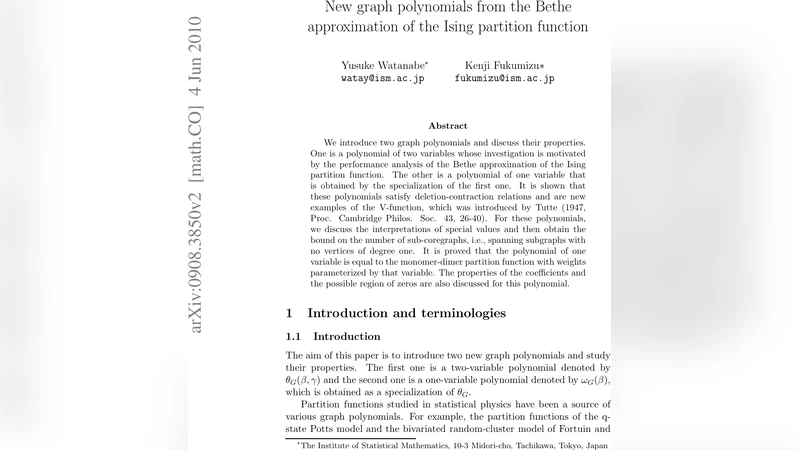
We introduce two graph polynomials and discuss their properties. One is a polynomial of two variables whose investigation is motivated by the performance analysis of the Bethe approximation of the Ising partition function. The other is a polynomial of one variable that is obtained by the specialization of the first one. It is shown that these polynomials satisfy deletion-contraction relations and are new examples of the V-function, which was introduced by Tutte (1947, Proc. Cambridge Philos. Soc. 43, 26-40). For these polynomials, we discuss the interpretations of special values and then obtain the bound on the number of sub-coregraphs, i.e., spanning subgraphs with no vertices of degree one. It is proved that the polynomial of one variable is equal to the monomer-dimer partition function with weights parameterized by that variable. The properties of the coefficients and the possible region of zeros are also discussed for this polynomial.
💡 Research Summary
The paper introduces two novel graph polynomials motivated by the Bethe approximation of the Ising model partition function and investigates their combinatorial and analytic properties. The first polynomial, denoted (B_G(x,y)), is a two‑variable invariant of a graph (G). Its definition stems from the observation that the Bethe approximation can be expressed as a sum over spanning subgraphs that contain no vertices of degree one—so‑called sub‑coregraphs. For each such sub‑coregraph (H) the term (x^{|E(H)|}y^{|V(H)|}) is contributed, where (x) encodes edge weights and (y) encodes vertex weights. Consequently, (B_G(x,y)) counts sub‑coregraphs with a weight that records the number of edges and vertices present.
A central result is that (B_G) satisfies a deletion‑contraction recurrence identical in form to the Tutte polynomial: \
Comments & Academic Discussion
Loading comments...
Leave a Comment