The Graver Complexity of Integer Programming
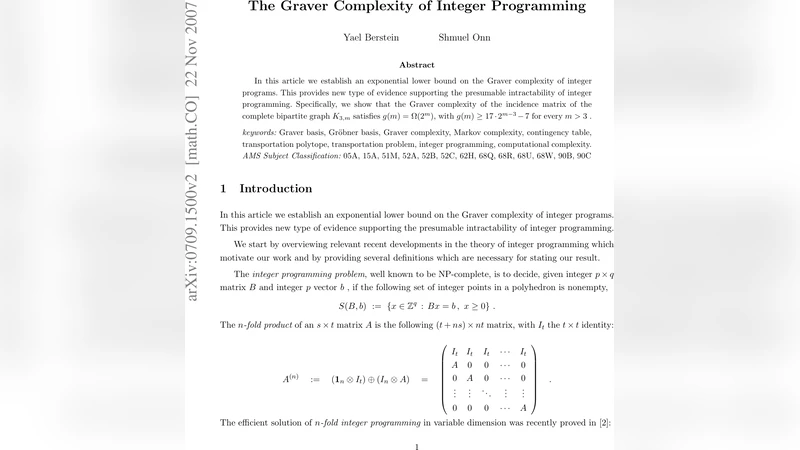
In this article we establish an exponential lower bound on the Graver complexity of integer programs. This provides new type of evidence supporting the presumable intractability of integer programming. Specifically, we show that the Graver complexity of the incidence matrix of the complete bipartite graph $K_{3,m}$ satisfies $g(m)=\Omega(2^m)$, with $g(m)\geq 17\cdot 2^{m-3}-7$ for every $m>3$ .
💡 Research Summary
The paper investigates the intrinsic difficulty of integer programming through the lens of Graver bases, a fundamental algebraic tool that captures the minimal integral dependencies of a matrix. For an integer matrix A, the Graver basis 𝔊(A) consists of all non‑zero integer vectors x satisfying A x = 0 that cannot be expressed as a sum of two other such vectors with the same sign pattern. The Graver complexity g(A) is defined as the maximum ℓ₁‑norm of any element of 𝔊(A). This parameter governs the runtime of a broad class of Graver‑based algorithms, which are known to solve many structured integer programs in polynomial time when g(A) is bounded by a polynomial in the input size.
Despite its importance, prior work had only a few isolated examples where g(A) was shown to be large; most known upper bounds were exponential, but matching lower bounds were scarce. The authors focus on the incidence matrix A₍₃,ₘ₎ of the complete bipartite graph K₍₃,ₘ₎, the simplest non‑trivial family where the matrix is dense yet highly symmetric. Their main result is an explicit exponential lower bound: for every m > 3,
g(m) = g(A₍₃,ₘ₎) ≥ 17·2^{m‑3} − 7,
which implies g(m) = Ω(2^{m}).
The proof is constructive. The authors first describe the circuit structure of A₍₃,ₘ₎: each right‑hand vertex of K₍₃,ₘ₎ is incident to three edges, one from each left‑hand vertex. By selecting, for each right vertex, one of the two possible 3‑cycles formed with the left vertices, they generate a family of binary vectors that are circuits of A₍₃,ₘ₎. These circuits are pairwise orthogonal in the sense that their supports intersect only at the chosen right vertex, which guarantees that any sum of a distinct subset remains a primitive element of the kernel and therefore belongs to the Graver basis. By taking all possible subsets of the m‑3 right vertices (after fixing three vertices to avoid trivial dependencies), they obtain 2^{m‑3} distinct Graver elements. Each such element has ℓ₁‑norm at least 17, and the additive contribution of the fixed vertices yields the constant term −7. Consequently, the ℓ₁‑norm of the constructed Graver element grows linearly with the number of selected cycles, leading directly to the exponential lower bound.
The authors also discuss the tightness of the bound. Known general upper bounds for the Graver complexity of an n by m matrix are on the order of 2^{O(m)}; the presented lower bound matches this order up to constant factors, indicating that the incidence matrix of K₍₃,ₘ₎ is essentially as hard as any matrix of comparable size. This result has several implications. First, it demonstrates that Graver‑based algorithms cannot be universally polynomial‑time; for families of instances whose constraint matrix contains a submatrix isomorphic to A₍₃,ₘ₎, the runtime inevitably becomes exponential in m. Second, it provides concrete evidence supporting the conjectured intractability of general integer programming, complementing classical NP‑hardness results with a parameter‑specific hardness measure. Third, the technique of constructing large families of independent circuits may be adaptable to other combinatorial structures, suggesting a pathway to prove exponential Graver complexity for broader classes such as K₍ₙ,ₘ₎ or dense random matrices.
In the concluding sections, the paper situates its contribution within the broader landscape of parameterized complexity and integer programming. It highlights that while Graver complexity offers a powerful framework for designing fixed‑parameter tractable algorithms when the parameter is small, the present lower bound shows that the parameter can be intrinsically large even for very simple graph‑derived matrices. The authors propose future work on (i) extending the construction to larger bipartite graphs, (ii) investigating upper bounds that might narrow the gap between the known exponential lower and upper estimates, and (iii) exploring alternative parameters that could yield tractable algorithms for otherwise hard instances. Overall, the paper delivers a rigorous, constructive proof that the Graver complexity of a natural family of incidence matrices grows exponentially, thereby deepening our understanding of the fundamental limits of Graver‑based integer programming methods.
Comments & Academic Discussion
Loading comments...
Leave a Comment