Centrality Metric for Dynamic Networks
Centrality is an important notion in network analysis and is used to measure the degree to which network structure contributes to the importance of a node in a network. While many different centrality measures exist, most of them apply to static networks. Most networks, on the other hand, are dynamic in nature, evolving over time through the addition or deletion of nodes and edges. A popular approach to analyzing such networks represents them by a static network that aggregates all edges observed over some time period. This approach, however, under or overestimates centrality of some nodes. We address this problem by introducing a novel centrality metric for dynamic network analysis. This metric exploits an intuition that in order for one node in a dynamic network to influence another over some period of time, there must exist a path that connects the source and destination nodes through intermediaries at different times. We demonstrate on an example network that the proposed metric leads to a very different ranking than analysis of an equivalent static network. We use dynamic centrality to study a dynamic citations network and contrast results to those reached by static network analysis.
💡 Research Summary
The paper addresses a fundamental limitation of most existing centrality measures: they are defined on static graphs and therefore ignore the temporal ordering of edges in networks that evolve over time. To overcome this, the authors propose a novel “dynamic centrality” metric that explicitly counts time‑respecting paths—sequences of edges whose timestamps are strictly increasing—from a source node to a destination node.
The authors first formalize a memoryless dynamic process. The network is represented as a series of snapshots Gₜ₁,…,Gₜₙ, each with its adjacency matrix A(tᵢ). At each time step a node may initiate transmission with probability β, and any node that receives a message forwards it in the next step with probability α. Under these assumptions the expected amount of information that travels from node i at time t₁ to node j at time tₙ is given by the (i,j) entry of
Cᵈ(t₁→tₙ) = βA(t₁) + βαA(t₁)A(t₂) + … + βαⁿ⁻¹A(t₁)…A(tₙ).
Summing over all start times yields a cumulative dynamic centrality matrix Cᵈ(β,α,Δ₁,ₙ) that captures the total expected influence of each node over a chosen interval Δ₁,ₙ.
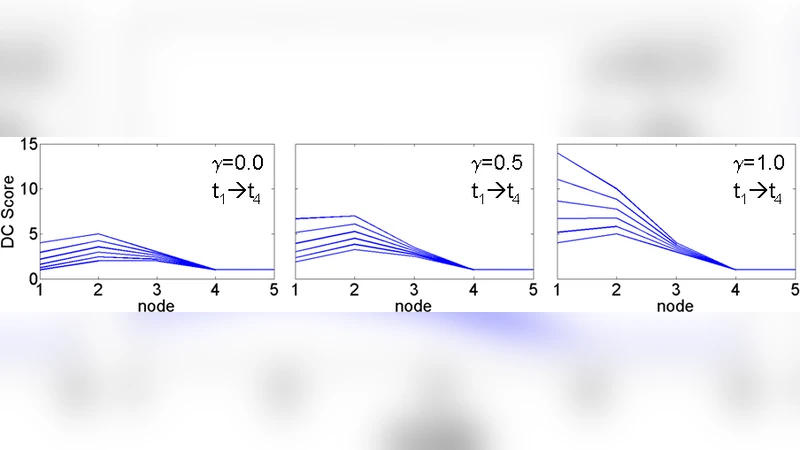
Recognizing that many real‑world systems retain information beyond a single time step, the authors extend the model to include memory. They introduce a retention probability γ (0≤γ≤1) and a retention length m, constructing a “retained adjacency” matrix R(tₙ,γ) that linearly combines the current and recent past adjacency matrices weighted by powers of γ. The retained dynamic centrality RCᵈ(t₁→tₙ) is then defined analogously to the memoryless case, but using R matrices instead of raw A matrices. This formulation allows the metric to model scenarios where past interactions continue to affect future diffusion, with the strength of that effect controlled by γ.
The paper provides two illustrative experiments. The first uses a toy network with four time‑stamped snapshots. When the network is aggregated into a static graph, three distinct paths from node 1 to node 5 appear. However, only one of these respects the temporal order (1→2→3→4→5). Dynamic centrality correctly assigns higher scores to the intermediate nodes that lie on the feasible temporal path, demonstrating that static aggregation can severely misrepresent influence.
The second experiment applies the metric to a real citation network. Citations are naturally directed and only ever added, making them an ideal dynamic network. By fitting the parameters α and γ to the empirical distributions of citation lag times and path lengths, the authors obtain a calibrated dynamic centrality. Rankings derived from this metric differ markedly from those produced by PageRank, CiteRank, or simple citation counts. Notably, recent papers that have not yet accumulated many citations can receive high dynamic centrality scores because they lie on many short, time‑respecting citation chains, revealing “latent influence” that static measures miss. Conversely, some older, heavily cited papers drop in rank when their influence is spread over long, temporally dispersed paths.
Key contributions of the work are:
- A rigorous definition of dynamic centrality based on time‑ordered paths, with both memoryless and memory‑augmented formulations.
- Introduction of tunable parameters (α, β, γ) that control the spatial and temporal scales of influence, together with a data‑driven method for estimating them.
- Empirical validation showing that dynamic centrality can uncover influential nodes that static analyses overlook, especially in domains where timing matters (e.g., information diffusion, scientific impact).
The authors conclude by suggesting future directions such as automatic parameter learning, extensions to stochastic propagation models, and scalable algorithms for massive dynamic graphs. The proposed metric offers a principled way to incorporate temporal dynamics into centrality analysis, opening new possibilities for studying influence in evolving networks.
Comments & Academic Discussion
Loading comments...
Leave a Comment