Noncommutative calculus and the Gauss-Manin connection
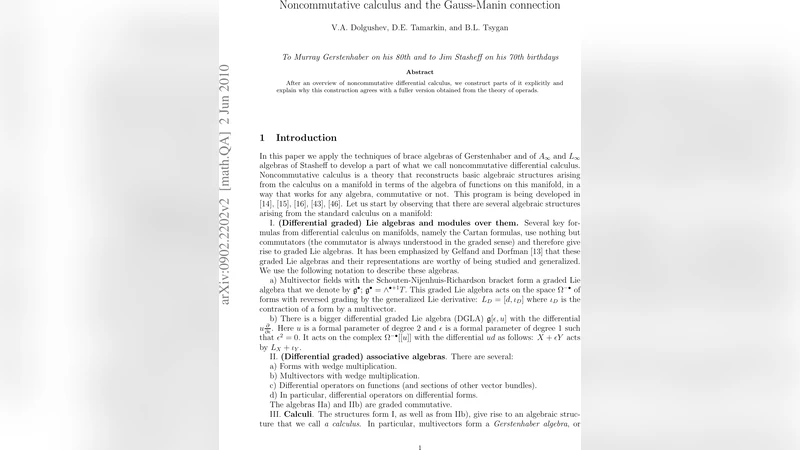
After an overview of noncommutative differential calculus, we construct parts of it explicitly and explain why this construction agrees with a fuller version obtained from the theory of operads.
💡 Research Summary
The paper provides a comprehensive treatment of non‑commutative differential calculus and demonstrates how the Gauss‑Manin connection, a fundamental tool in algebraic geometry, can be constructed in the non‑commutative setting. After a concise overview of the necessary background—Hochschild complexes, cyclic homology, and the Connes B‑operator—the author first revisits the operadic approach to non‑commutative calculus. In this framework the Hochschild cohomology HH⁎(A) acquires a Gerstenhaber‑algebra structure, and higher homotopies are encoded by an L∞‑algebra that mimics the classical Lie derivative, interior product, and de Rham differential. This operadic viewpoint guarantees that the algebraic structures are homotopy‑invariant and provides a clean conceptual explanation for the appearance of the B‑operator as a homotopy‑derived analogue of the de Rham differential.
The core of the work, however, is an explicit construction that does not rely on abstract operads. Starting from an arbitrary associative algebra A (over a field k of characteristic zero), the author equips A with an A∞‑structure μₙ (n≥1) and builds the bar‑cobar resolution B(A). The differential d on the resulting complex is defined using μ₁ (the original differential, if any) and μ₂ (the multiplication), while higher μₙ’s generate higher‑order corrections that reproduce the Connes B‑operator when summed with appropriate signs and a formal parameter u. A detailed chain homotopy is exhibited, showing that this concrete model is homotopy‑equivalent to the operadic construction; consequently, the two approaches yield the same Hochschild‑Kostant‑Rosenberg type isomorphism in the non‑commutative case.
Having established a robust non‑commutative de Rham complex (Ω⁎(A), d, B), the paper turns to the Gauss‑Manin connection. Let R be a smooth commutative k‑algebra that serves as a parameter space, and consider the R‑linear extension C⁎(A,R)=C⁎(A)⊗ₖR. The connection ∇ is defined on this family by the formula
∇ = d_R⊗1 + 1⊗d + u·B,
where d_R is the ordinary de Rham differential on R and u is a formal variable of degree –2. The crucial flatness condition ∇²=0 follows from the identities b²=0, B²=0 and the mixed relation bB+Bb=0 in the cyclic bicomplex, together with the fact that d_R²=0. This flat connection therefore endows the periodic cyclic homology HP₍*₎(A) with a natural “variation of Hodge structure’’ over Spec R, exactly mirroring the classical Gauss‑Manin connection on the de Rham cohomology of a smooth family of varieties.
To illustrate the theory, the author works out two non‑trivial examples. The first is the non‑commutative two‑torus A_θ, where θ∈ℝ. By explicitly computing Ω⁎(A_θ) and the action of ∇, the paper shows that the resulting connection coincides with the usual Gauss‑Manin connection on the ordinary torus after passing to the commutative limit θ→0. The second example is the quantum plane ℂ_q, where the deformation parameter q introduces non‑trivial commutation relations between coordinates. In this case the B‑operator acquires q‑dependent correction terms, yet the flatness of ∇ persists, confirming that the construction is stable under deformation quantization.
In summary, the article achieves three major objectives: (1) it clarifies the relationship between operadic and explicit A∞‑based formulations of non‑commutative calculus; (2) it constructs a flat Gauss‑Manin connection on families of non‑commutative algebras, thereby extending the classical Hodge‑de Rham picture to the non‑commutative realm; and (3) it validates the theory through concrete calculations on deformed geometric objects. This work therefore bridges a gap between abstract homotopical algebra and concrete non‑commutative geometry, opening avenues for further exploration of non‑commutative Hodge theory, deformation quantization, and the study of moduli spaces of non‑commutative algebras.
Comments & Academic Discussion
Loading comments...
Leave a Comment