Entropy Measures vs. Algorithmic Information
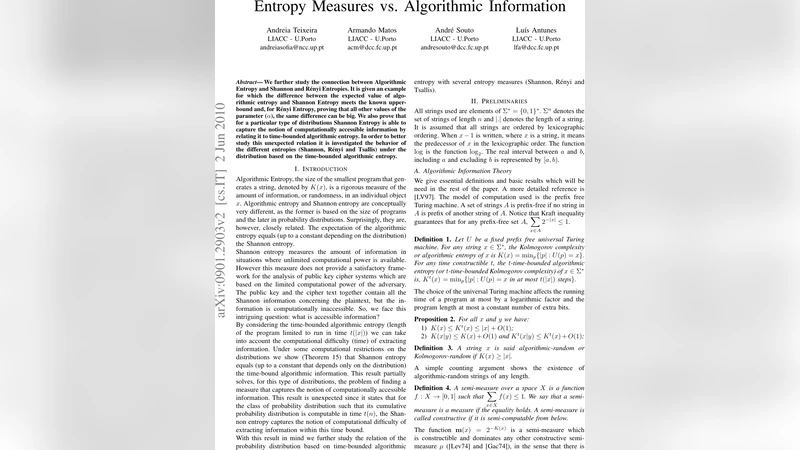
Algorithmic entropy and Shannon entropy are two conceptually different information measures, as the former is based on size of programs and the later in probability distributions. However, it is known that, for any recursive probability distribution, the expected value of algorithmic entropy equals its Shannon entropy, up to a constant that depends only on the distribution. We study if a similar relationship holds for R'{e}nyi and Tsallis entropies of order $\alpha$, showing that it only holds for R'{e}nyi and Tsallis entropies of order 1 (i.e., for Shannon entropy). Regarding a time bounded analogue relationship, we show that, for distributions such that the cumulative probability distribution is computable in time $t(n)$, the expected value of time-bounded algorithmic entropy (where the alloted time is $nt(n)\log (nt(n))$) is in the same range as the unbounded version. So, for these distributions, Shannon entropy captures the notion of computationally accessible information. We prove that, for universal time-bounded distribution $\m^t(x)$, Tsallis and R'{e}nyi entropies converge if and only if $\alpha$ is greater than 1.
💡 Research Summary
The paper investigates the relationship between algorithmic information (Kolmogorov complexity) and several entropy measures—Shannon, Rényi, and Tsallis—under both unbounded and time‑bounded settings. It begins by recalling the classic result that for any recursive (computable) probability distribution P, the expected Kolmogorov complexity E_P
Comments & Academic Discussion
Loading comments...
Leave a Comment