Wirtingers Calculus in general Hilbert Spaces
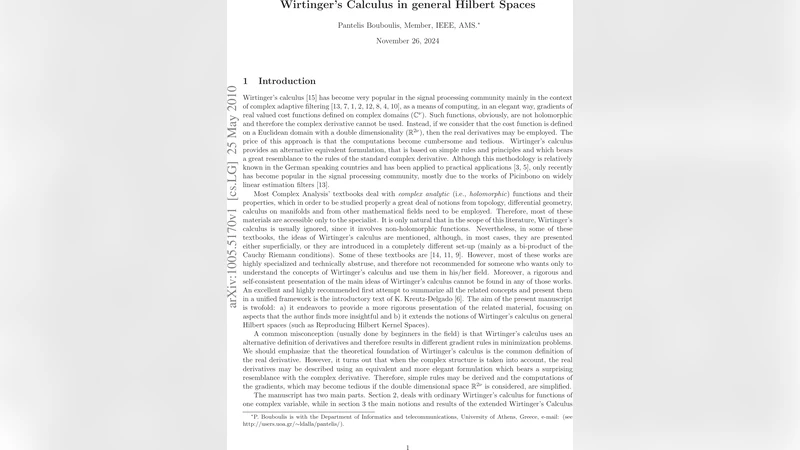
The present report, has been inspired by the need of the author and its colleagues to understand the underlying theory of Wirtinger’s Calculus and to further extend it to include the kernel case. The aim of the present manuscript is twofold: a) it endeavors to provide a more rigorous presentation of the related material, focusing on aspects that the author finds more insightful and b) it extends the notions of Wirtinger’s calculus on general Hilbert spaces (such as Reproducing Hilbert Kernel Spaces).
💡 Research Summary
The manuscript “Wirtinger’s Calculus in General Hilbert Spaces” offers a comprehensive treatment of Wirtinger’s calculus, beginning with its classical formulation on the complex plane and extending it to arbitrary Hilbert spaces, with a particular focus on reproducing kernel Hilbert spaces (RKHS).
The authors start by recalling the standard definition of a complex‑valued function (f(z)=u(x,y)+i v(x,y)) on an open subset of (\mathbb{C}). They re‑derive the Cauchy‑Riemann equations as the necessary and sufficient condition for complex differentiability, and they introduce the “conjugate‑Cauchy‑Riemann” equations that characterize functions differentiable with respect to the conjugate variable. By exploiting the real partial derivatives (\partial/\partial x) and (\partial/\partial y), they define the Wirtinger derivative (\partial f/\partial z = \frac12(\partial f/\partial x - i\partial f/\partial y)) and its conjugate (\partial f/\partial z^{} = \frac12(\partial f/\partial x + i\partial f/\partial y)). They prove that when (f) is holomorphic, (\partial f/\partial z) coincides with the usual complex derivative and (\partial f/\partial z^{}=0); conversely, for conjugate‑holomorphic functions the roles are swapped.
A large part of the paper is devoted to establishing the calculus rules for these operators. Linearity, product rule, chain rule, and higher‑order differentiation are shown to hold in exactly the same way as for ordinary real derivatives. This is particularly valuable for optimization problems where the cost function is real‑valued but depends on complex parameters (e.g., widely‑linear adaptive filters). In such cases the gradient with respect to the complex variable can be expressed compactly as
\
Comments & Academic Discussion
Loading comments...
Leave a Comment