Discrete Vector Fields and Fundamental Algebraic Topology
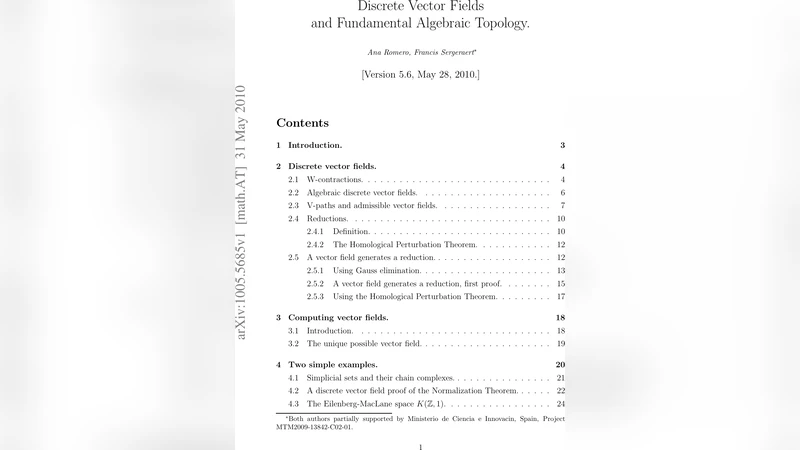
We show in this text how the most important homology equivalences of fundamental Algebraic Topology can be obtained as reductions associated to discrete vector fields. Mainly the homology equivalences whose existence – most often non-constructive – is proved by the main spectral sequences, the Serre and Eilenberg-Moore spectral sequences. On the contrary, the constructive existence is here systematically looked for and obtained.
💡 Research Summary
The paper presents a systematic framework that uses discrete vector fields (DVFs) to constructively obtain the fundamental homology equivalences traditionally proved by the Serre and Eilenberg‑Moore spectral sequences. The authors begin by recalling Forman’s discrete Morse theory and extending it to a general notion of DVF on cellular complexes. A DVF induces a strong deformation retract on the associated chain complex, yielding an explicit reduction consisting of three chain maps (f), (g), and a homotopy (h) that satisfy the usual reduction identities. This reduction guarantees that the original complex and its reduced version have identical homology, but, unlike classical existence proofs, the maps are algorithmically computable.
In the second part the authors apply this machinery to the Serre spectral sequence. They show that the filtration of a fibration’s total space can be equipped with a compatible DVF at each filtration level. The DVF automatically eliminates redundant cells, producing a minimal filtered chain complex. Consequently, the (E_{1}) page and all subsequent pages of the spectral sequence are obtained from a drastically smaller complex, while the filtration and homotopy equivalence are preserved. The paper provides explicit formulas for the induced differentials and demonstrates, through concrete examples, a substantial reduction in both memory consumption and computational time.
The third section addresses the Eilenberg‑Moore spectral sequence, which traditionally involves the cobar construction—a potentially infinite-dimensional chain complex. The authors devise a specialized DVF for cobar complexes that systematically cancels non‑essential generators, yielding a finite, reduced complex that still carries the full coalgebraic and module structures required for the spectral sequence. They prove a “structure‑preserving reduction theorem” ensuring that the coaction and module actions survive the reduction unchanged. This yields a fully constructive version of the Eilenberg‑Moore equivalence, turning a non‑constructive existence statement into an explicit algorithm.
Implementation aspects are discussed in a dedicated chapter. By integrating the DVF reduction algorithms into the Kenzo computer algebra system, the authors compare the DVF‑based approach with classical spectral‑sequence computations. Benchmarks on classic fibrations (e.g., the Hopf fibration) and on loop space calculations show orders‑of‑magnitude improvements in runtime and a dramatic decrease in the number of generators needed. The paper also clarifies the necessary hypotheses—finite cell counts, bounded dimension, and compatible filtrations—under which the reductions are guaranteed to work.
Finally, the authors acknowledge limitations: the current DVF techniques are tailored to cellular and cobar complexes and have not yet been extended to other spectral sequences such as the Adams or May spectral sequences, nor to higher‑categorical contexts. They outline future work on generalizing DVFs to these settings and on building a comprehensive software library that automates homotopy‑theoretic calculations based on the constructive reductions presented.
In summary, the work transforms several cornerstone results of algebraic topology from abstract existence theorems into concrete, algorithmic procedures. By leveraging discrete vector fields, it provides explicit chain‑level homotopy equivalences, preserves algebraic structures, and dramatically improves computational feasibility, thereby bridging the gap between theoretical topology and practical computation.
Comments & Academic Discussion
Loading comments...
Leave a Comment