Computational Transition at the Uniqueness Threshold
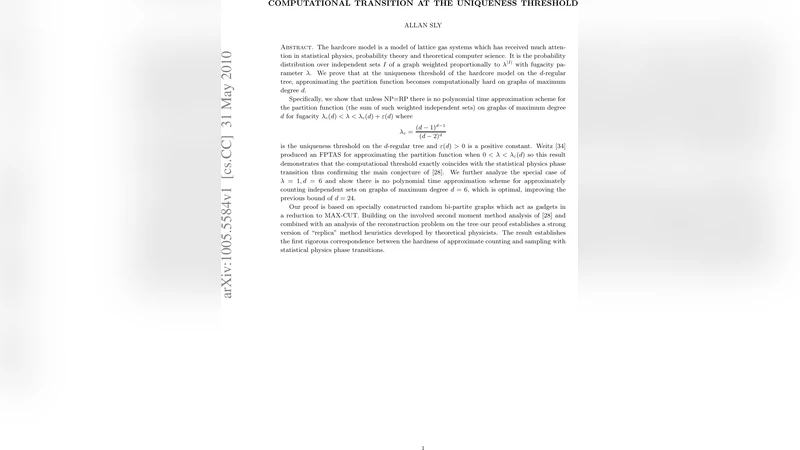
The hardcore model is a model of lattice gas systems which has received much attention in statistical physics, probability theory and theoretical computer science. It is the probability distribution over independent sets $I$ of a graph weighted proportionally to $\lambda^{|I|}$ with fugacity parameter $\lambda$. We prove that at the uniqueness threshold of the hardcore model on the $d$-regular tree, approximating the partition function becomes computationally hard on graphs of maximum degree $d$. Specifically, we show that unless NP$=$RP there is no polynomial time approximation scheme for the partition function (the sum of such weighted independent sets) on graphs of maximum degree $d$ for fugacity $\lambda_c(d) < \lambda < \lambda_c(d) + \epsilon(d)$ where $\lambda_c = \frac{(d-1)^{d-1}}{(d-2)^d}$ is the uniqueness threshold on the $d$-regular tree and $\epsilon(d)>0$. Weitz produced an FPTAS for approximating the partition function when $0<\lambda < \lambda_c(d)$ so this result demonstrates that the computational threshold exactly coincides with the statistical physics phase transition thus confirming the main conjecture of [28]. We further analyze the special case of $\lambda=1, d=6$ and show there is no polynomial time algorithm for approximately counting independent sets on graphs of maximum degree $d= 6$ which is optimal. Our proof is based on specially constructed random bi-partite graphs which act as gadgets in a reduction to MAX-CUT. Building on the second moment method analysis of [28] and combined with an analysis of the reconstruction problem on the tree our proof establishes a strong version of ‘replica’ method heuristics developed by theoretical physicists. The result establishes the first rigorous correspondence between the hardness of approximate counting and sampling with statistical physics phase transitions.
💡 Research Summary
The paper studies the computational complexity of approximating the partition function of the hardcore model on graphs of bounded degree, establishing a sharp threshold that coincides with the statistical‑physics uniqueness phase transition on the infinite $d$‑regular tree. The hardcore model assigns to each independent set $I$ of a graph $G$ a weight $\lambda^{|I|}$, where $\lambda>0$ is the fugacity, and the partition function $Z_G(\lambda)$ is the sum of these weights. Weitz previously gave a deterministic fully polynomial‑time approximation scheme (FPTAS) for $Z_G(\lambda)$ when $0<\lambda<\lambda_c(d)$, where $\lambda_c(d)=\frac{(d-1)^{d-1}}{(d-2)^d}$ is the uniqueness threshold beyond which long‑range correlations appear on the $d$‑regular tree. The main contribution of this work is to prove that for any fixed $d\ge 3$ there exists a constant $\epsilon(d)>0$ such that, unless NP = RP, no polynomial‑time approximation scheme exists for $Z_G(\lambda)$ on graphs of maximum degree $d$ when $\lambda$ lies in the interval $\bigl(\lambda_c(d),\lambda_c(d)+\epsilon(d)\bigr)$. In particular, the authors show that for $\lambda=1$ and $d=6$ the problem of approximately counting independent sets on degree‑6 graphs is already hard, which matches the best possible known hardness result.
The proof proceeds in two major stages. First, the authors construct a family of random bipartite $d$‑regular graphs $G_{n,d}$ that serve as “gadgets”. Using the second‑moment method, they demonstrate that the distribution of independent sets in $G_{n,d}$ closely mimics the Gibbs measure on the infinite $d$‑regular tree. When $\lambda>\lambda_c(d)$, the tree exhibits a reconstruction phenomenon: the spin at the root retains non‑vanishing information about spins far down the tree, implying strong long‑range dependencies. This property transfers to the random gadgets, establishing that their local marginals are highly sensitive to boundary conditions.
In the second stage the gadgets are assembled into a reduction from the well‑known MAX‑CUT problem. Each vertex of a given bounded‑degree instance of MAX‑CUT is replaced by a gadget; edges between vertices become carefully designed connections between the corresponding gadgets. The external fields imposed on the gadgets encode a bias that forces the independent‑set configuration to “choose” a side of the cut. When $\lambda>\lambda_c(d)$, the reconstruction effect guarantees that the optimal cut value is reflected in the value of the partition function of the constructed graph, up to a known multiplicative factor. Consequently, an algorithm that could approximate $Z_G(\lambda)$ within any reasonable ratio would yield a polynomial‑time approximation for MAX‑CUT, contradicting the assumption NP ≠ RP. Conversely, when $\lambda<\lambda_c(d)$, correlation decay holds, the gadgets become essentially independent, and Weitz’s correlation‑decay based algorithm provides an FPTAS, confirming that the hardness barrier aligns precisely with the uniqueness threshold.
The paper also gives an explicit quantitative bound for the case $d=6$, showing that $\epsilon(6)>0$ and that the interval $(\lambda_c(6),\lambda_c(6)+\epsilon(6))$ already contains $\lambda=1$. This yields optimal hardness for counting independent sets on degree‑6 graphs, a long‑standing open problem.
Beyond the specific result, the work bridges a gap between physics heuristics (the replica method, replica symmetry breaking, and reconstruction) and rigorous computational complexity. It demonstrates that the onset of long‑range correlations in a spin system is not merely a physical curiosity but directly translates into a computational phase transition: the problem switches from being efficiently approximable to being provably intractable exactly at the point where the underlying Gibbs measure ceases to be unique. The techniques—combining second‑moment analysis, reconstruction on trees, and AP‑reductions—constitute a versatile framework that the authors suggest can be adapted to other counting problems such as the Potts model or graph coloring, potentially leading to a general theory of “statistical‑computational thresholds”.
Comments & Academic Discussion
Loading comments...
Leave a Comment