Sequential properties of function spaces with the compact-open topology
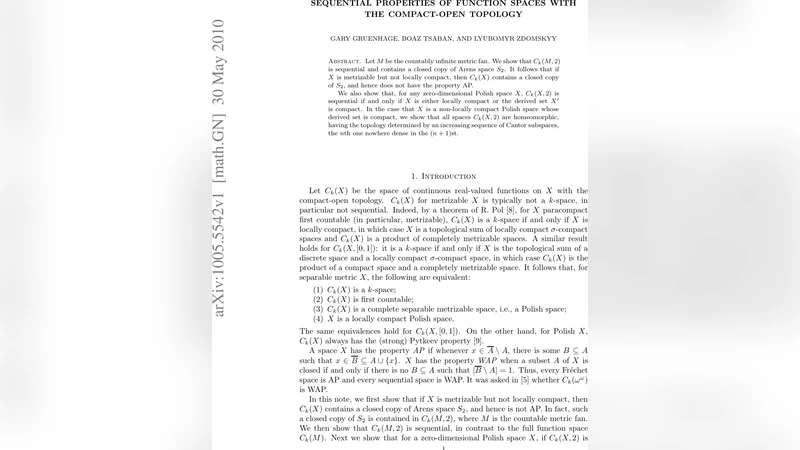
Let M be the countably infinite metric fan. We show that C_k(M,2) is sequential and contains a closed copy of Arens space S_2. It follows that if X is metrizable but not locally compact, then C_k(X) contains a closed copy of S_2, and hence does not have the property AP. We also show that, for any zero-dimensional Polish space X, C_k(X,2) is sequential if and only if X is either locally compact or the derived set X’ is compact. In the case that X is a non-locally compact Polish space whose derived set is compact, we show that all spaces C_k(X, 2) are homeomorphic, having the topology determined by an increasing sequence of Cantor subspaces, the n-th one nowhere dense in the (n+1)-st.
💡 Research Summary
The paper investigates sequential properties of function spaces equipped with the compact‑open topology, focusing on spaces of continuous maps into the two‑point discrete space {0,1}. The authors begin by introducing the countably infinite metric fan M, a classic non‑locally compact metric space constructed by attaching to a single accumulation point a countable family of line segments whose lengths tend to zero. They prove that the function space Cₖ(M, 2) (continuous maps from M to 2 with the compact‑open topology) is sequential. The proof proceeds by describing a basis of neighbourhoods in Cₖ(M, 2) and constructing, for each “branch’’ of M, a sequence of functions that converges to the constant‑zero function. By arranging these sequences appropriately, they embed a closed copy of the Arens space S₂ inside Cₖ(M, 2). Since S₂ is a classic example of a sequential space that fails the Arens‑Pettis (AP) property, the presence of a closed S₂ shows that Cₖ(M, 2) is sequential yet does not enjoy AP.
Using this embedding, the authors extend the result to any metrizable space X that is not locally compact. Any such X contains a closed subspace homeomorphic to M (for instance, a countable family of convergent sequences accumulating at a non‑isolated point). The restriction map from Cₖ(X) to Cₖ(M, 2) is continuous and surjective onto a closed subspace, so Cₖ(X) also contains a closed copy of S₂. Consequently, for every non‑locally compact metrizable space X, the function space Cₖ(X) fails the AP property. This yields a clean dichotomy: AP holds for Cₖ(X) precisely when X is locally compact.
The second major theme concerns zero‑dimensional Polish spaces (i.e., separable completely metrizable spaces with a basis of clopen sets). The authors characterize when Cₖ(X, 2) is sequential. They prove that sequentiality occurs exactly in two mutually exclusive situations: (1) X is locally compact, which recovers the classical case; or (2) X is not locally compact but its derived set X′ (the set of non‑isolated points) is compact. In the latter case, the topology of Cₖ(X, 2) can be described explicitly. One enumerates an increasing sequence of compact neighbourhoods K₁⊂K₂⊂… of X′. For each n, the set of functions that are constant on X∖Kₙ and arbitrary on Kₙ is homeomorphic to a Cantor space Cₙ. Moreover, Cₙ is nowhere dense in Cₙ₊₁, and the whole space Cₖ(X, 2) is the direct limit (union) of this increasing chain:
Cₖ(X, 2)=⋃ₙ Cₙ.
Thus the topology is completely determined by an “increasing Cantor tower” where each level is a closed, nowhere‑dense copy of the Cantor set inside the next level.
A striking corollary follows: for any two zero‑dimensional Polish spaces X and Y that are non‑locally compact but have compact derived sets, the corresponding function spaces Cₖ(X, 2) and Cₖ(Y, 2) are homeomorphic. The homeomorphism is obtained by matching the Cantor towers level‑by‑level, using standard homeomorphisms between Cantor spaces and preserving the inclusion relations. Hence the fine structure of X (e.g., the exact arrangement of isolated points) does not affect the topological type of Cₖ(X, 2) in this regime.
Overall, the paper delivers three key contributions. First, it provides a concrete example (Cₖ(M, 2)) of a sequential function space that fails AP, and uses it to show that AP holds for Cₖ(X) if and only if X is locally compact. Second, it gives a complete sequentiality criterion for Cₖ(X, 2) when X is a zero‑dimensional Polish space, linking the property to the compactness of the derived set. Third, it uncovers a uniform topological structure—an increasing sequence of nowhere‑dense Cantor subspaces—for all Cₖ(X, 2) in the non‑locally compact, compact‑derived‑set case, establishing a strong classification theorem. These results deepen our understanding of how the fine combinatorial features of the domain space X influence the sequential behaviour and the AP property of its compact‑open function spaces.
Comments & Academic Discussion
Loading comments...
Leave a Comment