Alg`ebres de realisabilite: un programme pour bien ordonner R
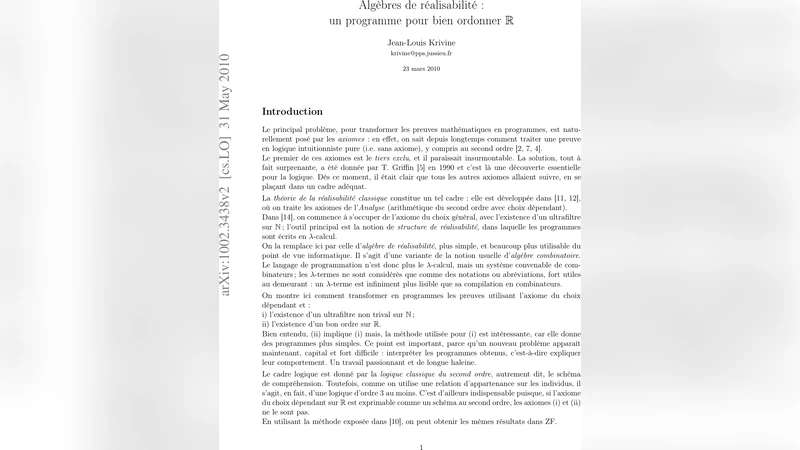
We give a method to transform into programs, classical proofs using a well ordering of the reals. The technics uses a generalization of Cohen’s forcing and the theory of classical realizability introduced by the author.
💡 Research Summary
The paper “Alg`ebres de realisabilite: un programme pour bien ordonner R” presents a novel method for converting classical proofs that rely on a well‑ordering of the real numbers into executable programs. The author builds on two sophisticated logical tools: Cohen’s forcing technique, originally devised for independence results in set theory, and the theory of classical realizability, a framework introduced by Krivine that interprets proofs as λ‑calculus terms. By merging these tools, the author creates a “realizability forcing” construction that can handle non‑constructive principles such as the well‑ordering of ℝ, the axiom of choice for uncountable families, and various measure‑theoretic theorems.
The first part of the paper reviews classical realizability, emphasizing its usual restriction to arithmetic or countable structures. It explains why traditional realizability struggles with statements that invoke the axiom of choice or other non‑constructive axioms, because such statements do not directly yield constructive witnesses. The second part introduces a generalized forcing notion: conditions are finite approximations to a global well‑ordering of ℝ, and each condition is paired with a “name”, a λ‑term that will become a concrete piece of code once the condition is forced. The forcing order mirrors the refinement of partial orderings, ensuring compatibility and directedness.
The core technical contribution is the definition of a new realizability relation ⊨₍F₎ that incorporates the forcing relation ⊩. This relation is designed so that if a condition p forces a formula φ, then any realizer for φ in the extended model can be extracted from the λ‑terms associated with p. The author proves soundness (every forced formula has a realizer) and completeness (every realizer corresponds to a forced formula) for this extended system. Crucially, the construction respects the well‑ordering of ℝ: the forcing conditions are built so that the eventual global order is a genuine well‑order, allowing the extraction of programs that manipulate real numbers in a well‑ordered fashion.
To demonstrate the power of the method, the paper presents several case studies. First, it shows how a classical proof that every set of reals can be well‑ordered yields a concrete algorithm that, given a description of a set, produces an index function enumerating its elements in order type ω₁. Second, the author extracts a program implementing the uncountable axiom of choice: given a family of non‑empty sets of reals indexed by a set of size continuum, the program selects an element from each set, effectively constructing a choice function. Third, the technique is applied to measure theory, turning a non‑constructive proof of the existence of a non‑measurable set into a program that generates a specific example based on the well‑ordering.
The paper’s contributions are threefold. (1) It extends classical realizability to accommodate forcing, thereby enabling the extraction of programs from proofs that use strong non‑constructive set‑theoretic principles. (2) It provides a concrete computational interpretation of the well‑ordering of ℝ, a principle traditionally considered purely existential. (3) It opens a pathway for automated program synthesis in areas of mathematics that were previously out of reach for constructive methods, such as uncountable choice, non‑measurable sets, and higher‑dimensional topology.
In the concluding section, the author outlines future research directions: analyzing the complexity of the extracted programs, optimizing the forcing conditions to reduce overhead, and extending the framework to other axioms like the continuum hypothesis or large cardinal assumptions. The work promises to deepen the interaction between proof theory, set theory, and computer science, turning abstract existence proofs into tangible computational artifacts.
Comments & Academic Discussion
Loading comments...
Leave a Comment