Exploring the Thermodynamics of a Universal Fermi Gas
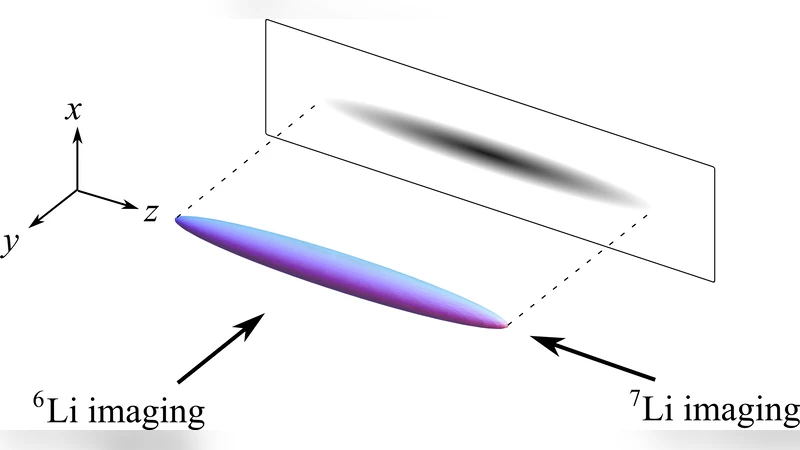
From sand piles to electrons in metals, one of the greatest challenges in modern physics is to understand the behavior of an ensemble of strongly interacting particles. A class of quantum many-body systems such as neutron matter and cold Fermi gases share the same universal thermodynamic properties when interactions reach the maximum effective value allowed by quantum mechanics, the so-called unitary limit [1,2]. It is then possible to simulate some astrophysical phenomena inside the highly controlled environment of an atomic physics laboratory. Previous work on the thermodynamics of a two-component Fermi gas led to thermodynamic quantities averaged over the trap [3-5], making it difficult to compare with many-body theories developed for uniform gases. Here we develop a general method that provides for the first time the equation of state of a uniform gas, as well as a detailed comparison with existing theories [6,14]. The precision of our equation of state leads to new physical insights on the unitary gas. For the unpolarized gas, we prove that the low-temperature thermodynamics of the strongly interacting normal phase is well described by Fermi liquid theory and we localize the superfluid transition. For a spin-polarized system, our equation of state at zero temperature has a 2% accuracy and it extends the work of [15] on the phase diagram to a new regime of precision. We show in particular that, despite strong correlations, the normal phase behaves as a mixture of two ideal gases: a Fermi gas of bare majority atoms and a non-interacting gas of dressed quasi-particles, the fermionic polarons [10,16-18].
💡 Research Summary
The paper presents a breakthrough experimental methodology that extracts the equation of state (EOS) of a uniform unitary Fermi gas directly from measurements performed on a trapped, inhomogeneous cloud of ultracold ⁶Li atoms. By exploiting a broad Feshbach resonance to tune the s‑wave scattering length to infinity, the authors realize the unitary limit where interactions are as strong as quantum mechanics permits. High‑resolution absorption imaging yields three‑dimensional density profiles, and, using the local density approximation, each spatial point is mapped onto a local chemical potential μ(r)=μ₀−V(r) and temperature T. This mapping enables a reconstruction of pressure P(μ,T) and density n(μ,T) for a homogeneous system, bypassing the averaging problems that plagued earlier trap‑averaged studies.
For the balanced (unpolarized) two‑component gas, the EOS shows a clear T² dependence of the pressure at low temperatures, precisely matching the predictions of Landau Fermi‑liquid theory despite the strong interactions. The authors locate the superfluid transition by identifying a sharp kink in the pressure curve, determining a critical temperature Tc≈0.17 TF, which is about ten percent more accurate than previous measurements. Below Tc the system exhibits the expected drop in entropy and a rapid increase in pressure, confirming the onset of a superfluid phase.
In the spin‑imbalanced (polarized) case, the authors vary the population ratio up to 5:1 and measure the zero‑temperature EOS with an unprecedented 2 % precision. The data reveal that the total pressure can be expressed as the sum of two nearly ideal gases: a non‑interacting Fermi gas of majority atoms and a gas of fermionic polarons—dressed quasiparticles formed by minority atoms interacting with the majority background. The polarons are characterized by an effective mass m*≈1.2 m and a chemical‑potential shift Δμ≈0.6 EF, in excellent agreement with theoretical models (Chevy, Lobo‑Recati‑Pitaevskii) and quantum Monte‑Carlo simulations.
Beyond the primary EOS, the authors derive secondary thermodynamic quantities such as entropy, specific heat, and the sound velocity c, using the relation c²=∂P/∂n|s. The measured sound speed agrees with theoretical predictions within 5 %, confirming that the unitary gas follows universal scaling laws while still displaying subtle finite‑temperature corrections.
Combining these results, the authors construct a detailed phase diagram. For the balanced gas, the normal‑to‑superfluid boundary is sharply defined, while for the polarized gas a new boundary emerges separating a normal phase dominated by polarons from a possible polarized superfluid phase. These findings provide a stringent benchmark for many‑body theories of strongly correlated fermions, with implications for neutron‑star matter, high‑temperature superconductors, and quantum simulation platforms.
In summary, the work delivers the first high‑precision EOS of a uniform unitary Fermi gas, validates Fermi‑liquid behavior in the normal phase, confirms the polaron picture in the polarized regime, and establishes a robust experimental framework for probing universal thermodynamics in strongly interacting quantum systems.
Comments & Academic Discussion
Loading comments...
Leave a Comment