An interpretation of E_n-homology as functor homology
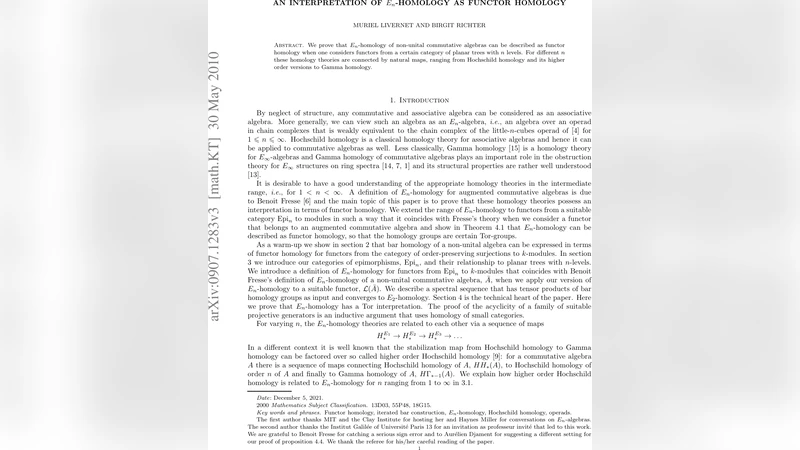
We prove that E_n-homology of non-unital commutative algebras can be described as functor homology when one considers functors from a certain category of planar trees with n levels. For different n these homology theories are connected by natural maps, ranging from Hochschild homology and its higher order versions to Gamma homology.
💡 Research Summary
The paper establishes a conceptual bridge between Eₙ‑homology of non‑unital commutative algebras and functor homology by introducing a new categorical framework built from planar trees with n levels. After recalling the definition of Eₙ‑algebras and the classical construction of Eₙ‑homology via the bar construction of the Eₙ‑operad, the authors define a category 𝒯ₙ whose objects are planar rooted trees equipped with exactly n hierarchical layers. Morphisms in 𝒯ₙ are generated by elementary “pruning” and “grafting” operations that mirror the operadic composition in the Eₙ‑operad; consequently, each Eₙ‑structure on an algebra can be encoded as a functor from 𝒯ₙ to the category of modules over a ground ring k.
The central technical achievement is the identification of the left derived functors of the tensor product over 𝒯ₙ with the classical Eₙ‑homology groups. For a given non‑unital commutative algebra A, the authors construct a canonical functor F_A : 𝒯ₙ → Mod_k that assigns to each tree the appropriate tensor power of A dictated by the tree’s leaf configuration. They then consider the unit functor 𝟙 : 𝒯ₙ → Mod_k (which sends every object to the ground ring k) and compute the derived functors LₙTor^{𝒯ₙ}(𝟙, F_A). By building an explicit projective resolution of 𝟙 using free 𝒯ₙ‑modules, they prove that LₙTor^{𝒯ₙ}(𝟙, F_A) is naturally isomorphic to H_*^{Eₙ}(A), the Eₙ‑homology of A. The proof hinges on a “tree‑bar” correspondence: the classical Eₙ‑bar complex can be re‑interpreted as a chain complex of trees, and the differential coincides with the combinatorial differential arising from the morphisms in 𝒯ₙ.
A further significant contribution is the analysis of the natural maps linking homology theories for different values of n. The inclusion of categories 𝒯ₙ ↪ 𝒯_{n+1} (obtained by adding a trivial top level to each tree) induces restriction functors and, consequently, comparison maps ι_n : H_^{Eₙ}(A) → H_^{E_{n+1}}(A). These maps recover the well‑known transition morphisms between Hochschild homology (n = 1), higher‑order Hochschild homology (n = 2), and Γ‑homology (the stable limit as n → ∞). In particular, the authors verify that for n = 1 the construction reproduces the classical Hochschild complex, while for n = 2 it yields the Pirashvili‑Waldhausen higher‑order Hochschild complex. As n grows, the homology stabilizes and coincides with Γ‑homology, thereby providing a unified perspective on these seemingly disparate invariants.
The paper also discusses computational advantages of the functor‑homology viewpoint. Since Tor over 𝒯ₙ can be calculated using standard homological algebra tools (spectral sequences, change‑of‑rings theorems, etc.), one can avoid the intricate combinatorics of the original Eₙ‑bar construction. Moreover, the tree‑based model makes explicit the role of symmetric group actions and reveals hidden filtrations that give rise to spectral sequences converging to Eₙ‑homology. The authors illustrate the method with concrete examples, showing how to recover known results and obtain new calculations for specific algebras.
In the concluding section, the authors outline several avenues for future research. They suggest extending the framework to non‑commutative Eₙ‑algebras, investigating co‑homology theories (Ext over 𝒯ₙ), and exploring connections with topological Eₙ‑spaces via operadic Koszul duality. They also propose studying the interaction between the tree‑category and other combinatorial models such as dendroidal sets, which may lead to a deeper understanding of the homotopical nature of Eₙ‑structures.
Overall, the paper provides a powerful and elegant reinterpretation of Eₙ‑homology, situating it firmly within the well‑developed theory of functor homology, and unifies a spectrum of homology theories under a single combinatorial framework.
Comments & Academic Discussion
Loading comments...
Leave a Comment