The cyclic theory of Hopf algebroids
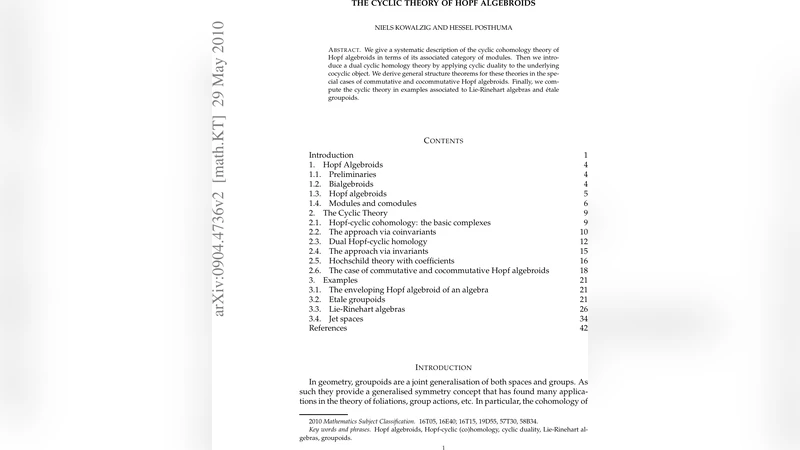
We give a systematic description of the cyclic cohomology theory of Hopf algebroids in terms of its associated category of modules. Then we introduce a dual cyclic homology theory by applying cyclic duality to the underlying cocyclic object. We derive general structure theorems for these theories in the special cases of commutative and cocommutative Hopf algebroids. Finally, we compute the cyclic theory in examples associated to Lie-Rinehart algebras and 'etale groupoids.
💡 Research Summary
The paper develops a unified cyclic (co)homology theory for Hopf algebroids by working directly in the category of modules over a Hopf algebroid (\mathcal{H}). Starting from the basic data—a base algebra (A), the source and target maps, the coproduct, counit and antipode—the authors construct a cocyclic object (C^{\bullet}(\mathcal{H})) whose (n)-th term is the ((n+1))-fold tensor product (\mathcal{H}^{\otimes_A (n+1)}). The coface, codegeneracy and cyclic operators are defined using the coproduct and the diagonal map, and a careful verification shows that they satisfy the standard cocyclic identities. This construction is intrinsic to the module category: it does not rely on any external resolution or bar construction, but rather on the internal algebraic structure of (\mathcal{H}).
Having obtained a cocyclic object, the authors apply Connes’ cyclic duality functor to produce a cyclic object (C_{\bullet}(\mathcal{H})). The resulting cyclic complex provides a homology theory that is formally dual to the previously defined cohomology. The paper proves that this homology coincides with the Hopf‑cyclic homology introduced by Connes‑Moscovici when (\mathcal{H}) is a Hopf algebra, and that the duality is natural with respect to morphisms of Hopf algebroids.
The next part of the work focuses on two important special cases. When (\mathcal{H}) is commutative as an (A)-algebra, the base algebra (A) sits in the centre, and the cocyclic structure reduces to a Hochschild‑Kostant‑Rosenberg type description. In this setting the cyclic (co)homology can be computed via the de Rham complex of the underlying smooth algebra, and the augmentation map yields a simple spectral sequence that collapses at the (E^2)-page. Conversely, when (\mathcal{H}) is cocommutative, the coproduct is symmetric, which forces the cyclic operator to be trivial up to homotopy. The authors prove a structure theorem showing that the cyclic homology of a cocommutative Hopf algebroid agrees with the ordinary cyclic homology of the underlying Hopf algebra, thereby recovering known results for group algebras and enveloping algebras.
To illustrate the theory, two concrete families of examples are worked out in detail. The first concerns Lie–Rinehart algebras ((A,L)). The universal enveloping algebroid (\mathcal{U}(A,L)) is a Hopf algebroid whose module category is equivalent to the category of (L)-connections on (A)-modules. The authors show that the cocyclic complex for (\mathcal{U}(A,L)) is canonically isomorphic to the Chevalley–Eilenberg complex computing Lie–Rinehart cohomology, and that the resulting cyclic cohomology recovers the de Rham cohomology of the associated foliation. The second family of examples involves étale groupoids (\mathcal{G}) acting on a smooth manifold (M). The crossed product Hopf algebroid (C^{\infty}(M)\rtimes \mathcal{G}) encodes the groupoid action, and its cyclic homology is identified with the cyclic homology of the classifying space (B\mathcal{G}). This identification uses the fact that étale groupoids have locally constant isotropy, allowing a reduction to the groupoid’s nerve and the standard cyclic complex of a simplicial set.
The final section discusses implications and future directions. By grounding cyclic (co)homology in the module category, the paper opens the way to apply these invariants in noncommutative geometry, deformation quantization, and the study of quantum symmetries where Hopf algebroids naturally appear. The structure theorems for commutative and cocommutative cases provide computational tools that can be adapted to more general settings, such as Hopf algebroids arising from Poisson manifolds or from stacks. Moreover, the explicit calculations for Lie–Rinehart algebras and étale groupoids demonstrate that the theory is not merely abstract but yields concrete invariants that connect with classical geometric cohomology theories. In summary, the work delivers a coherent, duality‑respecting cyclic theory for Hopf algebroids, establishes its compatibility with known special cases, and showcases its applicability through detailed examples, thereby laying a solid foundation for further exploration of cyclic phenomena in the broader landscape of algebraic and differential structures.
Comments & Academic Discussion
Loading comments...
Leave a Comment