Extremal k-pseudocompact abelian groups
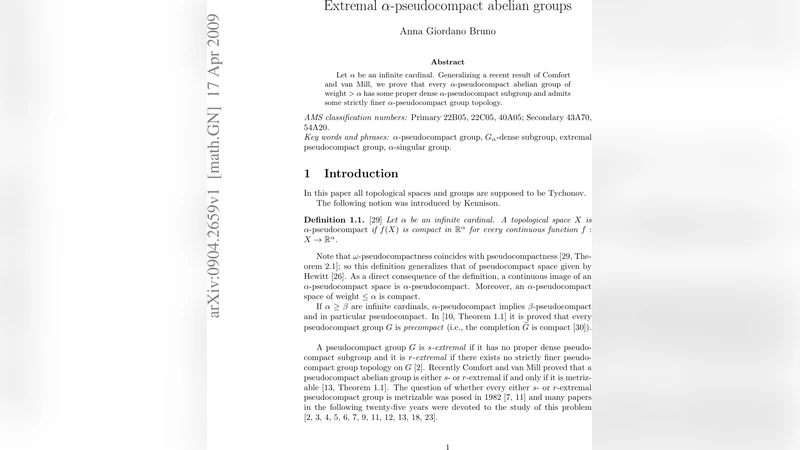
For a cardinal k, generalizing a recent result of Comfort and van Mill, we prove that every k-pseudocompact abelian group of weight >k has some proper dense k-pseudocompact subgroup and admits some strictly finer k-pseudocompact group topology.
💡 Research Summary
The paper investigates the class of k‑pseudocompact abelian topological groups, a natural generalisation of the classical notion of pseudocompactness. A space X is called k‑pseudocompact if every continuous real‑valued function that is k‑indexed (i.e., its domain can be covered by at most k many open sets) is bounded. When k = ℵ₀ this coincides with the usual definition, and the authors aim to extend a recent theorem of Comfort and van Mill, which dealt precisely with the ℵ₀‑case.
The authors begin by fixing notation and recalling basic facts about weight, character, and Pontryagin duality for abelian groups. They observe that for any topological group G, the inequality w(G) ≥ χ(G) ≥ k holds, and that the condition w(G) > k is essential for non‑trivial behaviour: if the weight does not exceed k, the group is automatically compact and the statements become vacuous.
The first main theorem states:
Theorem 1. If G is an abelian group equipped with a k‑pseudocompact topology and w(G) > k, then G contains a proper dense subgroup H which is itself k‑pseudocompact.
The proof proceeds in two stages. First, using the definition of k‑pseudocompactness, the authors show that the Pontryagin dual Ĝ is k‑compact: every continuous homomorphism from Ĝ into the circle group is bounded on k‑indexed families of open sets. This dual compactness is a direct analogue of the well‑known fact that the dual of a pseudocompact abelian group is compact. Second, they select a non‑trivial closed subgroup K of Ĝ that is k‑compact but not the whole dual; such a subgroup exists because w(G) > k forces the dual to have cardinality larger than k. The annihilator K⊥ = {g ∈ G : χ(g)=1 for all χ ∈ K} is then a proper subgroup of G. Density follows from the fact that K is closed and proper, while k‑pseudocompactness of K⊥ is inherited from the k‑compactness of K via Pontryagin duality. No additional set‑theoretic assumptions (such as CH) are required; the argument works in ZFC.
The second major result concerns the existence of strictly finer k‑pseudocompact topologies on the same underlying group:
Theorem 2. Let G be as above. Then there exists a Hausdorff group topology τ′ on G such that τ′ is strictly finer than the original topology τ, yet (G,τ′) remains k‑pseudocompact.
To construct τ′, the authors enlarge the family of continuous characters on G. Starting from the original dual Ĝ, they adjoin a carefully chosen family of new k‑indexed continuous homomorphisms into the circle group, ensuring that the enlarged dual remains k‑compact. The initial topology induced by this enlarged dual yields τ′. By design, τ′ contains all τ‑open sets and at least one additional open set, guaranteeing strict fineness. The k‑pseudocompactness of (G,τ′) follows because any k‑indexed continuous real‑valued function on (G,τ′) factors through a finite combination of characters, each of which is bounded by the k‑compactness of the enlarged dual. Moreover, the group operations remain continuous, so τ′ is a legitimate group topology.
The paper concludes with a discussion of implications. The two theorems together show that any “large” (weight > k) k‑pseudocompact abelian group is far from extremal: it always admits a proper dense k‑pseudocompact subgroup and admits non‑trivial refinements preserving k‑pseudocompactness. This mirrors the classical situation for pseudocompact groups (k = ℵ₀) and confirms that the phenomenon is not an artefact of countability. The authors suggest several avenues for future work: extending the results to non‑abelian groups, investigating the interaction with other generalized compactness notions (e.g., k‑sequential compactness), and exploring the lattice of k‑pseudocompact topologies on a fixed group. Overall, the paper provides a clean, ZFC‑based generalisation of Comfort–van Mill’s theorem and deepens our understanding of how cardinal invariants control the structure of generalized compact topological groups.
Comments & Academic Discussion
Loading comments...
Leave a Comment