A graph $G$ with a list of colors $L(v)$ and weight $w(v)$ for each vertex $v$ is $(L,w)$-colorable if one can choose a subset of $w(v)$ colors from $L(v)$ for each vertex $v$, such that adjacent vertices receive disjoint color sets. In this paper, we give necessary and sufficient conditions for a weighted path to be $(L,w)$-colorable for some list assignments $L$. Furthermore, we solve the problem of the free-choosability of a cycle.
Deep Dive into Choosability of a weighted path and free-choosability of a cycle.
A graph $G$ with a list of colors $L(v)$ and weight $w(v)$ for each vertex $v$ is $(L,w)$-colorable if one can choose a subset of $w(v)$ colors from $L(v)$ for each vertex $v$, such that adjacent vertices receive disjoint color sets. In this paper, we give necessary and sufficient conditions for a weighted path to be $(L,w)$-colorable for some list assignments $L$. Furthermore, we solve the problem of the free-choosability of a cycle.
The concept of choosability of a graph, also called list coloring, has been introduced by Vizing in [16], and independently by Erdős, Rubin and Taylor in [5]. It contains of course the colorability as a particular case. Since its introduction, choosability has been extensively studied (see for example [1,3,14,15,7] and more recently [8,9]). Even for the original (unweighted) version, the problem proves to be difficult, and is NP-complete for very restricted graph classes. Existing results for the weighted version mainly concern the case of constant weights (i.e. (a, b)-choosability), see [1,5,8,15]. For the coloring problem of weighted graphs, quite a little bit more is known, see [13,10,11,12].
This paper considers list colorings of weighted graphs by studying conditions on the list assignment for a weighted path to be choosable. Starting from the idea that in a path, the lists of colors of non consecutive vertices do not interfere, and following the work in [6], we introduce here the notion of a waterfall list assignment of a weighted path. It is a list assignment such that any color is present only on one list or on two lists of consecutive vertices. We show that any list assignment (with some additional properties) can be transformed into a similar waterfall list assignment. Then, using the result of Cropper et al. [4] about Hall’s condition for list multicoloring, we prove a necessary and sufficient condition for a weighted path with a given waterfall list L to be (L, w)-colorable (Theorem 9) and use it to derive (L, w)-colorability results for some general lists assignments.
In 1996, Voigt considered the following problem: let G be a graph and L a list assignment and assume that an arbitrary vertex v ∈ V (G) is precolored by a color f ∈ L(v). Is it always possible to complete this precoloring to a proper list coloring ? This question leads to the concept of free-choosability introduced by Voigt in [17].
We investigate here the free-choosability of the first interesting case, namely the cycle. As an application of Theorem 9, we prove our second main result which gives a necessary and sufficient condition for a cycle to be (a, b)-free-choosable (Theorem 12). In order to get a concise statement, we introduce the free-choice ratio of a graph, in the same way that Alon, Tuza and Voigt in [1] introduced the choice ratio (which equals the so-called fractional chromatic number).
In addition to the results obtained in this paper, the study of waterfall lists may be of more general interest. For now on, the method is extended in [2] to be used in a reduction process, allowing to prove colorability results on triangle-free induced subgraphs of the triangular lattice.
We recall in Section 2 some definitions related to choosability and freechoosability and introduce the definitions of the similarity between two lists and of a waterfall list that are fundamental for this paper. In Section 3, we show how to transform a list into a similar waterfall list and present a necessary and sufficient condition for a weigthed path to be choosable. Theses result are used in Section 4 to obtain conditions for the (L, w)colorability of a weighted path and for the (a, b)-free-choosability of a cycle.
Let G = (V (G), E(G)) be a graph where V (G) is the set of vertices and E(G) is the set of edges, and let a, b, n and e be integers.
Let w be a weight function of G i.e. a map w : V (G) → N and let L be a list assignment of G i.e. a map L : V (G) → P(N). By abuse of language and to simplify, we will just call L a list. If A is a finite set, we denote by |A| the cardinal of A.
A weighted graph (G, w) is a graph G together with a weight function w of G.
Let us recall the definitions of an (L, w)-colorable graph and an (a, b)free-choosable graph which are essential in this paper. Definition 1. An (L, w)-coloring c of a graph G is a map that associate to each vertex v exactly w(v) colors from L(v) such that adjacent vertices receive disjoints color sets, i.e. for all v ∈ V (G):
and for all vv
We say that G is (L, w)-colorable if there exists an (L, w)-coloring c of G.
Particular cases of (L, w)-colorability are of great interest. In order to introduce them, we define (L, b)-colorings and a-lists. We define now the similarity of two lists with respect to a weighted graph: Definition 4. Let (G, w) be a weighted graph. Two lists L and L ′ are said to be similar if this assertion is true:
The path P n+1 of length n is the graph with vertex set
By analogy with the flow of water in waterfalls, we define a waterfall list as follows:
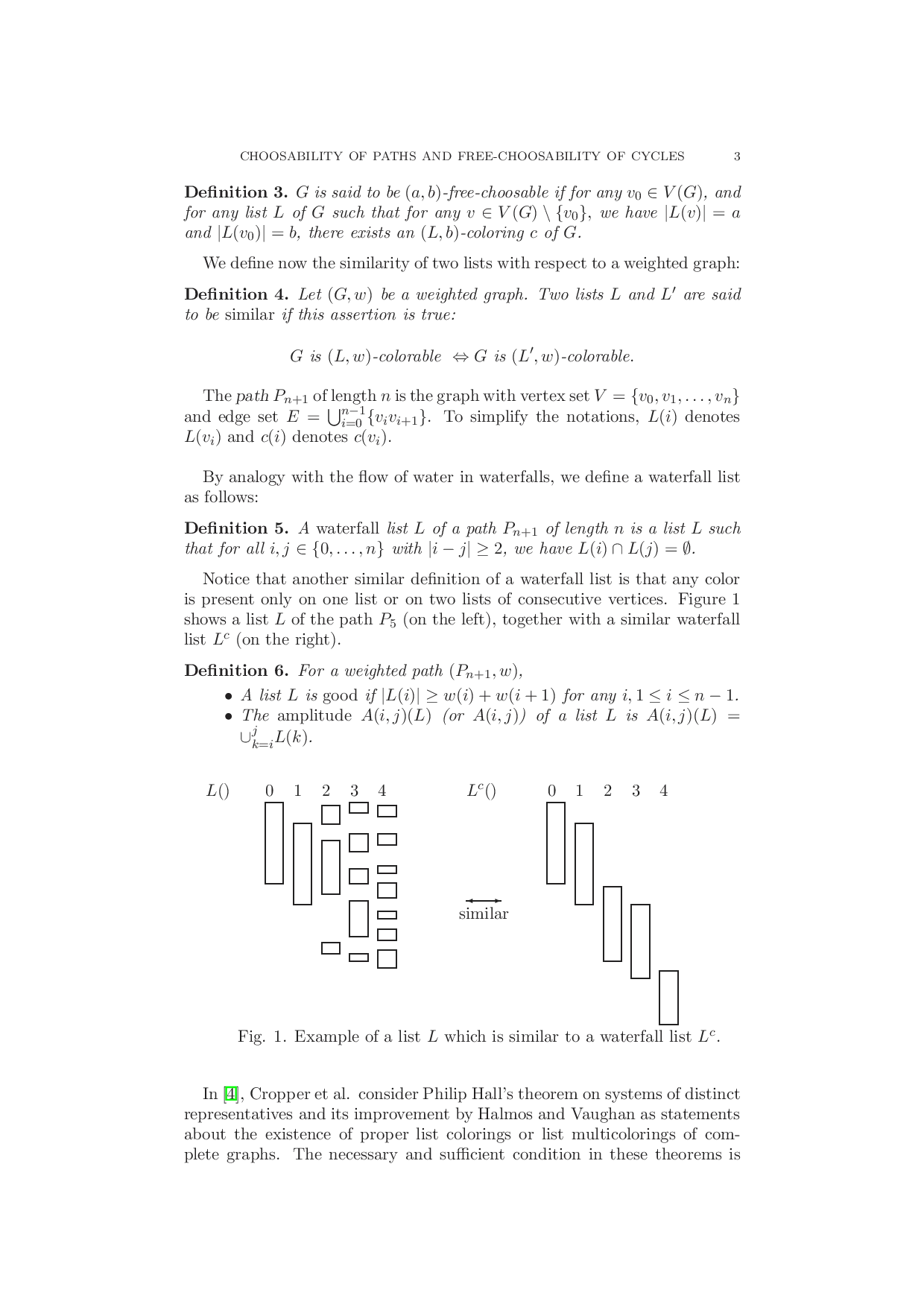
Notice that another similar definition of a waterfall list is that any color is present only on one list or on two lists of consecutive vertices. Figure 1 shows a list L of the path P 5 (on the left), together with a similar waterfall list L c (on the right). Definition 6. For a weighted path (P n+1 , w),
•
Fig. 1. Example of a list L which is similar to a waterfall list L c .
In [4], Cropper et al
…(Full text truncated)…
This content is AI-processed based on ArXiv data.