This article discusses the limits of the Anthropogenic Global Warming Theory advocated by the Intergovernmental Panel on Climate Change. A phenomenological theory of climate change based on the physical properties of the data themselves is proposed. At least 60% of the warming of the Earth observed since 1970 appears to be induced by natural cycles which are present in the solar system. A climatic stabilization or cooling until 2030-2040 is forecast by the phenomenological model.
Deep Dive into Climate Change and Its Causes, A Discussion About Some Key Issues.
This article discusses the limits of the Anthropogenic Global Warming Theory advocated by the Intergovernmental Panel on Climate Change. A phenomenological theory of climate change based on the physical properties of the data themselves is proposed. At least 60% of the warming of the Earth observed since 1970 appears to be induced by natural cycles which are present in the solar system. A climatic stabilization or cooling until 2030-2040 is forecast by the phenomenological model.
Climate Change and Its Causes
A Discussion About Some Key Issues
Nicola Scafetta 1,2
1Active Cavity Radiometer Irradiance Monitor (ACRIM) Lab, Coronado, CA 92118, USA
2Department of Physics, Duke University, Durham, NC 27708, USA.
Abstract
This article discusses the limits of the Anthropogenic Global Warming Theory advocated by the Intergov-
ernmental Panel on Climate Change. A phenomenological theory of climate change based on the physical
properties of the data themselves is proposed. At least 60% of the warming of the Earth observed since 1970
appears to be induced by natural cycles which are present in the solar system. A climatic stabilization or
cooling until 2030-2040 is forecast by the phenomenological model.
***************************************************************************************
This work is made of
• An translation into English of the paper:
Scafetta N., “Climate Change and Its causes: A
Discussion about Some Key Issues,” La Chimica
e l’Industria 1, p. 70-75 (2010);
• Several additional supporting notes are added to the
paper;
• An extended appendix section part is added to cover
several thematic issues to support particular topics
addressed in the main paper. (not in this preprint)
This work covers most topics presented by Scafetta at a seminar at the U.S. Environmental Protection Agency, DC
USA, February 26, 2009. A video of the seminar is here:
http://yosemite.epa.gov/ee/epa/eed.nsf/vwpsw/360796B06E48EA0485257601005982A1#video
Cite as:
Scafetta N., “Climate Change and Its causes: A Discussion about Some Key Issues,” La Chimica e l’Industria
1, p. 70-75 (2010).
The full English version with the appendixes can be downloaded from
http://scienceandpublicpolicy.org/originals/climate change causes.html
The Italian version of the original paper can be downloaded (with possible journal restrictions) from
http://www.soc.chim.it/files/chimind/pdf/2010/2010 1 70.pdf
Preprint submitted to Science & Public Policy (SPPI)
October 22, 2018
arXiv:1003.1554v1 [physics.geo-ph] 8 Mar 2010
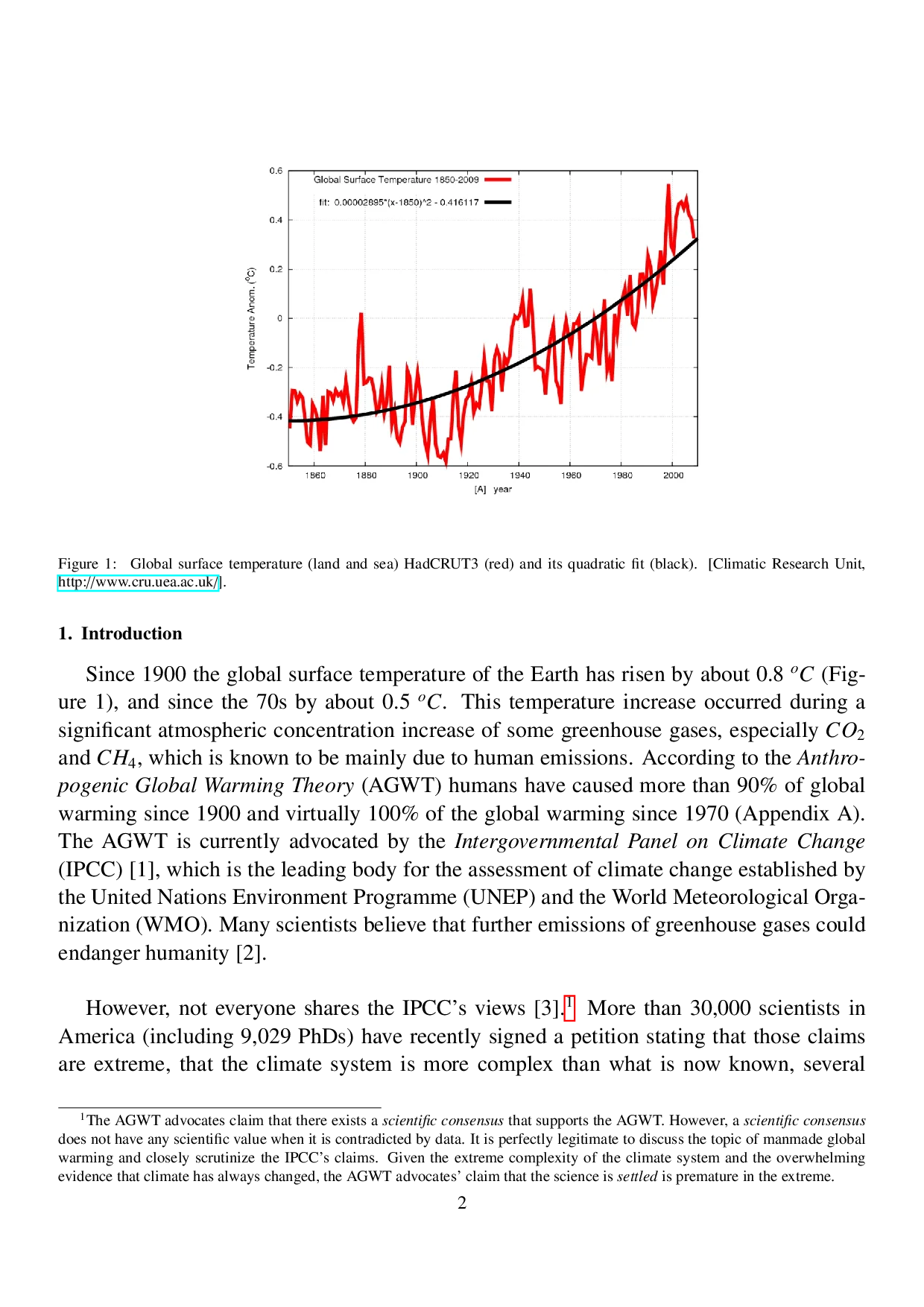
Figure 1:
Global surface temperature (land and sea) HadCRUT3 (red) and its quadratic fit (black). [Climatic Research Unit,
http://www.cru.uea.ac.uk/].
1. Introduction
Since 1900 the global surface temperature of the Earth has risen by about 0.8 oC (Fig-
ure 1), and since the 70s by about 0.5 oC. This temperature increase occurred during a
significant atmospheric concentration increase of some greenhouse gases, especially CO2
and CH4, which is known to be mainly due to human emissions. According to the Anthro-
pogenic Global Warming Theory (AGWT) humans have caused more than 90% of global
warming since 1900 and virtually 100% of the global warming since 1970 (Appendix A).
The AGWT is currently advocated by the Intergovernmental Panel on Climate Change
(IPCC) [1], which is the leading body for the assessment of climate change established by
the United Nations Environment Programme (UNEP) and the World Meteorological Orga-
nization (WMO). Many scientists believe that further emissions of greenhouse gases could
endanger humanity [2].
However, not everyone shares the IPCC’s views [3].1 More than 30,000 scientists in
America (including 9,029 PhDs) have recently signed a petition stating that those claims
are extreme, that the climate system is more complex than what is now known, several
1The AGWT advocates claim that there exists a scientific consensus that supports the AGWT. However, a scientific consensus
does not have any scientific value when it is contradicted by data. It is perfectly legitimate to discuss the topic of manmade global
warming and closely scrutinize the IPCC’s claims. Given the extreme complexity of the climate system and the overwhelming
evidence that climate has always changed, the AGWT advocates’ claim that the science is settled is premature in the extreme.
2
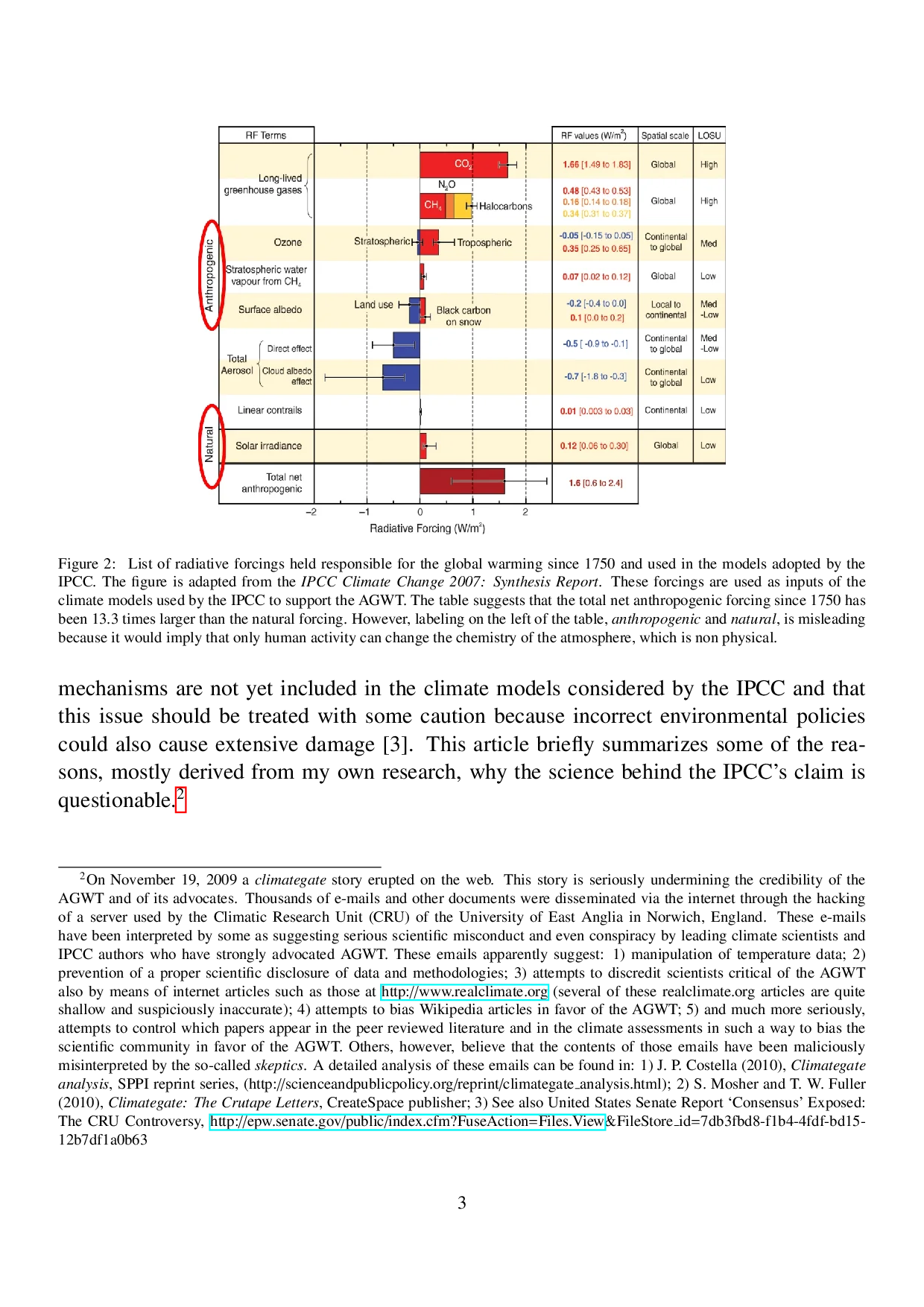
Figure 2: List of radiative forcings held responsible for the global warming since 1750 and used in the models adopted by the
IPCC. The figure is adapted from the IPCC Climate Change 2007: Synthesis Report. These forcings are used as inputs of the
climate models used by the IPCC to support the AGWT. The table suggests that the total net anthropogenic forcing since 1750 has
been 13.3 times larger than the natural forcing. However, labeling on the left of the table, anthropogenic and natural, is misleading
because it would imply that only human activity can change the chemistry of the atmosphere, which is non physical.
mechanisms are not yet included in the climate models considered by the IPCC and that
this issue should be treated with some caution because incorrect environmental policies
could also cause extensive damage [3]. This article briefly summarizes some of the rea-
sons, mostly derived from my own research, why the science behind the IPCC’s claim is
questionable.2
2On November 19, 2009 a climategate story erupted on the web. This story is seriously undermining the credibility of the
AGWT and of its advocates. Thousands of e-mails and oth
…(Full text truncated)…
This content is AI-processed based on ArXiv data.