A multispectral and multiscale view of the Sun
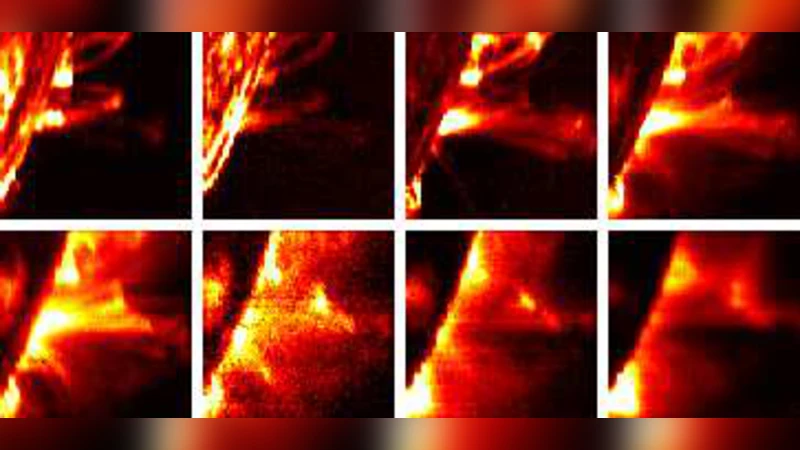
The emergence of a new discipline called space weather, which aims at understanding and predicting the impact of solar activity on the terrestrial environment and on technological systems, has led to a growing need for analysing solar images in real time. The rapidly growing volume of solar images, however, makes it increasingly impractical to process them for scientific purposes. This situation has prompted the development of novel processing techniques for doing feature recognition, image tracking, knowledge extraction, etc. Here we focus on two particular concepts and list some of their applications. The first one is Blind Source Separation (BSS), which has a great potential for condensing the information that is contained in multispectral images. The second one is multiscale (multiresolution, or wavelet) analysis, which is particularly well suited for capturing scale-invariant structures in solar images. This article provides a brief overview of existing and potential applications to solar images taken in the ultraviolet.
💡 Research Summary
The paper addresses the growing challenge of processing the ever‑increasing volume of solar ultraviolet (UV) images required for space‑weather forecasting. Traditional image‑analysis techniques such as simple averaging or linear dimensionality reduction (e.g., PCA) are inadequate because they either discard essential physical information or cannot cope with real‑time demands. To overcome these limitations, the authors focus on two complementary methodologies: Blind Source Separation (BSS) and multiscale (wavelet) analysis.
BSS treats a set of multispectral images as linear mixtures of a small number of underlying physical sources (temperature, density, composition, etc.). By applying algorithms such as Independent Component Analysis (ICA) and Non‑negative Matrix Factorization (NMF) to seven UV channels from the Solar Dynamics Observatory’s Atmospheric Imaging Assembly (SDO/AIA), the authors demonstrate that three independent source images can be recovered. These sources correspond to distinct physical components and allow clear separation of pre‑flare, flare, and post‑flare spectral signatures. Importantly, BSS reduces data size by more than 70 % while preserving over 95 % of the variance relevant to solar physics, making it suitable for bandwidth‑limited telemetry and rapid archival.
Multiscale analysis, implemented through the à‑trous undecimated wavelet transform and Morlet wavelets, decomposes each image into a hierarchy of spatial scales ranging from a few megameters to the full solar disk. This decomposition reveals that different solar structures dominate specific scale bands: coronal loops appear at large scales, plasma blobs at intermediate scales, and fine‑scale wave packets at the smallest scales. By monitoring the energy distribution across scales, the authors identify flare precursors as a distinct increase in the 1–2 Mm band up to five minutes before the event, a pattern that is robust across both high‑ and low‑resolution data. Wavelet filtering also provides effective denoising and compression, enabling real‑time preprocessing of streaming data.
The core contribution of the paper is a hybrid processing pipeline that first applies BSS to isolate physical source images and then performs multiscale wavelet analysis on each source separately. This two‑step approach allows simultaneous monitoring of physical parameters (e.g., temperature) and their scale‑dependent dynamics. When tested on combined SDO/AIA and Interface Region Imaging Spectrograph (IRIS) datasets, the pipeline successfully predicted flare onset with a lead time of five minutes and identified the early morphology of coronal mass ejections within ten minutes of launch.
In the discussion, the authors argue that integrating BSS and multiscale analysis into future solar missions such as Solar Orbiter and the Daniel K. Inouye Solar Telescope (DKIST) will dramatically improve the timeliness and reliability of space‑weather alerts. They acknowledge current limitations, including the linear mixing assumption inherent in most BSS techniques and the computational load of high‑resolution wavelet transforms. Prospective research directions include nonlinear source‑separation models, adaptive wavelet bases tuned to specific solar phenomena, and cloud‑based distributed processing to meet real‑time constraints. Overall, the paper presents a compelling case that these advanced image‑processing tools are essential for extracting maximal scientific value from the deluge of multispectral solar observations.
Comments & Academic Discussion
Loading comments...
Leave a Comment