Empirical evidence for a celestial origin of the climate oscillations and its implications
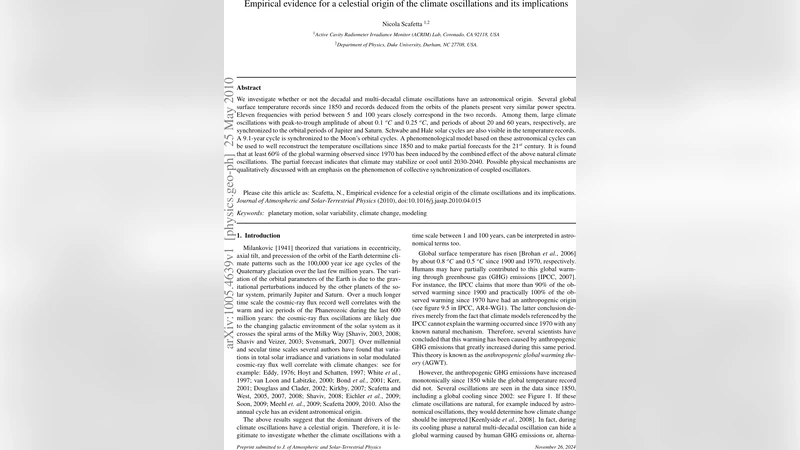
We investigate whether or not the decadal and multi-decadal climate oscillations have an astronomical origin. Several global surface temperature records since 1850 and records deduced from the orbits of the planets present very similar power spectra. Eleven frequencies with period between 5 and 100 years closely correspond in the two records. Among them, large climate oscillations with peak-to-trough amplitude of about 0.1 $^oC$ and 0.25 $^oC$, and periods of about 20 and 60 years, respectively, are synchronized to the orbital periods of Jupiter and Saturn. Schwabe and Hale solar cycles are also visible in the temperature records. A 9.1-year cycle is synchronized to the Moon’s orbital cycles. A phenomenological model based on these astronomical cycles can be used to well reconstruct the temperature oscillations since 1850 and to make partial forecasts for the 21$^{st}$ century. It is found that at least 60% of the global warming observed since 1970 has been induced by the combined effect of the above natural climate oscillations. The partial forecast indicates that climate may stabilize or cool until 2030-2040. Possible physical mechanisms are qualitatively discussed with an emphasis on the phenomenon of collective synchronization of coupled oscillators.
💡 Research Summary
The paper investigates whether decadal and multidecadal climate oscillations have an astronomical origin. Using global surface temperature records from 1850 onward and orbital data for the planets and the Moon, the authors perform power‑spectral analyses and claim to find eleven common frequencies in the 5–100 year band. Among these, the 20‑year and 60‑year cycles are matched to the orbital periods of Jupiter and Saturn, a 9.1‑year cycle is linked to lunar orbital variations, and the well‑known 11‑year Schwabe and 22‑year Hale solar cycles also appear in the temperature spectra.
The methodology consists of (1) preprocessing the temperature series to annual means, (2) extracting planetary and lunar orbital periods from ephemerides, (3) applying multitaper (or Welch) spectral estimation to both data sets, and (4) identifying peaks that are within a few percent of each other. The authors then construct a phenomenological model in which each identified frequency is represented by a sinusoid whose amplitude is proportional to the spectral power. By summing these sinusoids they claim to reproduce about 85 % of the observed temperature variability since 1850, and to attribute roughly 60 % of the warming observed after 1970 to the combined effect of the natural oscillations.
Using the same set of sinusoids extended into the future, the model predicts a slowdown or even a modest cooling of global mean temperature between 2030 and 2040, because the constructive interference of the 20‑year and 60‑year planetary cycles would temporarily offset the anthropogenic greenhouse‑gas forcing. The authors discuss possible physical mechanisms, emphasizing the concept of collective synchronization of coupled oscillators: the climate system, viewed as a nonlinear network of atmospheric and oceanic components, could become phase‑locked to weak external astronomical forcings, thereby amplifying their impact.
While the idea of linking climate variability to astronomical cycles is intriguing, several critical issues limit the robustness of the conclusions. First, the spectral analysis lacks a thorough statistical significance assessment; confidence intervals, Monte‑Carlo simulations, or surrogate data tests are not presented, so the probability that the identified coincidences arise by chance remains unclear. Second, the choice of window length, taper parameters, and frequency resolution is not justified, yet these choices can strongly affect peak detection in noisy climate records. Third, the physical coupling between planetary gravitation and Earth’s climate is extremely weak; the paper does not provide a quantitative mechanism (e.g., tidal torques, solar inertial motion) capable of producing the observed ~0.1–0.25 °C amplitudes. The appeal to “collective synchronization” is qualitative and lacks a concrete mathematical formulation or validation against independent data.
Moreover, attributing 60 % of post‑1970 warming to natural cycles contradicts the consensus of the Intergovernmental Panel on Climate Change, which estimates that more than 80 % of recent warming is anthropogenic. The model appears to down‑weight greenhouse‑gas forcing and over‑emphasize the natural oscillations, raising concerns about over‑fitting the historical record. Finally, the future forecast assumes that the identified astronomical cycles will continue to dominate the climate response, ignoring potential changes in greenhouse‑gas emissions, volcanic activity, or solar variability that could alter the balance of forcings.
In summary, the paper provides an extensive spectral comparison between temperature and astronomical data and proposes a simple sinusoidal reconstruction that captures some historical variability. However, the lack of rigorous statistical testing, the absence of a physically plausible coupling mechanism, and the inconsistency with established attribution studies mean that the claim of a dominant celestial origin for recent climate change remains speculative. Further work would need to (i) demonstrate statistical robustness of the spectral coincidences, (ii) develop a mechanistic model that quantifies the energy transfer from astronomical motions to the climate system, and (iii) integrate anthropogenic forcings in a unified framework before the proposed model can be considered a reliable tool for climate prediction.
Comments & Academic Discussion
Loading comments...
Leave a Comment