An infinite combinatorial statement with a poset parameter
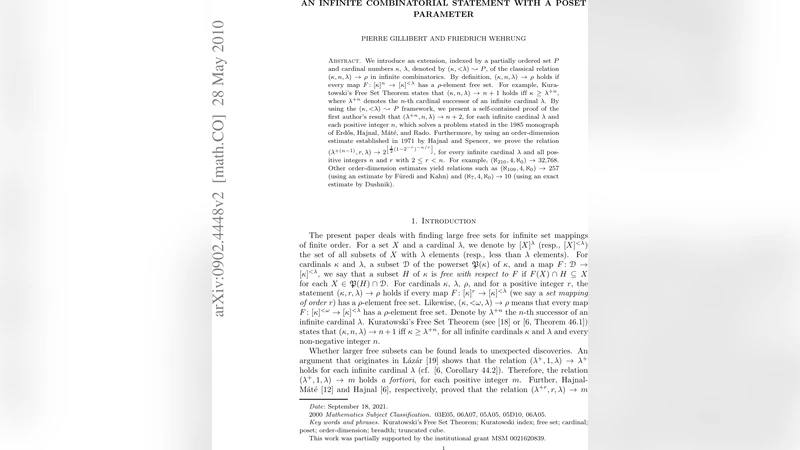
We introduce an extension, indexed by a partially ordered set P and cardinal numbers k,l, denoted by (k,l)–>P, of the classical relation (k,n,l)–> r in infinite combinatorics. By definition, (k,n,l)–> r holds, if every map from the n-element subsets of k to the subsets of k with less than l elements has a r-element free set. For example, Kuratowski’s Free Set Theorem states that (k,n,l)–>n+1 holds iff k is larger than or equal to the n-th cardinal successor l^{+n} of the infinite cardinal k. By using the (k,l)–>P framework, we present a self-contained proof of the first author’s result that (l^{+n},n,l)–>n+2, for each infinite cardinal l and each positive integer n, which solves a problem stated in the 1985 monograph of Erd"os, Hajnal, Mate, and Rado. Furthermore, by using an order-dimension estimate established in 1971 by Hajnal and Spencer, we prove the relation (l^{+(n-1)},r,l)–>2^m, where m is the largest integer below (1/2)(1-2^{-r})^{-n/r}, for every infinite cardinal l and all positive integers n and r with r larger than 1 but smaller than n. For example, (\aleph_{210},4,\aleph_0)–>32,768. Other order-dimension estimates yield relations such as (\aleph_{109},4,\aleph_0)–> 257 (using an estimate by F"uredi and Kahn) and (\aleph_7,4,\aleph_0)–>10 (using an exact estimate by Dushnik).
💡 Research Summary
The paper introduces a novel generalization of the classical infinite combinatorial relation (k,n,l) → r by incorporating a partially ordered set (poset) P as a parameter, denoted (k,l) → P. In the traditional setting, a function f defined on the n‑element subsets of a cardinal k that assigns to each such subset a set of size < l is said to have an r‑element free set if there exists a subset A ⊆ k of size r such that for every X ⊆ A with |X| < n we have f(X)∩A = ∅. The new formulation replaces the numeric target r with the structural requirement that the collection of “forbidden” intersections respects the order structure of P. Concretely, (k,l) → P holds if for every map f:
Comments & Academic Discussion
Loading comments...
Leave a Comment