Dark radiation as a signature of dark energy
We propose a simple dark energy model with the following properties: the model predicts a late-time dark radiation component that is not ruled out by current observational data, but which produces a distinctive time-dependent equation of state w(z) f…
Authors: Sourish Dutta, Stephen D. H. Hsu, David Reeb
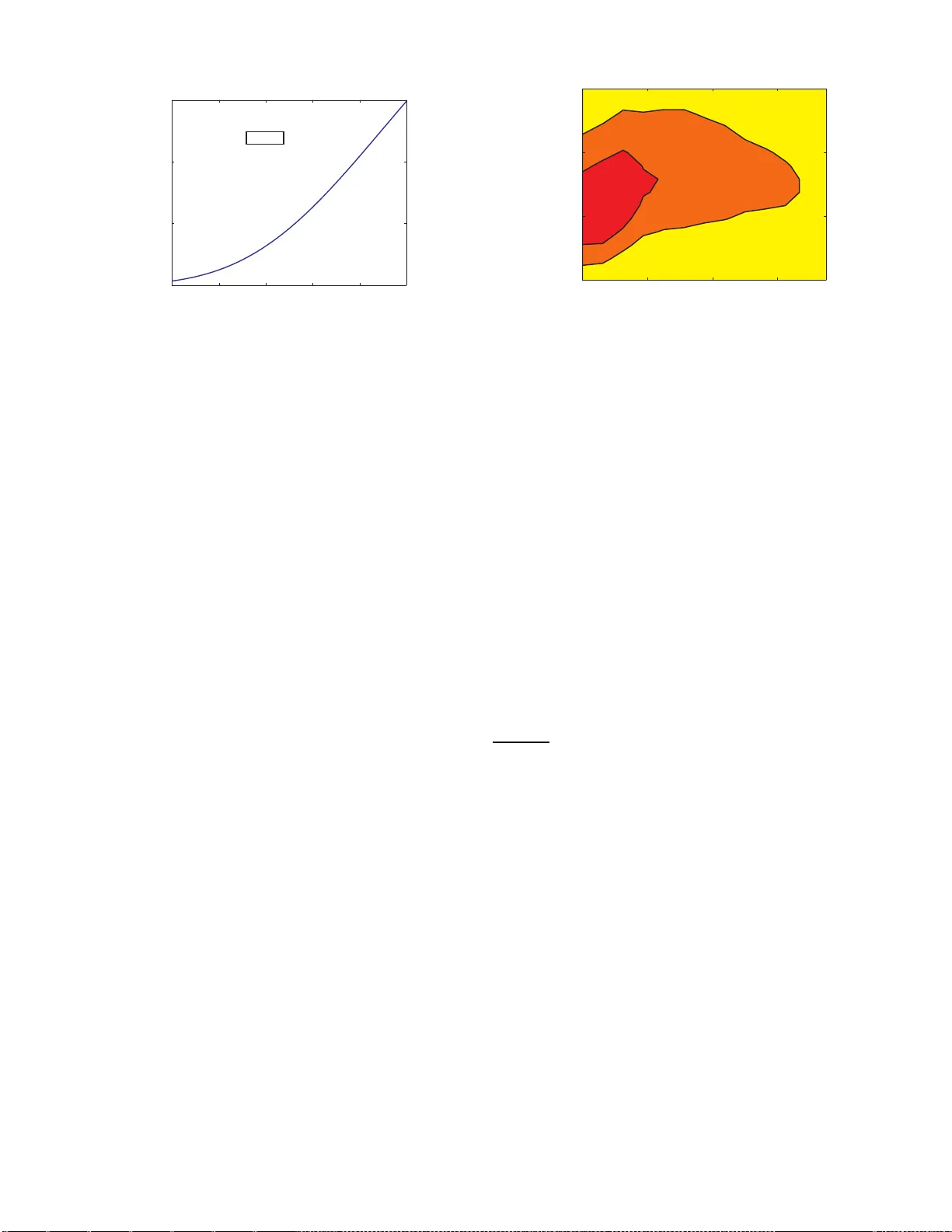
Dark radiation as a signa ture of dark energy Sourish Dutta, 1 , ∗ Stephen D. H. Hsu, 2 , † David Reeb, 2 , ‡ and Rober t J. Sc herrer 1 , § 1 Dep a rtment of Physics and Astr onomy, V and erbilt University, Nashvil le, TN 3723 5 2 Institute of The or etic al Scienc e, University of Or e gon, Eugen e, OR 97403-5203 (Dated: Ma y 6, 2009 ) W e prop ose a si mple dark energy mod el wi th the f ollo wing prop erties: the model predicts a late-time dark radiation comp onent that is not ruled out by curren t observa tional data, but which prod uces a d istinctive time-depend ent e quation of state w ( z ) for z < 3. The d ark energy field can b e coupled strongly en ough to Stand ard Model particles to b e detected in colli ders, and the mo del requires only mo dest add itional particle content and little or no fi ne-tuning other th an a new energy scale of order milli-electron volts . P A CS num bers: 95.36.+x 98.80.Cq I. INTRO DUCTION Considerable evidence [1, 2] has accumu lated sugg est- ing that approximately 70% of the energy density in the Universe co mes in the fo rm of an exotic, neg ative- pressure component, called dark energy . (F or a recent review, se e [3].) The equation of state (EoS) parameter is defined a s the ra tio of the dark ener gy pressur e to its density: w = p DE /ρ DE . (1) Observ a tions constrain w to b e very close to − 1. F or instance, if w is as sumed to b e consta nt, then necessar ily − 1 . 1 < ∼ w < ∼ − 0 . 9 [4, 5]. If w = − 1, the dark en- ergy dens it y r emains co ns tant even thoug h the Univ erse is expanding. The simplest way of pro ducing a w = − 1 comp onent is through a cosmological consta nt , or v ac- uum energy density . How ever, as is well known, the en- ergy density needed to explain the observed acce leration, ∆ 4 ≡ 10 − 3 eV 4 , is considera bly smaller than the v alue of 10 19 GeV 4 (Planck densit y) pre dic ted from quantum field theory . This 124- orders - of-magnitude discrepancy is called the cosmologica l co nstant pr oblem. The fact tha t the observed v acuum energy also hap- pens to be just a few times g r eater than the present mat- ter dens ity h as led to sp ecula tions that it might in fact be evolving with time – only now reaching a v alue com- parable to the matter density . Such a time-v arying v ac- uum ener gy is sometimes referred to as quintessenc e . The simplest wa y of ac hieving a time-v arying v a cuum energy is through the use of spatially homogeneous ca nonical scalar fields [6, 7, 8, 9 , 10]. In these mo dels, the field t ypically rolls down a very shallow potential, even tually coming to rest when it can find a lo ca l minimum. Quintessence mo dels typically hav e fine-tuning pro b- lems. F or example, since the quin tes sence redshifts ∗ Electronic address: souri sh.d@gmail.com † Electronic address: hsu@uoregon.edu ‡ Electronic address: dreeb@uoregon.edu § Electronic address: r ob ert.scherrer@v anderbilt.edu more slowly than or dinary matter or ra dia tion, the cur- rent quintessence dominance can only b e explained by fine-tuning the initial conditions . This pro ble m ca n be av o ided in the class of so-ca lled “tracker” mo dels, in which the evolution of the quintessence field is ins ensitive to the initial co nditions. F or ge ne r ic quintessence mo d- els, the flatness of the p otential makes an y excita tions of the field a lmost massless ∼ 10 − 33 eV. T o provide the necessary v acuum energy densit y , the pr esent v alue of the po tent ial energ y should b e on the order of ∆ 4 (although there is really no rigo rous physical reason to exp ect this). The field v alue φ 0 to day should therefore b e o n the or- der o f the P lanck mass, i.e. φ 0 ∼ 10 18 GeV. 1 In [1 7] it was shown that couplings b etw een q uin tessence and ordinary matter, even if Planck-suppressed, ca n lead to long rang e forces and time-dependence in the constants of Nature, both o f which are tightly constra ine d. Reference [18] s howed that ev en P lanck-suppressed thermal in terac- tions b etw een matter and quintessence can significantly alter the evolution of the latter, leading to a problema tic equation of state. An a lternative to a s lowly rolling field is a scenario where the field is stuck in a false v acuum minimum. In this case, the o bserved cosmological constant is at- tributed to the energ y difference betw e e n the fals e and true v a cua, which could either arise fro m higher- order [19, 20] or no n- pe r turbative effects [21]. Other pr op osals for the orig in of the false v acuum ener gy are the con- fining scale of a hidden S U (2) sector [22], Planck-scale suppressed mediation in to a hidden sec tor of electroweak T eV-scale sup ersy mmetry breaking [23, 24], or the v ac- uum energ y of a hidden sector which is stuck in a state of equilibrium betw een phas es [25]. In many of these quintessence mo dels, the field(s) re- sp onsible for the acceler ation have to b e a lmost com- 1 An al ternativ e class of mo dels which relies on non-linear oscill a- tions of the quintessence field and does not require an extremely flat p otent ial w as prop osed in [11, 12] and discussed further i n [13, 14, 15, 16]. 2 pletely decoupled from the r est of the Univ erse. 2 This is disappointing, since it suggests that direct detec tio n of quintessence throug h its in teractions with Standard Mo del particles will b e extremely challenging, per haps impo ssible. In this pa per we present a quintessence scenario in which the dark energ y field can b e coupled stro ngly enough to Sta ndard Mo del particles to be detected in col- liders, a nd which allows for a sig nificant time v ar iation in the equation of state. This time-v arying w = w ( z ) has a characteristic form which depe nds on only a single parameter, and ca n thus be exc luded by cosmolog ical ob- serv atio ns in the near future. Our mo del only requires a singlet sca la r field (or, a lternatively , a small g auge sector like S U (3) Y ang-Mills theory; other p ossible re alizations are also briefly outlined at the end o f the pap er) and a new ener gy scale on the or der of milli- electron volts. II. MODEL Consider a sing le t s c alar field dark energy with La - grangia n L = 1 2 ( ∂ µ φ ) 2 − V ( φ ) . (2) W e allo w this field to b e strongly c o upled to Standard Mo del particles. The finite temper ature effective p oten- tial, which includes interactions of this field with vir tual particles and the heat bath, can b e taken to b e similar to the Higgs potential in the electrow ea k phase tr ansition (see, e.g ., [27] for a re view): V ( φ, T ) = A + D T 2 − T 2 2 φ 2 − E T φ 3 + 1 4 λφ 4 . (3) D , E , λ and A are constants. A can b e adjusted to give the cor rect v alue of the observed dar k energ y den- sity when T = 0. T 2 is defined as the temper ature where V ′′ ( φ = 0) = 0. W e cho ose T 2 = ∆, i.e. roug hly T 2 ∼ 11 . 6 K, and ass ume that it represents a new ener gy scale in particle physics. At high temp eratures, T ≫ T 2 , φ = 0 is the only minimum of the p o ten tial. As the Universe co ols down, an inflection p oint app ears in the p otential at temper ature T ∗ = T 2 / p 1 − 9 E 2 / 8 λD . A t lower temp er- atures, this splits in to a barrier a nd a second minim um. The critical tempera ture T 1 = T 2 / p 1 − E 2 /λD co r re- sp onds to the p oint where the s econd minim um is equal in (free) energy to the φ = 0 minim um. A t tempe r atures T < T 1 , the s econd minim um has low er free ener gy than the one at φ = 0. The ev olution of the potential w ell with temp eratur e is shown in Fig. (1). 2 F or an en tir ely different t ype of dark energy model, whi c h can ha v e a particle ph ysics signature, see [26]. H er e the acce leration is provided b y mass- v arying neutrinos (MaV aNs) which act as a negativ e- pr essure fluid. φ V( φ ) T>T * T=T * T=T 1 T T 1 (whic h cor resp onds to roughly z > 3 ) the dark energy field r emains trapped at the φ = 0 minimum, pr oviding a constant ener gy density , which we ass ume to b e slightly higher than ∆ 4 . As the temper ature approaches T 1 and below, a firs t o r der phase transition is trig gered as the field tunnels into the true v acuum ∆. The ph ysics of the phas e tra nsition is almost ident ical to that of the Higgs sector in mo dels of e lec- trow eak baryogenesis. This transition releases energy in relativistic modes (i.e., s calar particles o f the φ field), and brings the v a cuum ener gy to ∆. Because the correlation length of the transition is micro scopic, and the r elativis- tic mo de s couple weakly to ordinar y matter (i.e., more weakly than photons, p erhaps similar to neutrino s ), such a transition is only lo o sely co nstrained b y o bs erv ation. The p ositive pressure of the ra diation, which eventu ally redshifts awa y , causes the effective EoS of the dark ener gy to v ar y in (redshift) time z . W e note that the only imp ortant feature of the mo del describ ed above is that it has a weakly first order phase transition a t a temp eratur e o f o rder ∆, which is natural if one assumes the dynamics of φ to be entirely determined by that energy scale and dimensionless couplings o f order one. It is an interesting coincidence that this o ccurs a t a redshift o f z ∼ 3 if the temperature of the dark ener gy field is similar to that of the Standa rd Mo del pa rticles. This need not be the ca se, but it seems a rea sonable assumption, esp ecially if there are non- negligible inter- actions b etw een φ and or dina ry particles , which would enforce therma l equilibrium a t sufficiently high tempera- tures. When the tra nsition happens at z ∼ 3 the r esult- ing radia tion comp onent lea ds to s ignificant and c harac- teristic v ariation in w ( z ). The form of w ( z ) is determined by a single par ameter – the energy fra ction in r elativistic dark radiation modes just a fter the phas e transition. In some ca ses, suc h as the gauge mo dels discussed b elow, even this fraction is calculable fro m the phase dia gram. An y secto r which pro duces a weakly first or der tran- 3 sition at a temp eratur e of order ∆ would also suffice. F or example, pure S U ( N ) gauge theories with N > 2 hav e first o rder deconfinement phas e transitions [2 8] and exhibit effective p otentials like tho s e in Fig. (1), with φ an order parameter for co nfinement , fo r exa mple the Poly ako v lo op. Her e, the latent heat and fraction of en- ergy in relativistic mo des is calcula ble via lattice sim ula- tion. W e stress that the mo dels discusse d do not in any way explain the existence of the energy sca le ∆, or why it determines the v acuum energy density today . In par- ticular, why should the v ac uum energies from all the other degr ees of freedom cancel out, leaving the dar k en- ergy field to determine the cosmolog ical constant? One wa y of explaining this w ould be to assume that some- where in the config uration space, outside the region de- picted in Fig . (1), the potential reaches a globa l mini- m um V ( φ ∗ ) = 0, where the total v acuum energ y (in- cluding zero p oint energies a nd r adiative c orrections from al l fields) is exactly zero. That is, s ome curren tly un- known mechanism (E uclidean wormholes, quantum gr av- it y , ...) cons pir es to make the total v acuum energy zer o at φ = φ ∗ , implying tha t the deviation of V ( φ ) from ze r o is the only v a cuum energy . In an y case, if one assumes that new physics at the energy scale ∆ determines the o bs erved cosmolo gical constant, it is easy to obtain a pr e dictable r e dshift- depe ndent w = w ( z ) together with interesting par ticle ph ysics signatures – no fine tuning of pa r ameters is re- quired. II I. OBSER V A TIONAL C ONSEQUENCES A. Astrophysics As discussed in the previous sectio n, our mo del pro- duces a c ertain amo un t of dar k radiation at r edshift z ∼ 3. This radiation affects the Hubble expansio n rate H as well as the effective equa tion of state of the da rk energy . Let f denote the fraction of the dark energ y that is to- day in the form of rela tivistic modes , and let us assume that the phase tra nsition o ccurr e d at reds hift z PT = 3. The Hubble ex pansion rate H ( z ) after the phase transi- tion z < z PT can b e written as H 2 ( z ) = H 2 0 h Ω m 0 (1 + z ) 3 + Ω r 0 (1 + z ) 4 + + f Ω φ 0 (1 + z ) 4 + Ω φ 0 i , (4) where Ω m 0 , Ω r 0 and Ω φ 0 denote the pres ent -day v alues of the density par ameters of matter, ra diation and dark energy . Note that at sufficien tly lo w temp eratur es the non-zero mass of the dark radiatio n (coming, e.g., fro m the curv ature at the lower minim um in Fig. (1)) will b e non-negligible a nd its ener gy density will then re dshift as (1 + z ) 3 . f Ω m0 0 0.02 0.04 0.06 0.08 0.1 0.12 0.2 0.25 0.3 0.35 0.4 FIG. 2: Lik eliho o d contour for the p arameters f and Ω m 0 . The yello w (light) region is excluded at th e 2 σ level and the orange (d arker ) region is excluded at the 1 σ level. The red (darkest) region is not excluded at either confidence level. Our mo del sup erficially resem bles other models with a da rk radiation co mpo nent, such as mo dels with extra relativistic degr ees of fre e do m or the Randall-Sundrum mo del with dark r adiation. The difference, of course, is that in our mo del the dark radiation arises very la te, and so is not sub ject to the well-known limits from Big Ba ng nu cleosynthesis or the cosmic micr owa v e background. It was noted b y Zentner and W alker [29] that if one cons id- ers only late-time constr aints on extra relativistic degr ees of freedom from SNIa da ta, the limits are surprising ly weak. O ur re sults, which we describ e no w, agree with this conclusion, even with the addition of more recent SNIa data. In Fig. (2) we construct a likelihoo d plot for the pa ram- eters Ω m 0 and f . W e choo se Ω φ 0 = 0 . 7 and marginalize ov e r the present v alue of the Hubble par ameter H 0 us- ing the recent T yp e Ia Super nov ae standard candle data (ESSENCE+SNLS+HST) from [5]. Clearly , the SNIa data do not rule out a sizable fraction of the dark energ y to day being in relativistic modes. It is easy to derive an ana lytic expr ession for w ( z ) in this mo del. T a k ing p DR , ρ DR to b e the da rk radia tion pressure and densit y , and p φ , ρ φ to be the scalar field pressure a nd density , we ha ve w = ( p DR + p φ ) / ( ρ DR + ρ φ ). But p DR = ρ DR / 3 and p φ = − ρ φ , lea ding to w ( z ) = (1 / 3) f (1 + z ) 4 − 1 f (1 + z ) 4 + 1 . (5) As an example o f the p ossible strong late-time v ariation of w ( z ) predic ted b y this mo del, in Fig. (3 ) w e plot w vs. z for f = 0 . 01; e.g ., the para meter choice f = 0 . 0 1 , Ω m 0 = 0 . 28 is co nserv ative, it is not excluded a t 1 σ by the SNIa data. The pres s ure of the relativistic comp onent increases the effective EoS of the dark energ y comp onent with increasing r edshift. Note that, in our model, the shap e of the w vs. z curve is fixed once f is fixed. Another diag nostic for da rk ener gy mo dels is the ev olu- tion in the w − w ′ phase plane [30], where w ′ ≡ a ( dw /da ) 4 0 0.4 0.8 1.2 1.6 2.0 −1.0 −0.8 −0.6 −0.4 z w f=.01 FIG. 3: w vs. z for th e choice f = 0 . 01, which along with, e.g., a conserv ativ e Ω m 0 = 0 . 28 is not excluded at th e 1 σ level by the SNIa d ata (see Fig. (2)). and a = 1 / (1 + z ) is the s cale factor. F rom (5), we find that w ′ = (1 + w )(3 w − 1) . (6) Note that the relationship b etw een w ′ and w is indep en- dent of f . This means that all of these mo dels ev olve along the same evolutionary tra ck in the w − w ′ plane; the v alue o f f simply determines where the mo del sits o n this evolutionary path at the presen t time. In the terminolo gy of [30], these ar e “ freezing” quint essence models, sinc e w decreases with time to w → − 1. How ev er, eqn. (6) predicts b ehavior that is distinct fro m standard freezing q uin tessence mo dels. F or them, [30] sugge s ted the b ound w ′ > 3 w (1 + w ), whereas our model always has w ′ < 3 w (1 + w ). In this resp ect, it more c losely resembles the baro tropic mo dels discus sed in refs. [31, 3 2]. This result arises from the fact that we hav e a tw o - comp onent dark energy mo del. In ter ms of the evolution of the equation o f state, our mo del re - sembles the bar otropic “wet dar k fluid” model prop osed in [33, 34], with the imp orta nt difference that the dar k radiation in our mo del appea rs only a t late times. As a p oint rela ted to our analys is , we consider the po ssibility that our Universe has exited the fals e v acuum in recent times, i.e. all o f the dar k energy ha s recently bee n dumped into r elativistic modes , whic h will eventu - ally redshift aw ay . This w o uld b e the ca se if the da rk energy field wen t thro ug h a firs t-order pha se tra nsition of the t y pe considered ab ov e, but in to the tr ue V = 0 v acuum and not in to a nother meta-s table v acuum. This scenario also arises in the “accele r escence” mo del co ns id- ered in [24]. Let z ∗ be the redshift-time of this phase transition, when the v acuum energy is instant aneously (relative to co s mological timescales) conv erted into radi- ation. The Hubble par ameter is therefore given b y H 2 ( z ) = H 2 0 h Ω m 0 (1 + z ) 3 + Ω r 0 (1 + z ) 4 + +Ω φ 0 (1 + z S ( z ∗ − z )) 4 i , (7) z * Ω m,0 0.04 0.08 0.12 0.15 0.25 0.35 0.45 FIG. 4: Likelihoo d contour for the parameters Ω m 0 and z ∗ , the redshift at which th e U niverse h as exited th e false v acuum and entered the true va cuum, releasing the energy of the cos- mological constant into relativistic mo des. The yello w (ligh t) region is excluded at the 2 σ level, and th e orange (darker) region is exclud ed at the 1 σ level. The red (d arkes t) region is not ex cluded at either confiden ce level. where S ( x ) is the Heaviside step function. Using the SNIa data, Fig. (4 ) is a likelihoo d plot for the par ameters Ω m, 0 and z ∗ . W e find that z ∗ is tightly constra ined by the data, with the maximum z ∗ allow ed b eing ∼ 0 . 1 a t 2 σ . Th us, if the Univ erse has already e x ited the v acuum energy ep o ch, it did so very recently . B. Par ticle physics An interesting fea tur e of our scenar io is that the dark energy field can b e co upled rela tively str o ngly to Stan- dard Mo del pa rticles. This makes it p ossible, in principle, for this kind of da rk ener gy to be detected in colliders. 3 3 The prop osed dark energy field φ (dark radiation) has very small mass ∼ meV, and mi ght be pro duced by thermal reac- tions in stars. The energy loss argument for globular-cluster stars or red gi an ts sets some stri ct limits on its coupling to the Standard Model, sim ilar to constrain ts on the axion deca y con- stan t [35]. E.g., an O (1) Y uk a w a coupling of a scalar field φ to quarks q induces, in one-lo op, an effectiv e di m ension-5 coupling to photons αφ ( F µν ) 2 / 4 πm q ; this coupling would cause glob- ular clusters to lose energy (int o φ modes) m ore quickly than is actually observed, unless suppressed by a quark m ass scale m q > 10 7 GeV, th us disallowing such a coupling to any Standa rd Mo del fermions. On the other hand, if the dark energy field ob eys a Z 2 symmetry φ → − φ , or i f φ is the glueball field of some addi- tional S U ( N ) gauge theory (with interpolating dimension-4 op- erator G µν G µν ) coupled to the Standard Mo del via messengers m q , the induced effectiv e interact ion w i th photons has higher dimension; dimension-6 interactions αφ 2 ( F µν ) 2 / 4 πm 2 q can al- ready av oid the energy-loss constraint s f or helium-burning stars ( T core ∼ 10 8 K) if m q ∼ > 20 GeV, thereb y allowing coupling of the dar k energy field to weak-scale Standard Mo del particles. These astrophysical constraints do not significant ly hinder de- tection of our prop osed dark energy field φ at particle colliders, which pro vide energies ≫ T core and pro duce we ak-scale particles abundan tly . 5 ∆ 4 Φ φ V( Φ , φ )=0 V( Φ , φ ) FIG. 5: P oten tial energy surface for a gauge th eory , where φ is an order parameter for confinement ( P olya ko v loop) and Φ a colored scalar field. F or N > 2, S U ( N ) mo dels will hav e a first order confinement-deconfinement transition as t h e temp erature is lo wered. How ev er, at zero temp erature the deconfined phase (Φ = φ = 0) is n ot necessarily metastable. The simples t mo del we cons idered, comprised of a s in- glet scalar φ , has so me challenges, as a dire ct co upling betw een φ and the Higgs b oson op er ator H † H canno t b e excluded. This w ould lead to significa nt r adiative c o rrec- tions to the φ po tent ial parameter s, making the mo del somewhat unnatural. How ever, if this fine tuning is ig- nored, the φ – H co upling w o uld pr ovide for direct pro- duction o f φ par ticles at colliders. Our a lternative mo del uses a pure S U ( N ) ga uge theory sector ( N > 2) with str o ng coupling scale Λ ∼ ∆. This mo del r equires no fine tuning and the fra ction o f ener gy in re la tivistic mo des after the phase transition can in principle be calculated from sim ula tions of the S U ( N ) theory . Glueba lls of this sector would be light excitations with mass of order ∆; the phase transition tempe rature would b e at least a few times the glueball mass. The glueballs could couple to Standard Mo del particles via higher dimensio n op erator s such a s G 2 µν O sm , (8) where G is the S U ( N ) fie ld strength a nd O sm a (Lore ntz scalar) Standar d Mo del oper ator such as H † H , ¯ q q , etc. If we wish to ensure that ther e exists a p oint in the configuratio n space where the v acuum ener gy v anishes exactly , o ne must add some extra de g rees of freedom. F or example, a colo red s calar Φ, whose p otential V (Φ) has po sitive seco nd deriv ative at Φ = 0 and a g lobal minimum at some non-zer o v alue, would s uffice (see Fig. (5)). Note, this likely re q uires a non-renormalizable p otential (i.e., with Φ 6 term). An exa ctly v a nishing p otential energy at some point in the configuration spa ce is a generic feature of many theories with global supersymmetr y [36] – the v acuum energy is zero precisely at the sup ersymmetric po int s. While this fact do es not expla in aw ay the cosmolo gical constant term in the Einstein-Hilb ert a ction, it may have something to do with the existence of an absolute mini- m um with small or v anishing energy density . In the su- per symmetric framework, a pres ent ly no n-zero and p osi- tive v acuum energy can b e explained by the fact that the Univ erse is currently sitting at a meta-stable v acuum of the field theo r y , and its difference to a sup ersymmetric v acuum gives the presen t p os itive v a cuum energy den- sity ∆ 4 . Examples of sup ersymmetr ic theories with such meta-stable v acua ca n re adily b e given either as simple W ess-Zumino models (e.g . [3 7]) or in ter ms o f sup ers ym- metric gauge theories which provide an ultr aviolet frame- work for (O ’Raifeartaigh- like) meta-stable sup ersymme- try breaking [38]. F urther more, the dyna mics for the Univ erse to initially be stuck in a meta-stable v ac uum in the course of its co oling with o nly subsequent tra nsi- tion to the a bs olute super symmetric minim um has been confirmed [39] and the lifetime of such meta-stable v a cua has b een considered. The pheno menologica lly plausible s c ale for electroweak sup e rsymmetry brea king of 1 T eV ≫ ∆ is muc h to o large to directly a ccount for the o bserved v acuum energ y in the wa y just outlined. Nevertheless, s up er symmetry mig ht be in v oked to provide for an abs olute zero of the ener gy , at least in the sector containing the dark ener gy dynam- ics itself. By small mo difica tions to the toy mo dels de- scrib ed in the previous par agraph (changing par a meters, or adding one or t w o new ch iral sup erfields) it is further- more p ossible to build dark ene r gy sectors, containing just a sma ll n um ber of chiral sup e rfields (po ssibly arising as effectiv e fields [38]), with two s lightly non-degenera te meta-stable v acua of ener gy ∼ ∆ along with a sup er sym- metric minim um, thereby giving a natural ex planation for an absolute zero energy a nd also exhibiting the in ter- esting dyna mics of dar k energy a nd recent dark radia tion of our models (2). The dark energy sector is likely to feel ele c trow eak su- per symmetry br eaking, at lea st through gravitational ef- fects [24], a nd is therefor e not ex p ected to b e p erfectly sup e rsymmetric. If this mediation happens only through gravitational interactions, the terms induced in the dar k energy sector are na tur ally o f the corr ect or der o f magni- tude (1 T eV ) 2 / M Pl ∼ 10 − 3 eV ∼ ∆ to provide for energy differences in the dark sector of the size of the obse r ved cosmolog ical constant. F urthermor e, a slig ht mo difica- tion of the first mo del of [24], e.g. addition o f a n m Φ 2 term to the sup erp otential o f the da rk sector, generically yields three non -degenera te meta-stable v acua of energy ∼ m ∼ ∆, ag ain yielding o ur scena r io of da r k radiation along with dark energy . If it is implemented in Nature, there could be dar k radiation acco rding to (4) as w ell as dark energy o f or der ∆ present. And unlike in the mo del in [24], this scenar io would cosmologically be detecta ble not solely in the v ery far future (billions of years from now), but could b e confirmed, r ejected or constr ained al- ready in the foreseeable future throug h co mparison of the more precisely meas ured p ast e xpansion rate of the Uni- verse (for 0 . 1 < z < 3) to our predictions fo r the equation of state w ( z ) a s Fig. (3 ). 6 IV. CONCLUSIONS W e hav e discussed a class of dark energy mo dels which hav e interesting cosmolo gical as well as collider signa- tures. In these mo dels, a first-orde r phase transition at redshift z ∼ 3 relea ses energy in relativistic mo des (dark radiation) le a ding to a c haracteristic time-dep endence in the effective dark ener gy equa tio n of state. W e hav e shown that such mo dels are cons is ten t with SNIa data, and are relatively easy to co nstruct as extensions to the Standard Mo del. As an interesting and impo rtant side is sue, we co nsid- ered the p ossibility that the Universe might hav e recently (at redshift z = z ∗ ) ex ited the false v a c uum phas e and ent ered the true v a cuum, conv erting all of the dark en- ergy into relativistic mo des. W e show that the SNIa data places tight cons traints on z ∗ , restr icting it to z ∗ ∼ 0 . 1 or less at the 2 σ confidence lev el. Ackno wl edgments S.D. ackno wledges the hospitality o f the Institute of Theoretical Science, Universit y of Or egon. S.D. and R.J.S. were s uppo rted in part by the Department of Energy under No. DE-FG05-85ER4 0 226. S.D.H.H. and D.R. were suppor ted by the Department of Energ y under No. DE-FG02-96ER4 0969 . [1] R. A. K nop et al. [Su p ernov a Cosmology Pro ject Collaboration], Astrophys. J. 598 , 102 (2003) [arXiv:astro-ph/030936 8 ]. [2] A. G. R iess et al. [Sup erno v a Search T eam Collaboration], Astrophys. J. 607 , 665 (2004) [arXiv:astro-ph/040251 2 ]. [3] E. J. Cop eland, M. Sami and S . Tsujik a w a, Int. J. Mo d. Phys. D 15 , 1753 (2006) [arXiv:hep-th/0603057]. [4] W. M. W o o d-V asey et al. [ESSENCE Collaboration], As- trophys. J. 666 , 694 (2007) [arXiv:astro-ph/0701041]. [5] T. M. Davis et al. , A strophys. J. 666 , 71 6 (2007) [arXiv:astro-ph/070151 0 ]. [6] B. Ratra and P . J. E. Peebles, Phys. Rev. D 37 , 3406 (1988). [7] M. S . T urner and M. J. White, Ph ys. Rev. D 56 , R4439 (1997) [arXiv:astro-ph/97011 38 ]. [8] R. R. Caldw ell, R . Dav e and P . J. Steinh ardt, Phys. R ev. Lett. 80 , 1582 (1998) [arXiv:astro-ph/9708069]. [9] A. R . Lidd le and R . J. Scherrer, Phys. Rev . D 59 , 023509 (1998) [arXiv:astro-ph/98092 72 ]. [10] P . J. S t einhardt, L. M. W ang and I. Zlatev, Ph ys. Rev. D 59 , 123504 (1999) [arXiv:astro-ph/9812313]. [11] V . Sahni and L. M. W ang, Phys. Rev. D 62 , 103517 (2000) [arXiv:astro-ph/99100 97 ]. [12] S . D. H. Hsu, Phys. Lett. B 567 , 9 (2003) [arXiv:astro-ph/030509 6 ]. [13] E. Masso, F. Rota and G. Zsem binszki, Phys. Rev. D 72 , 084007 (2005) [arXiv:astro-ph/0501 381]. [14] J. a. Gu, arX iv :0711.3 606 [astro-ph]. [15] S . D utta and R. J. Scherrer, Phys. Rev. D 78 , 083512 (2008) [arXiv:0805. 0763 [astro-ph]]. [16] M. C. Johnson and M. Kamionko wski, arXiv :0805.1748 [astro-ph]. [17] S . M. Carroll, Phys. R ev. Lett . 81 , 3067 (1998) [arXiv:astro-ph/980609 9 ]. [18] S . D. H. Hsu and B. Murra y , Phys. Lett. B 595 , 16 (2004) [arXiv:astro-ph/040254 1 ]. [19] W. D. Garretson and E. D. Carlson, Ph ys. Let t . B 315 , 232 (1993) [arXiv:hep-p h/9307346]. [20] S . M. Barr and D. Seck el, Phys. Rev. D 64 , 123513 (2001) [arXiv:hep-ph/0106239]. [21] J. Y ok o yama, Phys. Rev. Lett. 88 , 151302 (2002) [arXiv:hep-th/0110137]. [22] H. Goldb erg, Phys. Lett. B 492 , 153 (2000) [arXiv:hep-ph/0003197]. [23] N. Ark an i- Hamed, L. J. Hall, C. F. Kolda and H. Muraya ma, Phys. Rev. Lett. 85 , 4434 ( 2000) [arXiv:astro-ph/000511 1 ]. [24] Z. Chac ko, L. J. Hall and Y. Nomura, JCAP 0410 , 011 (2004) [arXiv:astro-ph/04055 96 ]. [25] A. Megev and, Phys. Lett. B 642 , 287 (2006) [arXiv:astro-ph/050929 1 ]. [26] R. F ardon, A. E. Nelson and N. W einer, JCAP 0410 , 005 (2004) [arXiv:astro-ph/03098 00 ]. [27] G. W. A nderson and L . J. Hall, Phys. Rev. D 45 , 2685 (1992). [28] B. Lu cini, M. T ep er and U. W enger, Ph y s. Lett. B 545 , 197 (2002) [arXiv:h ep -lat/020602 9 ]; B. Beinlich, F. Karsch, E. Laermann and A. Peik ert, Eur. Phys. J. C 6 , 133 (1999) [arXiv:hep-lat/9707023 ]. [29] A. R. Zentner and T. P . W alker, Phys. Rev. D 65 , 063506 (2002) [arXiv:astro-ph/01105 33 ]. [30] R. R. Caldwel l and E. V. Linder, Phys. Rev. Lett. 95 , 141301 (2005) [arXiv:astro-ph/0505 494 ]. [31] R. J. Scherrer, Ph ys. R ev. D 73 , 043502 (2006) [arXiv:astro-ph/050989 0 ]. [32] E. V. Linder and R. J. Sc herrer, arX iv:0811.2 797 [astro- ph]. [33] E. Babic hev, V. D okuchaev and Y u. Eroshenko, Class. Quant. Grav. 22 , 143 (2005) [arXiv:astro-ph/04071 90 ]. [34] R. Holman and S. N aidu, arXiv:astro-ph/0408102 . [35] G. G. Raffelt, Stars As L ab or atories F or F undamental Physics (Universit y of Chicago, Chicago 1996). [36] E. Witten, Nucl. Ph ys. B 202 , 253 (1982). [37] Z. K omargodski and D . Shih, arX iv :0902.0 030 [hep-th]; S. Ra y , arXiv:0708.2200 [hep-th ]. [38] K. A. In triligator, N. Seib erg and D. Shih, JHEP 0604 , 021 (2006) [arXiv:hep-th/0602239]; M. Dine, J. L. F eng and E. Silverstein, Ph y s. R ev. D 74 , 095012 (2006) [arXiv:hep-th/0608159]. [39] S. A. Ab el, C. S . Chu, J. Jaec ke l and V. V. Khoze, JHEP 0701 , 089 (2007) [arXiv:hep-th/0610334]; W. Fis- chle r, V. Kaplunovsky , C. K rishn an, L. Mannelli and M. A. C. T orres, JHEP 0703 , 107 ( 2007) [arXiv:hep-th/0611018].
Original Paper
Loading high-quality paper...
Comments & Academic Discussion
Loading comments...
Leave a Comment