Constructive Gelfand duality for C*-algebras
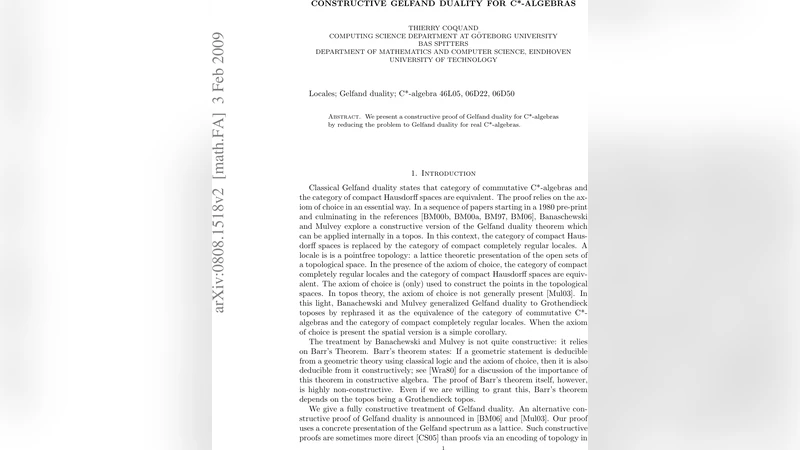
We present a constructive proof of Gelfand duality for C*-algebras by reducing the problem to Gelfand duality for real C*-algebras.
💡 Research Summary
The paper presents a fully constructive proof of the Gelfand duality theorem for C‑algebras, avoiding any reliance on classical principles such as the axiom of choice or the law of excluded middle. The central strategy is to reduce the complex‑valued case to the real‑valued case, for which a constructive version of the duality is already known. The authors begin by recalling the classical proof and identifying the non‑constructive steps (e.g., the use of Zorn’s lemma to obtain maximal ideals, the appeal to the completeness of the real numbers, and the construction of the spectrum as a set of characters). They then replace these steps with point‑free topology: the spectrum of a C‑algebra is defined as a locale, i.e., a complete Heyting algebra of opens, rather than as a set of points.
In the first technical section the authors show that any complex C‑algebra (A) can be expressed as the complexification of a real C‑algebra (A_{\mathbb R}). They prove constructively that the complexification functor preserves the *‑operation, the norm, and completeness, so that (A \cong A_{\mathbb R}\otimes_{\mathbb R}\mathbb C) is a genuine C‑algebra without invoking any choice principles.
The second section revisits the constructive Gelfand duality for real C‑algebras. Here the spectrum of a real C‑algebra (B) is defined as a regular, complete locale (X). The authors develop the necessary locale theory (regularity, completeness, and the notion of a compact‑regular locale) entirely within intuitionistic logic. They then construct an isometric *‑isomorphism (B \simeq C_{\mathbb R}(X)), where (C_{\mathbb R}(X)) denotes the algebra of real‑valued continuous functions on the locale (X). The proof uses only constructive tools: the existence of suprema and infima in the Heyting algebra, and the fact that the norm on (B) can be recovered from the lattice of opens.
The third part lifts the real result to the complex case. By taking the complexification of the locale (X) (which is again a regular, complete locale) the authors obtain a locale (X_{\mathbb C}) such that (C_{\mathbb C}(X_{\mathbb C})) is naturally isomorphic to (C_{\mathbb R}(X)\otimes_{\mathbb R}\mathbb C). They verify constructively that this complex function algebra is a C‑algebra and that the canonical map (A \to C_{\mathbb C}(X_{\mathbb C})) is an isometric *‑homomorphism. The crucial point is that the complexification operation respects the locale structure, so no additional choice is required to pass from real to complex spectra.
Finally, the authors assemble the pieces to obtain the main theorem: for every constructive C‑algebra (A) there exists a regular, complete locale (X) such that (A) is canonically *‑isomorphic to the algebra (C_{\mathbb C}(X)) of complex‑valued continuous functions on (X). This establishes a constructive version of the Gelfand duality, showing that the category of constructive C‑algebras is dually equivalent to the category of regular, complete locales.
The paper concludes with a discussion of implications. Because the proof is fully formalizable in intuitionistic type theory, it can be mechanized in proof assistants such as Coq or Agda, opening the way to computer‑verified quantum mechanics foundations. Moreover, the point‑free approach suggests new ways to model “spaces without points” in physics and computer science, and the authors outline future work on extending the constructive duality to non‑separable algebras, non‑regular locales, and non‑commutative generalisations.
Comments & Academic Discussion
Loading comments...
Leave a Comment