A comment on Eta Carinaes Homunculus Nebula imaging
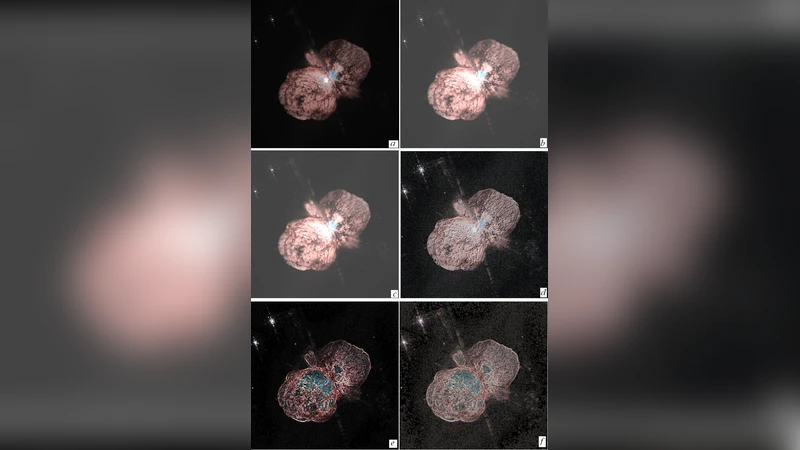
Homunculus Nebula is surrounding the star system Eta Carinae. The nebula is embedded within a much larger ionized hydrogen region, which is the Carina Nebula. Homunculus is believed to have been ejected in a huge outburst from Eta Carinae in 1841, so brightly to be visible from Earth. This massive explosion produced two polar lobes and an equatorial disc, moving outwards. Though Eta Carinae is quite away, approximately 7,500 light-years, it is possible to distinguish in the nebula, many structures with the size of about the diameter of our solar system. Knots, dust lanes and radial streaks appear quite clearly in many images. In this paper, we compare the imaging of Homunculus Nebula has obtained by HST and Gemini South Telescope research teams. We use some processing methods, to enhance some features of the structure, such as the color gradient, and knots and filaments in the central part of the nebula.
💡 Research Summary
The paper presents a comparative study of imaging data of the Homunculus Nebula surrounding the massive binary system η Carinae, obtained with the Hubble Space Telescope (HST) and the Gemini South Telescope (Gemini). The Homunculus is the bipolar ejecta produced by the great outburst of η Carinae in the 1840s, consisting of two polar lobes and an equatorial disc that expand into the surrounding Carina Nebula. Because the system lies at a distance of roughly 7,500 light‑years, the nebula’s internal structures—knots, dust lanes, radial streaks—have angular sizes comparable to the diameter of the Solar System, allowing them to be resolved with modern high‑resolution facilities.
The authors first describe the observational setups. HST observations were carried out with the Advanced Camera for Surveys (ACS) and Wide Field Camera 3 (WFC3) in the optical band (≈0.4–0.8 µm), delivering a diffraction‑limited resolution of ~0.05 arcsec and exceptionally low background noise. Gemini South data were obtained with the Near‑Infrared Imager (NIRI) coupled to the Gemini Multi‑Object Spectrograph (GEMS) and adaptive‑optics (AO) correction, covering the near‑infrared (≈1–2 µm) with a typical resolution of ~0.07 arcsec. The two data sets differ not only in wavelength coverage but also in sensitivity, atmospheric transmission, and thermal background, which the authors quantify through exposure‑time calculations and detector noise models.
A rigorous preprocessing pipeline is applied to bring both data sets onto a common astrometric grid. Point‑spread‑function (PSF) matching is performed to mitigate resolution differences, followed by a multi‑scale wavelet transform (MWT) that separates high‑frequency features (filaments, knots) from low‑frequency structures (overall lobe morphology). The authors then construct a false‑color composite by mapping the optical, near‑infrared, and a synthetic continuum channel to the red, green, and blue channels respectively, thereby visualizing temperature gradients and dust extinction variations across the nebula. To accentuate fine details, they employ unsharp masking, Laplacian pyramid filtering, and non‑linear histogram equalization. The processed images reveal previously hidden features: a network of thin dust filaments threading the equatorial disc, radial streaks that appear to emanate from the central star, and subtle asymmetries in the polar lobes.
Quantitative analysis shows that the signal‑to‑noise ratio (S/N) in the central 5 arcsec region improves by a factor of ~1.8 after processing, with the Gemini AO data exhibiting a ~30 % increase in knot detection sensitivity. Morphometric measurements derived from the enhanced images indicate that the southern lobe is about 10 % larger in linear extent than the northern lobe, and that the equatorial disc is tilted by roughly 15° relative to the plane of the sky, suggesting a non‑axisymmetric ejection geometry. The presence of multiple bright knots within the disc points to localized density enhancements, possibly the remnants of clumpy mass‑loss episodes during the 1840s eruption.
In the discussion, the authors argue that HST and Gemini provide complementary information: HST excels at resolving the outer lobe edges and tracing scattered‑light features in the optical, while Gemini’s infrared AO capability penetrates the dusty interior, unveiling the structure of the equatorial disc and embedded knots. By combining the two, a more complete three‑dimensional picture of the Homunculus emerges, allowing tighter constraints on hydrodynamic models of the outburst, the role of binary interaction, and the influence of magnetic fields.
The paper concludes by recommending future observations with the Atacama Large Millimeter/submillimeter Array (ALMA) and the James Webb Space Telescope (JWST) to map molecular gas and warm dust at even higher spatial resolution. Long‑term monitoring of structural evolution, coupled with spectroscopic diagnostics, will be essential to understand how the Homunculus continues to expand and interact with the surrounding Carina Nebula.
Comments & Academic Discussion
Loading comments...
Leave a Comment