Orientable homotopy modules
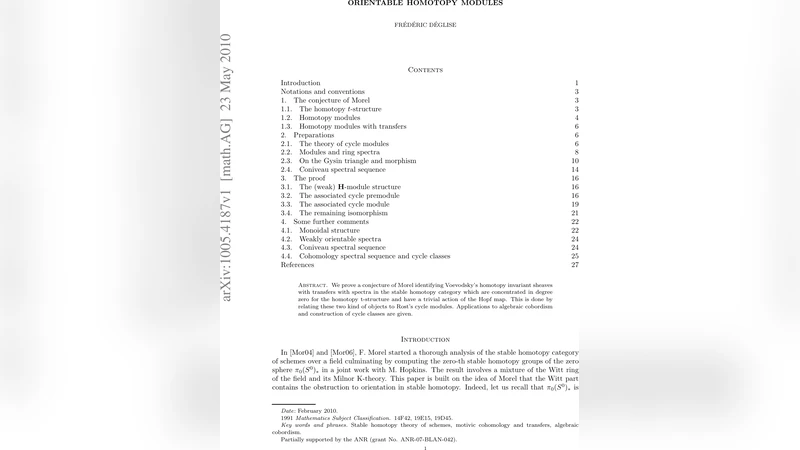
We prove a conjecture of Morel identifying Voevodsky’s homotopy invariant sheaves with transfers with spectra in the stable homotopy category which are concentrated in degree zero for the homotopy t-structure and have a trivial action of the Hopf map. This is done by relating these two kind of objects to Rost’s cycle modules. Applications to algebraic cobordism and construction of cycle classes are given.
💡 Research Summary
The paper resolves a conjecture of Morel concerning the precise relationship between Voevodsky’s homotopy invariant sheaves with transfers (often denoted HI_∗) and certain objects in the stable motivic homotopy category SH. Morel had predicted that the full sub‑category of SH consisting of spectra that are concentrated in degree zero for the homotopy t‑structure and on which the Hopf map η∈π_{−1,−1} acts trivially should be equivalent to the category of homotopy invariant sheaves with transfers. The authors prove this statement by constructing a bridge through Rost’s theory of cycle modules.
The exposition begins with a careful recollection of the necessary background: the homotopy t‑structure on SH, the role of the Hopf map η, and the definition of orientability (η‑triviality). They then review Rost’s cycle modules, emphasizing how these objects encode both transfer structures and the Gersten resolution, making them ideally suited to compare with homotopy invariant sheaves.
The core of the work is the construction of two mutually inverse functors. Starting from a homotopy invariant sheaf F, the authors associate a cycle module C(F) and show that its degree‑zero part reproduces F. Conversely, given a spectrum E in SH that is 0‑truncated (i.e. lies in the heart of the homotopy t‑structure) and satisfies η·E=0, they define a sheaf H⁰(E) by taking the zeroth homotopy sheaf of E. They then prove that the cycle module attached to H⁰(E) coincides with the one obtained directly from E. The proof relies on a series of purity and localization results, as well as a detailed analysis of the Gersten complex for both sides. This establishes a categorical equivalence \
Comments & Academic Discussion
Loading comments...
Leave a Comment