A Structured Framework for Assessing the "Goodness" of Agile Methods
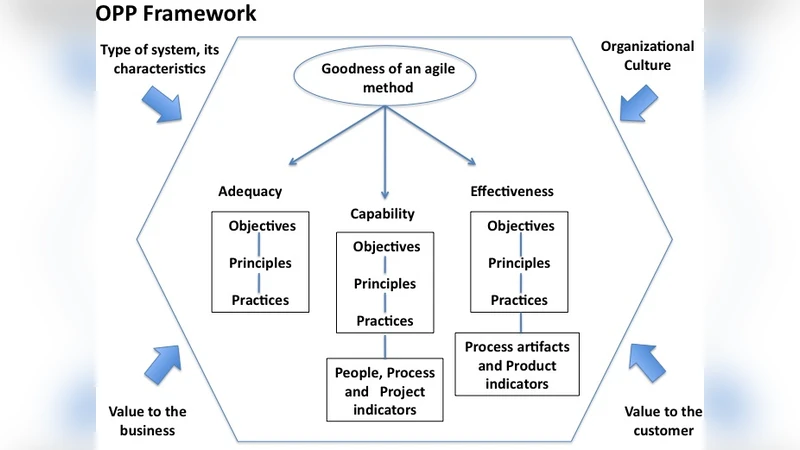
Agile Methods are designed for customization; they offer an organization or a team the flexibility to adopt a set of principles and practices based on their culture and values. While that flexibility is consistent with the agile philosophy, it can lead to the adoption of principles and practices that can be sub-optimal relative to the desired objectives. We question then, how can one determine if adopted practices are “in sync” with the identified principles, and to what extent those principles support organizational objectives? In this research, we focus on assessing the “goodness” of an agile method adopted by an organization based on (1) its adequacy, (2) the capability of the organization to provide the supporting environment to competently implement the method, and (3) its effectiveness. To guide our assessment, we propose the Objectives, Principles and Practices (OPP) framework. The design of the OPP framework revolves around the identification of the agile objectives, principles that support the achievement of those objectives, and practices that reflect the “spirit” of those principles. Well-defined linkages between the objectives and principles, and between the principles and practices are also established to support the assessment process. We traverse these linkages in a top-down fashion to assess adequacy and a bottom-up fashion to assess capability and effectiveness. This is a work-in-progress paper, outlining our proposed research, preliminary results and future directions.
💡 Research Summary
The paper addresses a fundamental tension in agile adoption: while agile methods are intentionally flexible, this very flexibility can lead organizations to select principles and practices that are misaligned with their strategic objectives. The authors therefore ask three core questions: (1) Are the practices adopted by an organization “in sync” with the identified agile objectives? (2) Does the organization possess the necessary environment—people, processes, tools, and culture—to implement those practices competently? (3) Do the practices actually deliver the intended outcomes? To answer these questions, the authors propose the Objectives‑Principles‑Practices (OPP) framework, a structured, three‑layer model that explicitly links high‑level objectives to supporting principles and, in turn, to concrete practices.
The top layer, Objectives, captures both canonical agile goals (customer satisfaction, rapid feedback, continuous improvement) and organization‑specific strategic aims (time‑to‑market, quality, cost reduction). The middle layer, Principles, enumerates abstract guidelines that enable the objectives, such as “prioritize collaboration,” “embrace change,” and “deliver small increments.” The bottom layer, Practices, lists concrete activities—sprints, daily stand‑ups, backlog grooming, test automation, pair programming, etc. Crucially, the framework defines two sets of linkages: (a) Objective‑to‑Principle connections that map each objective to the principles required for its achievement, and (b) Principle‑to‑Practice connections that identify which practices instantiate each principle.
These linkages support two complementary assessment directions. In a top‑down (goal‑driven) pass, the analyst starts from the organization’s stated objectives and traverses down through the principle and practice layers to evaluate adequacy: does the current practice set adequately support the objectives? In a bottom‑up (capability‑driven) pass, the analyst begins with the organization’s existing environment—its structure, tooling, skill sets, and cultural attributes—and works upward to assess capability (the feasibility of implementing the required practices) and effectiveness (the degree to which implemented practices actually realize the intended objectives).
Methodologically, the authors conducted a literature review of major agile frameworks (Scrum, XP, SAFe) and standards such as ISO/IEC 15504 and CMMI to extract a common set of objectives and principles. They then performed semi‑structured interviews and surveys with five companies of varying size and domain, gathering data on the practices actually in use. Using this data, they constructed an OPP linkage matrix in which each Objective‑Principle and Principle‑Practice pair is assigned a weight reflecting its perceived importance. This matrix enables quantitative scoring of adequacy, capability, and effectiveness.
Preliminary findings reveal that while most organizations share similar high‑level objectives (e.g., customer satisfaction, rapid feedback), there is considerable variance in how principles are operationalized. For instance, the principle “enhance collaboration” may be supported by pair programming in one firm but only by informal code reviews in another, due to differences in tooling or cultural openness to shared ownership. Moreover, the capability assessment highlighted that without a culture of transparency and autonomy, even well‑chosen practices can fail to deliver value, underscoring the interdependence of the three OPP layers.
The authors argue that existing agile maturity models focus primarily on the practice layer, neglecting the explicit alignment between objectives and principles. By incorporating all three layers, the OPP framework offers a more holistic view of “goodness” that can guide organizations in both selecting appropriate practices and shaping the supporting environment. The paper also outlines future work: refining weight assignments through larger empirical studies, developing a software tool that automates OPP‑based assessments, and integrating continuous feedback loops so that the framework evolves with organizational learning.
In summary, this work‑in‑progress introduces a novel, systematic approach to evaluating agile methods. It moves beyond checklist‑style maturity assessments toward a nuanced analysis that considers strategic alignment, organizational capability, and real‑world effectiveness. If validated across broader contexts, the OPP framework could become a practical “agile goodness” toolkit for practitioners seeking evidence‑based guidance on how to tailor agile methods to their unique goals and constraints.
Comments & Academic Discussion
Loading comments...
Leave a Comment