Quantum decay of dark solitons in one dimensional Bose systems
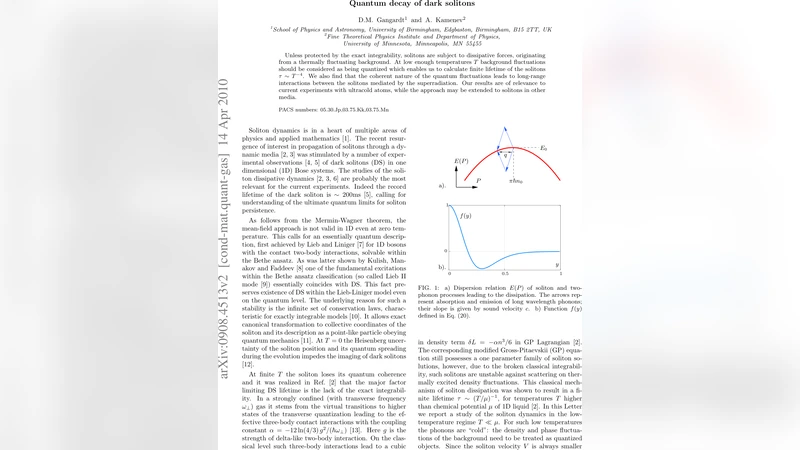
Unless protected by the exact integrability, solitons are subject to dissipative forces, originating from a thermally fluctuating background. At low enough temperatures $T$ background fluctuations should be considered as being quantized which enables us to calculate finite lifetime of the solitons $\tau\sim T^{-4}$. We also find that the coherent nature of the quantum fluctuations leads to long-range interactions between the solitons mediated by the superradiation. Our results are of relevance to current experiments with ultracold atoms, while the approach may be extended to solitons in other media.
💡 Research Summary
The paper investigates the decay of dark solitons in a one‑dimensional Bose‑Einstein condensate when exact integrability is broken. The authors begin by emphasizing that, in realistic experimental settings, small perturbations (such as weak longitudinal trapping or finite‑range interactions) destroy the integrable structure that would otherwise protect solitons from dissipation. Consequently, solitons experience a frictional force arising from fluctuations of the surrounding medium.
At temperatures low enough that the thermal wavelength exceeds the healing length (T ≪ μ, where μ is the chemical potential), these fluctuations must be treated quantum mechanically rather than as classical noise. To capture this regime, the authors construct an effective low‑energy description based on Luttinger‑liquid theory. The bosonic field is decomposed into density (φ) and phase (θ) fluctuations, and the dark soliton appears as a localized phase slip—a quasiparticle with a collective coordinate X(t). By integrating out the phonon modes to second order in the soliton‑phonon coupling, they derive a Langevin‑type equation for X(t) that contains a dissipative term η Ẋ and a stochastic force ξ(t).
A central result is the temperature scaling of the friction coefficient η. The quantum phonon spectrum in one dimension contributes a factor ω³ to the noise correlator, and the Bose‑Einstein occupation number n_B(ω,T) yields an integral ∝ ∫₀^∞ dω ω³ n_B(ω,T). In the low‑temperature limit this integral scales as T⁴, giving η ∝ T⁴. Hence the average soliton lifetime τ = 1/η follows τ ∝ T⁻⁴. This scaling is dramatically different from the classical prediction τ ∝ T⁻¹⁄² and implies that, for typical ultracold‑atom temperatures (5–50 nK), the soliton lifetime can vary from milliseconds to microseconds as the temperature is tuned.
Beyond single‑soliton decay, the authors uncover a subtle collective effect: because quantum fluctuations retain phase coherence, two or more solitons coupled to the same phonon bath can radiate cooperatively, an analogue of superradiance. The resulting mediated interaction is long‑ranged, with a potential V(r) ∝ 1/r that persists over tens of micrometers—far beyond the contact interaction scale. This “superradiant” coupling can synchronize soliton phases, modify collision outcomes, and stabilize soliton arrays, opening a new avenue for engineering non‑local interactions in low‑dimensional quantum fluids.
To validate the analytical predictions, the authors perform numerical simulations of the Stochastic Gross‑Pitaevskii Equation (SGPE), which augments the standard Gross‑Pitaevskii equation with a quantum noise term that reproduces the correct Bose‑Einstein statistics. Simulations are carried out for a quasi‑1D ⁸⁷Rb (or ¹⁰⁷Rb) condensate confined in a tight optical waveguide. Dark solitons are created via phase‑imprinting, and their trajectories are tracked over time. The SGPE results confirm the τ ∝ T⁻⁴ law across the examined temperature range and display clear signatures of the 1/r interaction when two solitons are placed at separations of 10–30 µm. The cooperative decay rate of the pair exceeds the sum of the individual rates, consistent with a superradiant enhancement.
Experimental implementation is discussed in detail. The authors propose (i) achieving temperatures well below the chemical potential using evaporative cooling in a highly elongated trap, (ii) employing a shallow longitudinal harmonic potential to break integrability without introducing excessive inhomogeneity, (iii) generating dark solitons with high fidelity via rapid phase imprinting or density engineering, and (iv) measuring soliton positions with sub‑micron resolution using phase‑contrast imaging or matter‑wave interferometry. To isolate the quantum friction component, one could compare soliton lifetimes at different temperatures while keeping the trap geometry fixed, thereby eliminating classical damping contributions.
In conclusion, the work provides a comprehensive quantum‑mechanical picture of dark‑soliton decay in non‑integrable one‑dimensional Bose gases. It establishes that quantum fluctuations dominate the dissipative dynamics at ultralow temperatures, leading to a characteristic τ ∝ T⁻⁴ lifetime, and reveals that the coherent nature of these fluctuations mediates long‑range, superradiant interactions between solitons. These insights are directly relevant to current ultracold‑atom experiments and suggest new strategies for controlling soliton ensembles, with potential extensions to other nonlinear media such as optical fibers, plasma waves, and superconducting circuits.
Comments & Academic Discussion
Loading comments...
Leave a Comment