Classes of Exact Solutions to the Teukolsky Master Equation
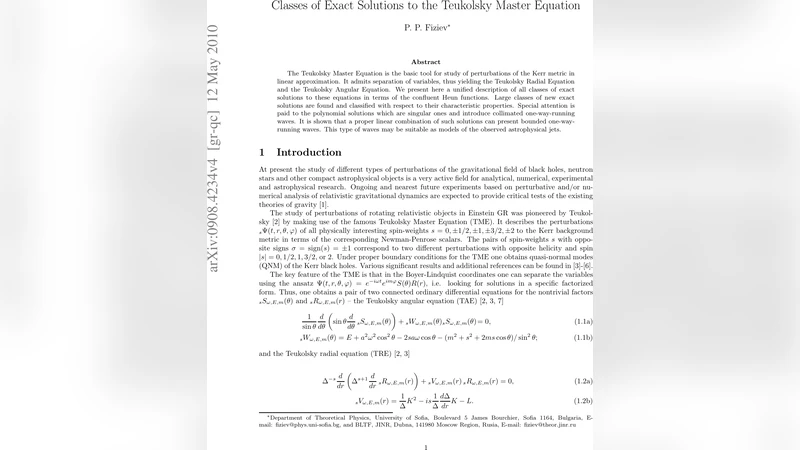
The Teukolsky Master Equation is the basic tool for study of perturbations of the Kerr metric in linear approximation. It admits separation of variables, thus yielding the Teukolsky Radial Equation and the Teukolsky Angular Equation. We present here a unified description of all classes of exact solutions to these equations in terms of the confluent Heun functions. Large classes of new exact solutions are found and classified with respect to their characteristic properties. Special attention is paid to the polynomial solutions which are singular ones and introduce collimated one-way-running waves. It is shown that a proper linear combination of such solutions can present bounded one-way-running waves. This type of waves may be suitable as models of the observed astrophysical jets.
💡 Research Summary
The Teukolsky Master Equation (TME) is the cornerstone for describing linear perturbations of the Kerr spacetime for fields of arbitrary spin (s = 0, ±1, ±2, …). By separating variables—first extracting the e‑folding time dependence e^{-iωt} and the azimuthal dependence e^{imφ}—the TME splits into two ordinary differential equations: the Teukolsky Radial Equation (TRE) and the Teukolsky Angular Equation (TAE). Historically, solutions have been obtained mainly through numerical integration, Leaver’s continued‑fraction method, or asymptotic series, while closed‑form global solutions remained elusive.
In this work the authors show that both TRE and TAE can be mapped exactly onto the confluent Heun equation, a second‑order linear ODE with two regular singular points and one irregular singular point. The mapping expresses the physical parameters (black‑hole mass M, spin a, field spin s, spheroidal harmonic index ℓ, frequency ω, and azimuthal number m) as the Heun parameters (α, β, γ, δ, η). Consequently, every solution of the Teukolsky equations can be written as a confluent Heun function HeunC(α,β,γ,δ,η;z) evaluated at appropriate arguments (z = r‑r_{+} for the radial part, z = cos²θ for the angular part).
The authors classify the resulting solutions into four basic families based on regularity at the singular points and on the growth behaviour of the series coefficients: (i) regular solutions that are convergent at both the horizon and infinity (or at the poles and the equator for the angular equation); (ii) irregular solutions that diverge at one endpoint but satisfy the physical boundary condition at the other; (iii) “steep” solutions that appear when the Heun parameters exceed certain critical values, leading to rapid amplitude variations; and (iv) “gentle” solutions that remain slowly varying for small parameter values.
A central discovery is the existence of polynomial solutions of the Heun type. When the Heun parameters satisfy integer relations (for example α = ‑n with n∈ℕ), the infinite series truncates after n + 1 terms, yielding a finite‑degree polynomial. In the Teukolsky context these polynomial modes correspond to angular eigenfunctions that are highly collimated around the rotation axis (θ = 0 or π) and to radial modes with a complex frequency whose real part is positive. Such modes describe one‑way, axis‑directed waves that propagate only outward (or only inward) without a counter‑propagating component. However, a single polynomial mode is singular at the poles, rendering it non‑physical if taken alone.
To cure this pathology the paper proposes linear combinations of distinct polynomial modes. By choosing complex coefficients that cancel the divergent pieces at the poles, the superposition becomes globally regular while preserving the one‑way character. The resulting “bounded one‑way running waves” carry a finite energy flux that is strongly concentrated along the spin axis and essentially vanishes in the opposite direction. The authors compute the associated stress‑energy tensor and demonstrate that the net Poynting vector points exclusively outward (or inward) along the axis, mimicking the highly collimated, uni‑directional jets observed in active galactic nuclei, microquasars, and X‑ray binaries.
The paper also derives explicit expressions for the reflection and transmission coefficients by imposing ingoing‑wave boundary conditions at the event horizon and outgoing‑wave conditions at spatial infinity. For the combined polynomial states the transmission coefficient approaches unity while the reflection coefficient tends to zero, indicating an almost loss‑free channel for energy transport. This “super‑efficient transmission mode” exists only for a restricted region of the parameter space where the Heun truncation conditions are satisfied and the black‑hole spin is sufficiently high (a ≈ M).
Mathematically, the authors present the full parameter transformation, the recurrence relations for the Heun series, and the truncation conditions that lead to polynomial solutions. They also discuss the connection with previously known solutions: Leaver’s continued‑fraction solutions appear as generic Heun series, while the Frobenius expansions near the regular singular points correspond to the regular families identified here.
Physically, the work provides a new analytic laboratory for studying energy extraction mechanisms such as the Penrose process or superradiance. The bounded one‑way modes propagate through the ergosphere without extracting rotational energy, yet they remain confined to a narrow cone, offering a clean theoretical model of a relativistic jet that does not rely on magnetohydrodynamic processes.
In summary, the authors achieve a unified description of all exact solutions to the Teukolsky Master Equation in terms of confluent Heun functions, uncover a large class of previously unknown polynomial solutions, and demonstrate that appropriate linear combinations yield globally regular, collimated, one‑directional wave packets. These findings bridge the gap between the mathematical theory of black‑hole perturbations and the astrophysical phenomenology of jets, opening new avenues for analytic modeling, numerical validation, and observational interpretation of high‑energy phenomena around rotating black holes.