The Mukai pairing, I: a categorical approach
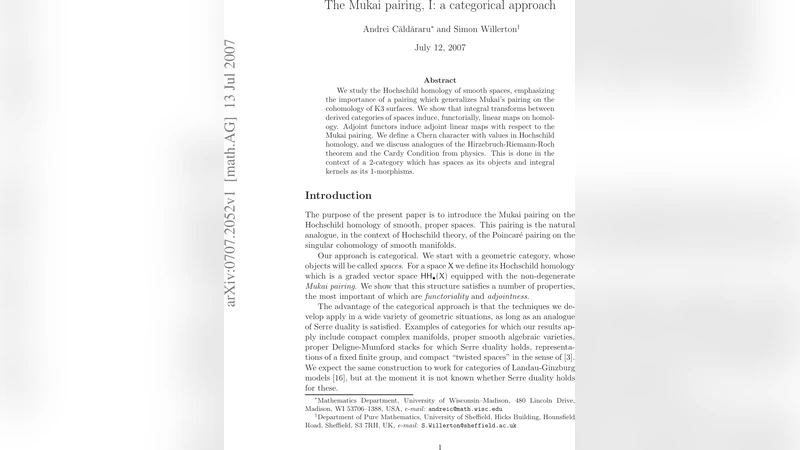
We study the Hochschild homology of smooth spaces, emphasizing the importance of a pairing which generalizes Mukai’s pairing on the cohomology of K3 surfaces. We show that integral transforms between derived categories of spaces induce, functorially, linear maps on homology. Adjoint functors induce adjoint linear maps with respect to the Mukai pairing. We define a Chern character with values in Hochschild homology, and we discuss analogues of the Hirzebruch-Riemann-Roch theorem and the Cardy Condition from physics. This is done in the context of a 2-category which has spaces as its objects and integral kernels as its 1-morphisms.
💡 Research Summary
The paper develops a categorical framework for studying Hochschild homology of smooth algebraic spaces, centering on a bilinear pairing that extends Mukai’s pairing from the cohomology of K3 surfaces to a far more general setting. The authors begin by constructing a 2‑category 𝔖 whose objects are smooth spaces, whose 1‑morphisms are integral kernels (objects of the bounded derived category of the product of two spaces), and whose 2‑morphisms are morphisms between kernels satisfying the usual compatibility conditions. Within this 2‑category they identify, for each space X, the Hochschild homology HH₍*₎(X) with Ext⁎_{X×X}(𝒪_Δ,𝒪_Δ), where Δ is the diagonal. This identification allows them to define a symmetric, non‑degenerate pairing
⟨α,β⟩X = Tr{X×X}(α∘β)
which they call the Mukai pairing on HH₍*₎(X). When X is a K3 surface this recovers the classical Mukai pairing on cohomology, but the definition works for any smooth proper space.
A central result is that any integral transform Φ_𝒦 : D⁽ᵇ⁾(X) → D⁽ᵇ⁾(Y) (given by a kernel 𝒦 ∈ D⁽ᵇ⁾(X×Y)) induces a linear map
Φ_* : HH₍₎(X) → HH₍₎(Y)
functorially. The construction of Φ_* uses the kernel to transport Ext‑classes along the diagonal, and it respects composition: (Ψ∘Φ)* = Ψ∘Φ_. Moreover, if Φ has a right (or left) adjoint Ψ in the derived category, then the induced maps are adjoint with respect to the Mukai pairing:
⟨Φ_(α),β⟩Y = ⟨α,Ψ(β)⟩_X.
Thus the familiar push‑forward/pull‑back adjunction on cohomology lifts to Hochschild homology.
The authors introduce a Chern character
ch : K₀(D⁽ᵇ⁾(X)) → HH₍*₎(X)
defined by sending a perfect complex E to the trace class of the diagonal embedding of E⊗E^∨. This Chern character is compatible with integral transforms: ch(Φ(E)) = Φ_*(ch(E)). Using this, they prove a Hochschild‑level Hirzebruch–Riemann–Roch formula: for any two objects E,F in D⁽ᵇ⁾(X),
χ(E,F) = Σ_i (−1)^i dim Ext^i(E,F) = ⟨ch(E), ch(F)⟩_X.
Thus the Euler pairing on the K‑theory of X is realized as the Mukai pairing on Hochschild homology.
In the physics‑motivated part of the paper, the Cardy condition from two‑dimensional topological quantum field theory is reformulated. Boundary conditions correspond to objects A,B in the derived category, and the closed‑string channel amplitude between them is the trace of the identity on Hom(A,B). The authors show that this amplitude equals the Mukai pairing ⟨ch(A), ch(B)⟩_X, thereby providing a mathematically precise version of the Cardy condition in terms of Hochschild homology.
The final sections discuss broader implications. Because the Mukai pairing is preserved by derived equivalences, the framework naturally accommodates mirror symmetry: a mirror pair of Calabi‑Yau manifolds have equivalent derived categories, and the induced Hochschild isomorphisms respect the Mukai pairing, matching the expected physical duality of closed‑string states. The authors also hint at extensions to non‑commutative geometry, deformation quantization, and higher‑categorical structures, suggesting that the categorical approach to the Mukai pairing could become a unifying language across algebraic geometry, homological algebra, and quantum field theory.
Overall, the paper provides a rigorous, functorial, and physically motivated extension of Mukai’s original construction, showing that Hochschild homology equipped with the Mukai pairing serves as a natural receptacle for Chern characters, Riemann–Roch formulas, and topological field‑theoretic consistency conditions.
Comments & Academic Discussion
Loading comments...
Leave a Comment