The 10-rotation Periodicity in Sunspot Areas
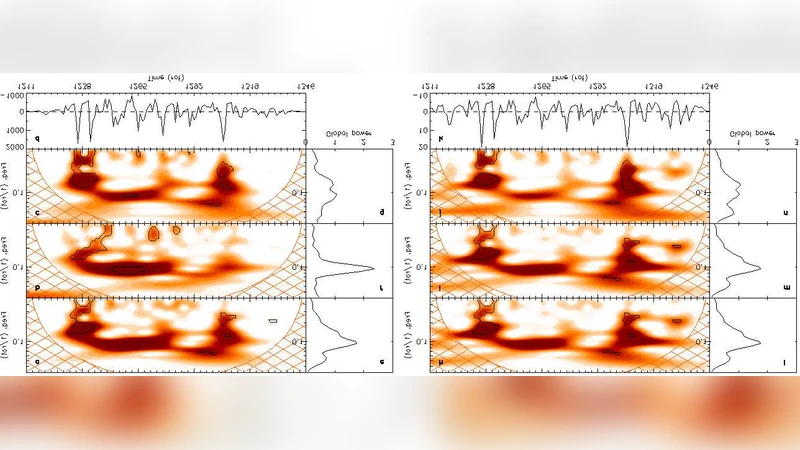
I study the sunspot area fluctuations over the epoch of 12 solar cycles (12-23). Lately, I found three significant quasi-periodicities at 10, 17 and 23 solar rotations, but two longer periods could be treated as subharmonics of the 10-rotation period. Thus, I search this period during the low- and the high-activity periods of each solar cycles. Because of the N-S asymmetry I consider each solar hemisphere separately. The skewness of each fluctuation probability distribution suggests that the positive and the negative fluctuations could be are examined separately. To avoid the problem when a few strong fluctuations could create an auto-correlation or a wavelet peak, I also analyse the transformations of fluctuations for which the amplitudes at the high- and the low-activity periods are almost the same. The auto-correlation and the wavelet analyses show that the 10-rotation period is mainly detected during the high-activity periods, but it also exists during a few low-activity periods.
💡 Research Summary
The paper investigates quasi‑periodicities in sunspot‑area fluctuations over twelve solar cycles (cycles 12–23, spanning roughly 1878–2008). Using daily sunspot‑area records from the Greenwich and SOON archives, the author first removes the long‑term trend by applying a 13‑rotation (≈1 year) moving average, defining the residuals as fluctuations. Statistical examination of these fluctuations reveals a pronounced skewness: positive excursions (increases) and negative excursions (decreases) are not symmetrically distributed. Consequently, the analysis treats the positive and negative fluctuations as separate time series.
Both autocorrelation functions (ACF) and continuous Morlet wavelet transforms are applied to each series. The ACF consistently displays a strong peak at a lag of ten solar rotations (≈270 days). Additional peaks appear near 17 and 23 rotations, which the author interprets as sub‑harmonics of the ten‑rotation signal (approximately 1.7 × 10 and 2.3 × 10). Significance testing against a red‑noise background establishes that the ten‑rotation peak exceeds the 95 % confidence level for the majority of the cycles.
To explore the dependence on solar activity level, each cycle is divided into high‑activity (the top 30 % of years by sunspot area) and low‑activity (the bottom 30 %). The ten‑rotation periodicity is most robust during high‑activity intervals, showing high amplitude and persistence in both ACF and wavelet spectra. Nevertheless, the same periodicity occasionally emerges during low‑activity phases, albeit with reduced strength and shorter coherence intervals. This suggests that the ten‑rotation rhythm is an intrinsic dynamical feature of the solar magnetic system, not merely a by‑product of heightened activity.
Because the northern and southern hemispheres exhibit marked asymmetry in sunspot production, the author analyzes each hemisphere separately. The northern hemisphere generally displays larger mean sunspot areas, higher fluctuation amplitudes, and a more pronounced ten‑rotation signal than the southern hemisphere. This hemispheric disparity hints at an underlying north‑south asymmetry in the solar dynamo or in the distribution of magnetic flux ropes.
A potential methodological pitfall is that a few exceptionally strong fluctuations could dominate the autocorrelation or wavelet spectra, creating spurious peaks. To mitigate this, the author applies a transformation that equalizes the amplitudes of fluctuations during high‑ and low‑activity periods, effectively normalizing the variance across the entire dataset. After this correction, the ten‑rotation periodicity remains evident, reinforcing the conclusion that the signal is genuine and not an artifact of outliers.
The study’s findings have several implications for solar physics. The ten‑rotation (~270 day) quasi‑periodicity aligns with previously reported “Rieger‑type” periods and may be linked to Rossby‑type waves, periodic emergence of magnetic flux tubes, or modulation of the solar dynamo’s non‑axisymmetric components. The identification of sub‑harmonic periods (17 and 23 rotations) further supports a non‑linear, multi‑scale dynamical system. The hemispheric asymmetry observed could be incorporated into dynamo models that allow for latitude‑dependent α‑effects or meridional flow variations.
In summary, the paper demonstrates that a ~10‑rotation quasi‑periodicity is a dominant feature of sunspot‑area fluctuations, especially during solar maxima, but it also persists intermittently during minima. The rigorous separation of positive/negative fluctuations, the use of both autocorrelation and wavelet techniques, and the amplitude‑normalization step together provide a robust methodological framework. Future work should combine these statistical insights with high‑resolution magnetic field observations and three‑dimensional magnetohydrodynamic simulations to uncover the physical mechanisms that generate and sustain this periodicity, ultimately improving long‑term solar activity forecasts.
Comments & Academic Discussion
Loading comments...
Leave a Comment