A note on critical points of integrals of soliton equations
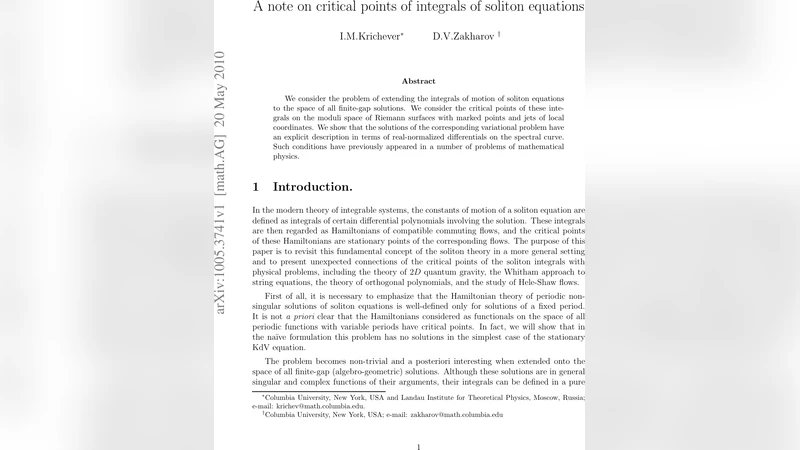
We consider the problem of extending the integrals of motion of soliton equations to the space of all finite-gap solutions. We consider the critical points of these integrals on the moduli space of Riemann surfaces with marked points and jets of local coordinates. We show that the solutions of the corresponding variational problem have an explicit description in terms of real-normalized differentials on the spectral curve. Such conditions have previously appeared in a number of problems of mathematical physics.
💡 Research Summary
The paper addresses the longstanding problem of extending the infinite hierarchy of conserved quantities associated with integrable soliton equations—such as the Korteweg‑de Vries (KdV) and Kadomtsev‑Petviashvili (KP) hierarchies—to the full class of finite‑gap (algebraic‑geometric) solutions. While the conserved integrals are traditionally defined for rapidly decaying fields on the line, their meaning becomes ambiguous when the solution is expressed through Baker‑Akhiezer functions on a compact Riemann surface (the spectral curve). To overcome this, the author introduces a geometric framework: a compact Riemann surface (\Gamma) of genus (g) equipped with a finite set of marked points ({P_i}{i=1}^N) and, at each marked point, a jet of local coordinates ({z_i^{(k)}}{k=1}^{m_i}). The collection ((\Gamma, {P_i}, {z_i^{(k)}})) lives in the moduli space (\mathcal{M}_{g,N}) and encodes the spectral data of a finite‑gap solution.
The next step is to reinterpret each conserved integral (I_n) as a period of a suitably normalized meromorphic differential (\omega_n) on (\Gamma). The crucial observation is that the differentials must be real‑normalized: all (a)-periods are real (often taken to be zero) while the (b)-periods may be complex. This choice eliminates the ambiguity inherent in the usual complex normalization and aligns the variational problem with physically meaningful real quantities.
The author then formulates a variational principle for a linear combination of the integrals, \
Comments & Academic Discussion
Loading comments...
Leave a Comment