Compressive Sensing over the Grassmann Manifold: a Unified Geometric Framework
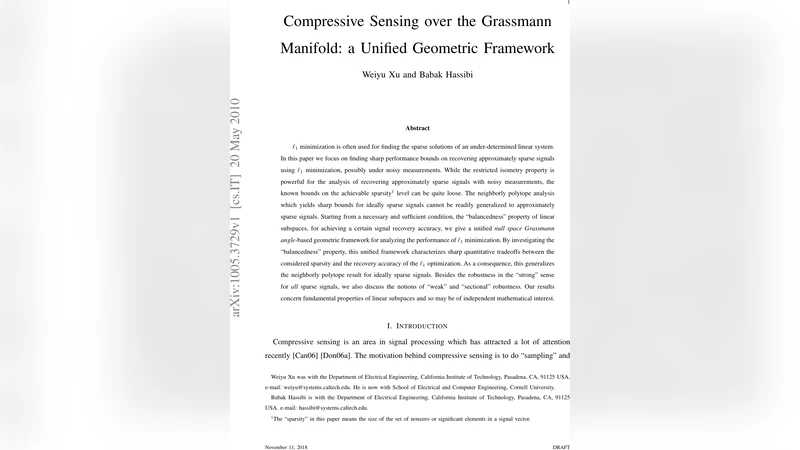
$\ell_1$ minimization is often used for finding the sparse solutions of an under-determined linear system. In this paper we focus on finding sharp performance bounds on recovering approximately sparse signals using $\ell_1$ minimization, possibly under noisy measurements. While the restricted isometry property is powerful for the analysis of recovering approximately sparse signals with noisy measurements, the known bounds on the achievable sparsity (The “sparsity” in this paper means the size of the set of nonzero or significant elements in a signal vector.) level can be quite loose. The neighborly polytope analysis which yields sharp bounds for ideally sparse signals cannot be readily generalized to approximately sparse signals. Starting from a necessary and sufficient condition, the “balancedness” property of linear subspaces, for achieving a certain signal recovery accuracy, we give a unified \emph{null space Grassmann angle}-based geometric framework for analyzing the performance of $\ell_1$ minimization. By investigating the “balancedness” property, this unified framework characterizes sharp quantitative tradeoffs between the considered sparsity and the recovery accuracy of the $\ell_{1}$ optimization. As a consequence, this generalizes the neighborly polytope result for ideally sparse signals. Besides the robustness in the “strong” sense for \emph{all} sparse signals, we also discuss the notions of “weak” and “sectional” robustness. Our results concern fundamental properties of linear subspaces and so may be of independent mathematical interest.
💡 Research Summary
The paper presents a unified geometric framework for analyzing the performance of ℓ₁‑minimization in compressed sensing, especially when the target signals are only approximately sparse and the measurements are contaminated by noise. Traditional analyses rely on the Restricted Isometry Property (RIP) or on neighborly polytope arguments. While RIP yields sufficient conditions, its quantitative bounds on the allowable sparsity level are often far from optimal. Neighborly polytope results, on the other hand, give sharp thresholds but only for perfectly sparse signals and do not extend naturally to the noisy, approximately sparse regime.
To bridge this gap, the authors introduce a new necessary and sufficient condition called “balancedness” of a linear subspace. For a measurement matrix A with null space N(A), balancedness requires that for every non‑zero vector v∈N(A) the inequality ‖v_S‖₁ ≤ θ‖v_{S^c}‖₁ holds, where S denotes the support of the significant entries of the original signal and 0<θ<1 is a parameter. This condition is shown to be equivalent to the guarantee that the solution (\hat{x}) of the ℓ₁ program satisfies (| \hat{x} - x |_2 \le C\varepsilon) for a noise level ε, thereby directly linking geometric properties of the null space to recovery accuracy.
The central technical tool for quantifying balancedness is the “null‑space Grassmann angle.” The Grassmann manifold (\mathcal{G}(n,m)) consists of all m‑dimensional subspaces of ℝⁿ; each subspace can be associated with an angular measure that reflects how it is positioned relative to a fixed cone defined by the balancedness inequality. The null‑space Grassmann angle is essentially the probability that a randomly drawn null space (e.g., from a Gaussian measurement matrix) lies outside this cone. By employing high‑dimensional integral geometry and conic intrinsic volumes, the authors derive explicit expressions for the distribution of this angle.
From these expressions they obtain sharp, non‑asymptotic trade‑offs among four key quantities: the ambient dimension n, the number of measurements m, the sparsity level k (size of S), and the balancedness parameter θ. In particular, they show that for a given failure probability δ, the minimal number of measurements required satisfies
\
Comments & Academic Discussion
Loading comments...
Leave a Comment