The role of newly born magnetars in gamma-ray burst X-ray afterglow emission: Energy injection and internal emission
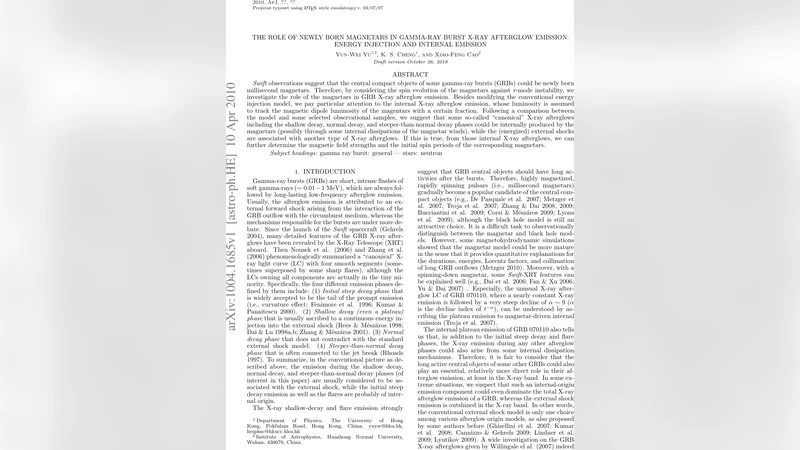
Swift observations suggest that the central compact objects of some gamma-ray bursts (GRBs) could be newly born millisecond magnetars. Therefore, by considering the spin evolution of the magnetars against r-mode instability, we investigate the role of the magnetars in GRB X-ray afterglow emission. Besides modifying the conventional energy injection model, we pay particular attention to the internal X-ray afterglow emission, whose luminosity is assumed to track the magnetic dipole luminosity of the magentars with a certain fraction. Following a comparison between the model and some selected observational samples, we suggest that some so-called “canonical” X-ray afterglows including the shallow decay, normal decay, and steeper-than-normal decay phases could be internally produced by the magnetars (possibly through some internal dissipations of the magnetar winds), while the (energized) external shocks are associated with another type of X-ray afterglows. If this is true, from those internal X-ray afterglows, we can further determine the magnetic field strengths and the initial spin periods of the corresponding magnetars.
💡 Research Summary
The paper addresses the puzzling features of X‑ray afterglows observed by the Swift satellite in a subset of gamma‑ray bursts (GRBs). While the canonical afterglow light curve—characterized by a shallow‑decay phase, a normal‑decay phase, and a steeper‑than‑normal decay—has traditionally been explained solely by external forward‑shock emission, the authors propose that a newly born millisecond magnetar can contribute both external and internal components to the observed X‑ray flux.
First, the authors model the spin evolution of a nascent magnetar taking into account the r‑mode instability, a non‑axisymmetric oscillation mode that efficiently extracts angular momentum and rotational energy from a rapidly rotating neutron star. The r‑mode drives a rapid spin‑down during the first few hundred seconds, while the magnetar continues to lose energy via magnetic dipole radiation. This combined loss determines the time‑dependent dipole luminosity L_dip(t).
Second, they extend the classic energy‑injection scenario for external shocks. In that picture, the dipole luminosity is injected into the blast wave, reheating the shocked external medium and sustaining the afterglow. The efficiency of this injection depends on the magnetar’s surface magnetic field B and its initial spin period P₀.
Third, and most innovatively, the authors introduce an “internal” X‑ray emission component. They assume that a fraction η of the dipole power is dissipated within the magnetar wind itself, through processes such as magnetic reconnection, pair production, or turbulent cascade. This internal dissipation directly produces X‑ray photons, independent of the external shock. The internal luminosity is therefore L_int(t)=η L_dip(t).
To test the model, the authors select a sample of about ten GRBs with well‑sampled X‑ray light curves. By fitting the combined external‑plus‑internal model to the data, they find that:
-
The shallow‑decay phase is best reproduced by the internal component, requiring η≈0.1–0.3. This suggests that a sizable fraction of the magnetar wind energy is converted into X‑rays before reaching the external medium.
-
The normal‑decay phase aligns with the external shock receiving continuous energy injection from the spinning‑down magnetar. The r‑mode‑driven spin‑down maintains a relatively flat injection rate during this interval.
-
The steeper‑than‑normal decay corresponds to the cessation of the r‑mode instability and the rapid decline of dipole power, causing both internal and external contributions to drop sharply.
From the fits, the inferred magnetar parameters cluster around B≈(1–5)×10¹⁴ G and P₀≈1–3 ms, values that are consistent with theoretical expectations for newborn magnetars formed in core‑collapse events. Moreover, the presence of a dominant internal component allows a more precise determination of these parameters than would be possible from external‑shock modeling alone.
The authors conclude that many “canonical” X‑ray afterglows may be internally powered by magnetar wind dissipation, while a separate class of afterglows—those lacking a clear shallow phase—could be dominated by external shock emission alone. This dual‑origin framework not only resolves several longstanding tensions in afterglow modeling (e.g., the prevalence of flat segments and abrupt steepenings) but also provides a novel diagnostic for probing the magnetic field strength and spin of the central engine. Future high‑sensitivity, multi‑wavelength observations will be crucial for disentangling the internal and external contributions and for testing the detailed physics of r‑mode evolution and magnetar wind dissipation.
Comments & Academic Discussion
Loading comments...
Leave a Comment