V1647 Orionis: Reinvigorated Accretion and the Re-Appearance of McNeils Nebula
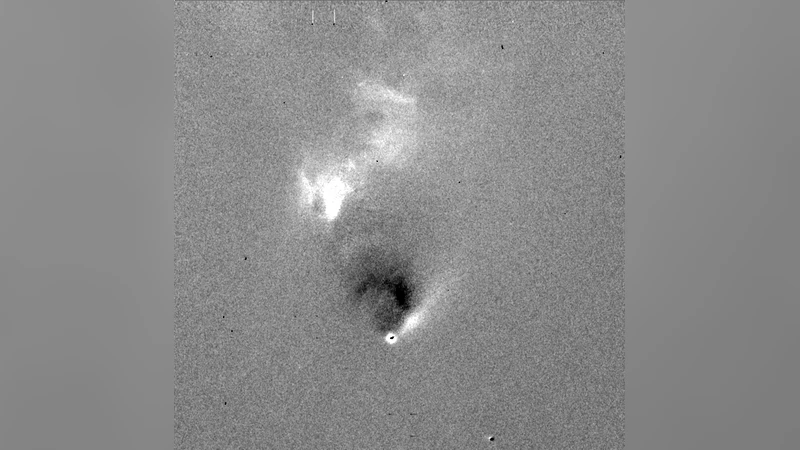
In late 2003, the young eruptive variable star V1647 Orionis optically brightened by over 5 magnitudes, stayed bright for around 26 months, and then decline to its pre-outburst level. In August 2008 the star was reported to have unexpectedly brightened yet again and we herein present the first detailed observations of this new outburst. Photometrically, the star is now as bright as it ever was following the 2003 eruption. Spectroscopically, a pronounced P Cygni profile is again seen in Halpha with an absorption trough extending to -700 km/s. In the near-infrared, the spectrum now possesses very weak CO overtone bandhead absorption in contrast to the strong bandhead emission seen soon after the 2003 event. Water vapor absorption is also much stronger than previously seen. We discuss the current outburst below and relate it to the earlier event.
💡 Research Summary
The paper presents the first detailed observations of the second outburst of the young eruptive star V1647 Orionis, which was first noted in late 2003 when the object brightened by more than five magnitudes in the optical, remained at a high state for roughly 26 months, and then faded back to its pre‑outburst level. In August 2008 the source unexpectedly brightened again, prompting a multi‑wavelength campaign that covered optical photometry, optical spectroscopy, and near‑infrared (NIR) spectroscopy.
Photometrically, the 2008 event has driven the V‑band magnitude to essentially the same peak value reached during the 2003 eruption. The light curve shows a relatively flat plateau lasting more than a year, with only minor fluctuations of order 0.1 mag. This similarity in peak brightness and plateau duration suggests that the same physical mechanism—most plausibly a large‑scale increase in the mass accretion rate from the circum‑stellar disk onto the protostar—is operating in both episodes.
Spectroscopically, the H α line again displays a pronounced P Cygni profile. The absorption component extends to a terminal velocity of about –700 km s⁻¹, slightly higher than the –600 km s⁻¹ measured during the 2003 outburst. The depth and breadth of the absorption imply a mass‑loss rate of order 10⁻⁶ M☉ yr⁻¹, while the emission component, together with the enhanced forbidden lines (
Comments & Academic Discussion
Loading comments...
Leave a Comment