On the relevance of avoided crossings away from quantum critical point to the complexity of quantum adiabatic algorithm
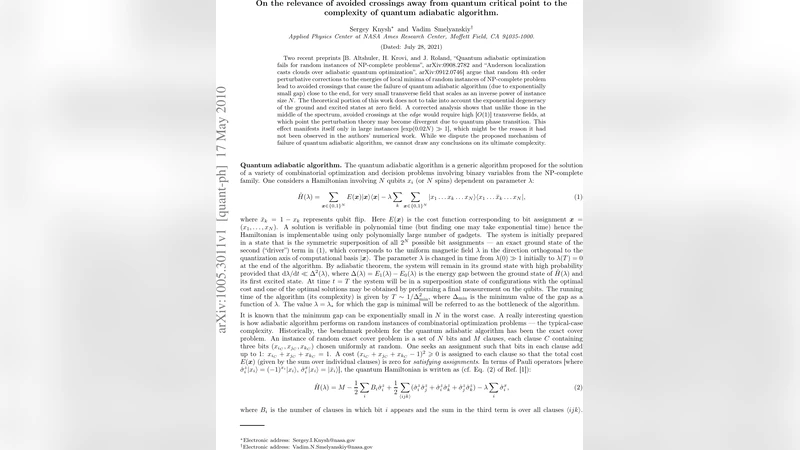
Two recent preprints [B. Altshuler, H. Krovi, and J. Roland, “Quantum adiabatic optimization fails for random instances of NP-complete problems”, arXiv:0908.2782 and “Anderson localization casts clouds over adiabatic quantum optimization”, arXiv:0912.0746] argue that random 4th order perturbative corrections to the energies of local minima of random instances of NP-complete problem lead to avoided crossings that cause the failure of quantum adiabatic algorithm (due to exponentially small gap) close to the end, for very small transverse field that scales as an inverse power of instance size N. The theoretical portion of this work does not to take into account the exponential degeneracy of the ground and excited states at zero field. A corrected analysis shows that unlike those in the middle of the spectrum, avoided crossings at the edge would require high [O(1)] transverse fields, at which point the perturbation theory may become divergent due to quantum phase transition. This effect manifests itself only in large instances [exp(0.02 N) » 1], which might be the reason it had not been observed in the authors’ numerical work. While we dispute the proposed mechanism of failure of quantum adiabatic algorithm, we cannot draw any conclusions on its ultimate complexity.
💡 Research Summary
The paper revisits two recent preprints that claimed quantum adiabatic optimization (QAO) fails on random instances of NP‑complete problems because fourth‑order perturbative corrections generate avoided crossings near the end of the anneal, producing exponentially small gaps at very small transverse fields that scale as an inverse power of the problem size N. The authors point out that those arguments ignore the exponential degeneracy of the ground‑state manifold and the first excited manifold at zero transverse field. By explicitly accounting for this degeneracy, they show that the density of states at the spectral edge is enormously large (∼exp(c N) with c≈0.02 for typical random SAT instances). Consequently, for an avoided crossing to occur between two such highly degenerate subspaces, the transverse field must be of order unity; a field that scales like N^{-α} is far too weak to bring levels from different subspaces into resonance.
When the transverse field is O(1), the perturbative expansion in λ (the transverse field strength) ceases to converge, because the system is driven into a quantum phase‑transition regime where the low‑energy effective Hamiltonian is no longer described by a simple fourth‑order series. In this regime the spectrum reorganizes dramatically, and the simple avoided‑crossing picture of the earlier works breaks down.
The authors also explain why the numerical studies of the earlier papers did not observe the predicted small gaps. Those simulations were limited to modest instance sizes (N≈20–30), for which exp(c N) is only a few, so the exponential degeneracy does not yet dominate the low‑energy sector. In such small systems the level spacing remains much larger than the perturbative shifts, and the avoided crossings that would require O(1) fields simply do not appear. Only for much larger instances—where exp(c N)≫1, i.e., N on the order of several hundred—does the degeneracy become large enough that a constant transverse field could generate avoided crossings, but then the perturbative analysis is invalid.
Thus the paper refutes the specific failure mechanism proposed in the two preprints: the small‑field avoided crossings that supposedly cause an exponential slowdown of QAO are not physically realized once the exponential ground‑state degeneracy is properly included. Instead, any meaningful avoided crossing at the edge of the spectrum would require a transverse field strong enough to push the system into a non‑perturbative regime, where the gap behavior must be analyzed by different methods (e.g., quantum Monte Carlo, renormalization‑group approaches).
While the authors dispute the particular argument that QAO necessarily fails due to fourth‑order perturbative avoided crossings, they stop short of claiming that QAO is efficient for NP‑complete problems. The ultimate computational complexity of the quantum adiabatic algorithm remains an open question; the present work merely clarifies that the previously suggested mechanism does not constitute a general proof of exponential hardness. Future work will need to address the behavior of QAO in the strong‑field, possibly critical, regime and to develop tools capable of handling the huge degeneracies that arise in large random instances.
Comments & Academic Discussion
Loading comments...
Leave a Comment