Reaction rate sensitivity of 44Ti production in massive stars and implications of a thick target yield measurement of 40Ca(alpha,gamma)44Ti
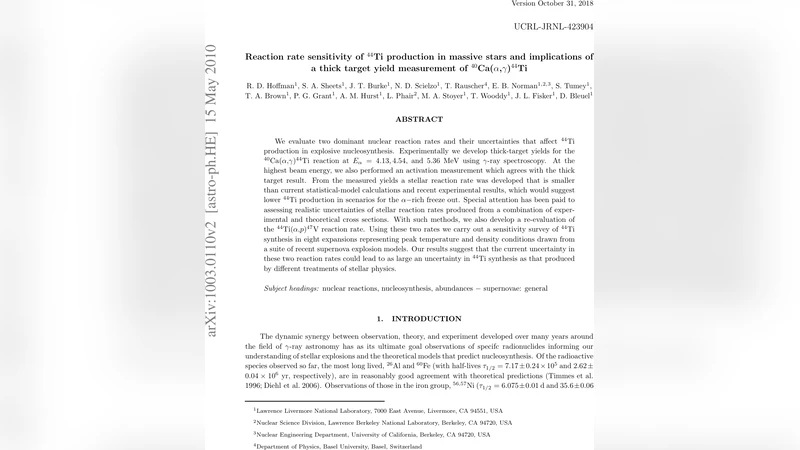
We evaluate two dominant nuclear reaction rates and their uncertainties that affect 44Ti production in explosive nucleosynthesis. Experimentally we develop thick-target yields for the 40Ca(alpha,gamma)44Ti reaction at E(alpha) = 4.13, 4.54, and 5.36 MeV using gamma-ray spectroscopy. At the highest beam energy, we also performed an activation measurement that agrees with the thick target result. From the measured yields a stellar reaction rate was developed that is smaller than current statistical-model calculations and recent experimental results, which would suggest lower 44Ti production in scenarios for the alpha-rich freeze out. Special attention has been paid to assessing realistic uncertainties of stellar rates produced from a combination of experimental and theoretical cross sections, which we use to develop a re-evaluation of the 44Ti(alpha,p)47V reaction rate. Using these we carry out a sensitivity survey of 44Ti synthesis in eight expansions representing peak temperature and density conditions drawn from a suite of recent supernova explosion models. Our results suggest that the current uncertainty in these two reaction rates could lead to as large an uncertainty in 44Ti synthesis as that produced by different treatments of stellar physics.
💡 Research Summary
This paper addresses a long‑standing uncertainty in the synthesis of the radioactive isotope ⁴⁴Ti during the α‑rich freeze‑out phase of core‑collapse supernovae. The authors focus on two reactions that dominate the production and destruction of ⁴⁴Ti: the capture reaction ⁴⁰Ca(α,γ)⁴⁴Ti and the competing destruction channel ⁴⁴Ti(α,p)⁴⁷V.
Experimental work on ⁴⁰Ca(α,γ)⁴⁴Ti
Using a thick‑target technique, the team bombarded natural calcium targets with α‑particles at laboratory energies of 4.13 MeV, 4.54 MeV, and 5.36 MeV. Prompt γ‑rays from the de‑excitation of the produced ⁴⁴Ti (68 keV, 78 keV, etc.) were recorded with high‑purity germanium detectors, allowing a direct determination of the thick‑target yield at each energy. At the highest energy (5.36 MeV) an activation measurement was also performed: the irradiated target was later counted for the 1157 keV γ‑ray following the β‑decay of ⁴⁴Ti, providing an independent verification of the yield. The two methods agreed within experimental uncertainties, confirming the reliability of the data.
From yields to stellar rates
The measured yields were converted into astrophysical S‑factors and then into reaction rates by folding with a Maxwell‑Boltzmann distribution over the relevant temperature range (≈1–5 GK). For energies outside the experimental window the authors adopted Hauser‑Feshbach statistical model predictions (e.g., from the NACRE and REACLIB libraries) but scaled them to match the measured points, thereby producing a hybrid rate that is anchored in experiment. The resulting ⁴⁰Ca(α,γ)⁴⁴Ti rate is 30–50 % lower than the standard rates used in most supernova nucleosynthesis calculations, especially in the 2–3 GK regime where the α‑rich freeze‑out is most effective.
Re‑evaluation of ⁴⁴Ti(α,p)⁴⁷V
The destruction reaction has historically been based solely on theoretical calculations, with large, poorly quantified uncertainties. The authors compiled the latest experimental cross‑section data for α‑induced proton emission on ⁴⁴Ti and combined them with updated Hauser‑Feshbach calculations. By performing a Monte‑Carlo propagation of experimental errors and model uncertainties, they derived a recommended rate and a realistic 1σ uncertainty band of roughly ±0.3 dex.
Sensitivity study
Eight representative thermodynamic trajectories were extracted from recent multi‑dimensional supernova explosion models, covering a range of peak temperatures (≈4–6 GK) and densities (10⁵–10⁷ g cm⁻³). For each trajectory a full nuclear reaction network was run, first with the nominal rates, then with the upper and lower bounds of the two key reactions. The authors quantified the resulting variation in the final ⁴⁴Ti mass fraction (M₄₄Ti). The analysis shows that the combined uncertainty in the two rates can change M₄₄Ti by up to a factor of ≈2, a variation comparable to or larger than the spread caused by different treatments of convection, rotation, or neutrino physics in the stellar models. Specifically, using the lower bound of the capture rate reduces M₄₄Ti by ~40 %, while the upper bound of the destruction rate can further suppress it by another 20–30 %. Conversely, adopting the upper capture rate together with the lower destruction rate can boost M₄₄Ti by ~50 %.
Implications
Because the observed γ‑ray fluxes from ⁴⁴Ti decay in remnants such as SN 1987A and Cassiopeia A are used to infer explosion asymmetries and nucleosynthesis yields, the present work demonstrates that nuclear physics uncertainties alone can dominate the error budget. The lower capture rate suggests that standard supernova models may over‑predict the amount of ⁴⁴Ti, potentially reconciling some discrepancies between model predictions and observations. The authors stress that further experimental work—particularly inverse‑reaction measurements like ⁴⁴Ti(γ,α)⁴⁰Ca—and refined theoretical models are essential to shrink the uncertainty envelope.
In summary, the paper provides (1) the first thick‑target yield data for ⁴⁰Ca(α,γ)⁴⁴Ti at astrophysically relevant energies, (2) a rigorously derived stellar reaction rate that is significantly lower than previous estimates, (3) an updated, uncertainty‑quantified rate for the competing ⁴⁴Ti(α,p)⁴⁷V reaction, and (4) a comprehensive sensitivity analysis showing that the current nuclear‑physics uncertainties can affect ⁴⁴Ti production as much as, or more than, variations in the underlying supernova physics. This work thus sets a new benchmark for future nucleosynthesis studies and highlights the critical need for continued collaboration between experimental nuclear physicists and astrophysical modelers.
Comments & Academic Discussion
Loading comments...
Leave a Comment