OPUCEM: A Library with Error Checking Mechanism for Computing Oblique Parameters
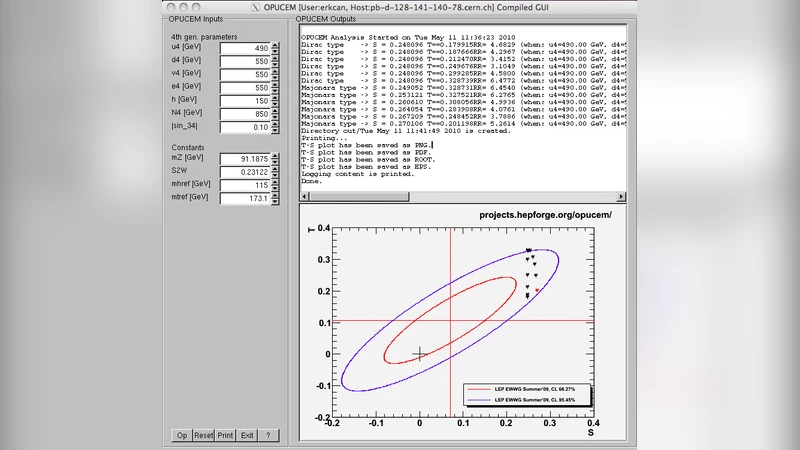
After a brief review of the electroweak radiative corrections to gauge-boson self-energies, otherwise known as the direct and oblique corrections, a tool for calculation of the oblique parameters is presented. This tool, named OPUCEM, brings together formulas from multiple physics models and provides an error-checking machinery to improve reliability of numerical results. It also sets a novel example for an “open-formula” concept, which is an attempt to improve the reliability and reproducibility of computations in scientific publications by encouraging the authors to open-source their numerical calculation programs. Finally, we demonstrate the use of OPUCEM in two detailed case studies related to the fourth Standard Model family. The first is a generic fourth family study to find relations between the parameters compatible with the EW precision data and the second is the particular study of the Flavor Democracy predictions for both Dirac and Majorana-type neutrinos.
💡 Research Summary
The paper introduces OPUCEM, an open‑source library designed to compute the electroweak oblique parameters S, T, and U with built‑in error‑checking. After a concise review of electroweak radiative corrections, the authors distinguish between direct vertex corrections and oblique corrections, the latter being loop‑induced modifications to gauge‑boson self‑energies that preserve gauge invariance. Oblique parameters provide a compact way to compare new‑physics models with precision electroweak data, because they encode the differences in vacuum‑polarisation functions and their derivatives.
OPUCEM’s main contribution is the unification of formulas from a variety of beyond‑Standard‑Model scenarios—fourth‑generation fermions, Dirac and Majorana neutrinos, and models motivated by flavor democracy—into a single, user‑friendly interface. Users supply particle masses, mixing angles, and quantum numbers; the library automatically converts units, applies numerical stabilisation techniques (e.g., fixed‑point scaling, regularisation of near‑singular denominators), and evaluates the corresponding S, T, U values.
A distinctive feature is the integrated error‑checking mechanism. The code validates input ranges, detects unit mismatches, flags potential overflow/underflow, and identifies pathological kinematic configurations. When an issue is found, OPUCEM either issues a clear warning or applies a predefined correction (such as substituting a small regulator value). Each physics module is accompanied by unit tests and regression suites, guaranteeing that updates do not alter previously verified results.
The authors also promote an “open‑formula” philosophy: every analytical expression used in the library is documented alongside its original literature source, and the exact code implementation is released publicly on a version‑controlled repository. This transparency enables other researchers to reproduce the calculations verbatim, thereby strengthening scientific reliability.
Two case studies illustrate the practical utility of OPUCEM. The first explores a generic fourth‑family scenario. By scanning over possible masses of the new quarks and leptons, the library computes the corresponding S and T values and compares them with the latest global electroweak fit (including LEP, SLD, Tevatron, and LHC constraints). The analysis shows that large regions of the naïvely allowed mass space are actually excluded by precision data, narrowing the viable parameter space for a fourth generation.
The second case study investigates predictions from the flavor‑democracy hypothesis for both Dirac and Majorana neutrinos. Flavor democracy posits equal Yukawa couplings for all fermions, leading to specific mass ratios among neutrinos and charged leptons. OPUCEM evaluates how these mass patterns affect the oblique parameters. The results indicate that Dirac‑type democratic neutrinos can be compatible with current electroweak measurements, whereas the Majorana‑type scenario tends to produce an excessively large T parameter unless additional model ingredients (e.g., scalar mixing) are introduced.
In the discussion, the authors outline future extensions: adding support for supersymmetric spectra, vector‑like fermions, and non‑linear Higgs sectors; incorporating automatic differentiation for precise sensitivity analyses; and developing a web‑based front end to make the tool accessible to non‑specialists.
Overall, OPUCEM standardises the computation of electroweak oblique corrections, embeds robust error detection, and embraces open‑source transparency. By demonstrating its application to fourth‑generation and flavor‑democracy models, the paper showcases how the library can provide quantitative guidance for model building and for interpreting precision electroweak data in the search for new physics.
Comments & Academic Discussion
Loading comments...
Leave a Comment