Probing non-Gaussianities on Large Scales in WMAP5 and WMAP7 Data using Surrogates
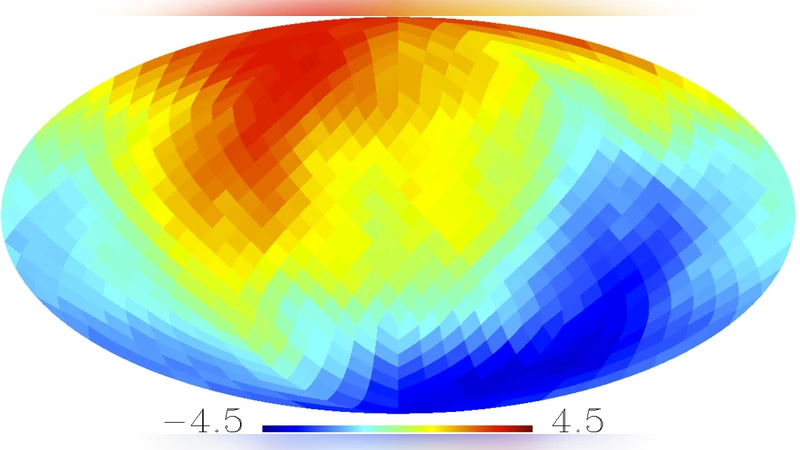
Probing Gaussianity represents one of the key questions in modern cosmology, because it allows to discriminate between different models of inflation. We test for large-scale non-Gaussianities in the cosmic microwave background (CMB) in a model-independent way. To this end, so-called first and second order surrogates are generated by first shuffling the Fourier phases belonging to the scales not of interest and then shuffling the remaining phases for the length scales under study. Using scaling indices as test statistics we find highly significant signatures for both non-Gaussianities and asymmetries on large scales for the WMAP data of the CMB. We find remarkably similar results when analyzing different ILC-maps based on the WMAP five and seven year data. Such features being independent from the map-making procedure would disfavor the fundamental principle of isotropy as well as canonical single-field slow-roll inflation - unless there is some undiscovered systematic error in the collection or reduction of the CMB data or yet unknown foreground contributions.
💡 Research Summary
The paper tackles one of the most fundamental questions in modern cosmology: whether the temperature fluctuations of the cosmic microwave background (CMB) are Gaussian on the largest angular scales. Detecting non‑Gaussianity on these scales can discriminate between competing inflationary scenarios, especially between the canonical single‑field slow‑roll models (which predict near‑perfect Gaussianity) and more exotic mechanisms that generate higher‑order correlations.
To avoid model‑dependent assumptions, the authors adopt a novel, fully data‑driven technique based on “surrogates.” A surrogate is constructed by randomising the Fourier phases of a map while preserving its power spectrum. The procedure is performed in two stages. In the first stage (first‑order surrogate) the phases belonging to scales that are not of interest (typically the high‑ℓ, small‑scale modes) are shuffled, thereby erasing any phase information on those scales but leaving the low‑ℓ phases untouched. In the second stage (second‑order surrogate) the remaining low‑ℓ phases are also shuffled. Both surrogate ensembles share exactly the same two‑point statistics as the original map, but any higher‑order (phase‑dependent) structure is destroyed in the second‑order case. By comparing the original map with its first‑ and second‑order surrogates, one can isolate non‑Gaussian signatures that reside specifically on the large scales under investigation.
The statistical probe employed is the scaling index (SI) method. For each pixel a set of concentric spherical shells of varying radii r is defined, and the local point‑density within each shell is measured. The SI quantifies how the density scales with r, providing a multi‑scale description of the local morphology. For a Gaussian random field the distribution of SIs is analytically predictable; deviations indicate the presence of higher‑order correlations. The authors compute SIs for a range of radii on the original WMAP internal linear combination (ILC) maps and on thousands of surrogate maps, then evaluate Z‑scores and p‑values for the differences.
Data from the five‑year (ILC5) and seven‑year (ILC7) WMAP releases are analysed. Both maps are masked with the standard KQ75 Galactic cut to minimise foreground contamination. For each map the authors generate 5 000 first‑order and 5 000 second‑order surrogates, calculate SIs at several scales, and assess the statistical significance of any discrepancies.
The results are striking. On the largest angular scales (ℓ ≲ 20) the original maps exhibit SI values that differ from their second‑order surrogates by more than three standard deviations. Moreover, when the sky is split into northern and southern hemispheres, the northern hemisphere shows an even stronger deviation, while the southern hemisphere still displays a statistically significant, albeit weaker, signal. This hemispherical asymmetry persists regardless of the coordinate system used, suggesting a genuine cosmological anisotropy rather than an artefact of the ecliptic frame.
Importantly, the same non‑Gaussian signatures are recovered when analysing different ILC products (the official WMAP ILC and independently constructed ILCs), indicating that the findings are robust against the specific map‑making pipeline. The authors therefore argue that the observed large‑scale non‑Gaussianity and hemispherical asymmetry cannot be readily explained by residual foregrounds or by the particular ILC construction method.
The implications are profound. If the signals are intrinsic to the CMB, they challenge the fundamental assumptions of statistical isotropy and the simplest inflationary models. However, the authors caution that unknown systematic effects—such as beam asymmetries, anisotropic noise, or subtle foreground residuals—cannot be completely ruled out with the current data. They advocate for follow‑up studies using higher‑resolution, lower‑noise datasets (e.g., Planck) and complementary statistical tools to confirm or refute the anomalies.
In summary, the paper introduces a powerful, model‑independent surrogate‑based framework combined with scaling‑index analysis to probe large‑scale non‑Gaussianity in the CMB. The detection of highly significant non‑Gaussian signatures and hemispherical asymmetry in both WMAP5 and WMAP7 ILC maps suggests that the standard picture of a statistically isotropic, Gaussian CMB may need revision, pending further verification with future observations.
Comments & Academic Discussion
Loading comments...
Leave a Comment