Equivariant homology for pseudo-differential operators
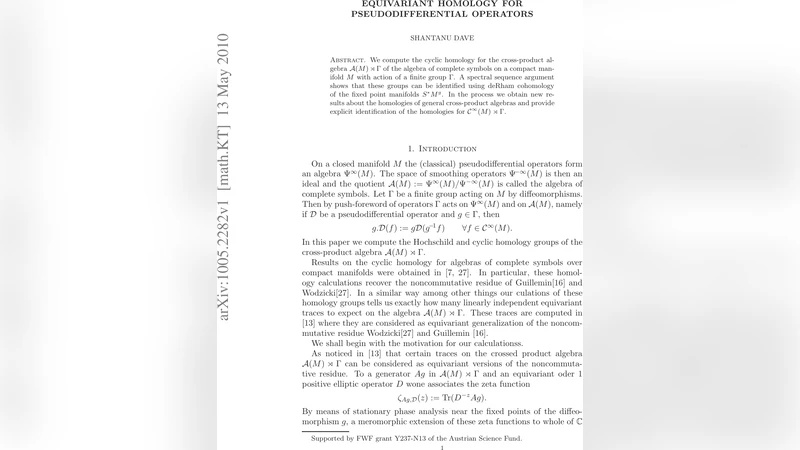
We compute the cyclic homology for the cross-product al- gebra $A(M)\rtimes\Gamma$ of the algebra of complete symbols on a compact man- ifold $M$ with action of a finite group $\Gamma$. A spectral sequence argument shows that these groups can be identified using deRham cohomology of the fixed point manifolds $S ^*M ^g$ . In the process we obtain new re- sults about the homologies of general cross-product algebras and provide explicit identification of the homologies for $C^{\infty}(M)\rtimes \Gamma$.
💡 Research Summary
The paper investigates the Hochschild and cyclic homology of the crossed‑product algebra obtained by letting a finite group Γ act on the algebra of complete symbols of pseudodifferential operators on a compact manifold M. The algebra of complete symbols, denoted A(M), is the completion of the classical symbol algebra with respect to the order filtration; its associated graded algebra is canonically isomorphic to C∞(S* M), the smooth functions on the cosphere bundle of M. Because the Γ‑action preserves the order of symbols, the filtration extends to the crossed product A(M)⋊Γ, and the associated graded of the crossed product is C∞(S* M)⋊Γ.
The authors apply a spectral sequence arising from this filtration to compute the homology groups. The E¹‑term of the spectral sequence is the Hochschild homology of the graded algebra, which splits into a sum over conjugacy classes
Comments & Academic Discussion
Loading comments...
Leave a Comment